[BBC] Wuhan: City of silence...Melbourne foils nation's pandemic success...[Workday Charity] EP: Cantlay (2), Matsuyama (2), Leishman, Champ...PR:1.Matsuyama, 2.Rose, 3.Cantlay, 4.Thomas, 5.Koepka, 6.Woodland, 7.Schauffele, 8.Wolff, 9.Kuchar, 10.Hovland, 11.Fowler, 12.Streelman, 13.Champ,14.Leishman, 15.Rahm
Good morning, it's 5:23 ante meridiem KST (2123GMT), Tuesday, July 7, 2020.
At Workday Charity Open odds, Justin Thomas has odds of +1100, followed by Patrick Cantlay (?, +1300), Jon Rahm (+1400), Hideki Matsuyama (?, +1500), Brooks Koepka (+1500) and Xander Schauffele (+1800). Odds between +2000 and +3000 are Viktor Hovland (+2000), Justin Rose (+2200), Collin Morikawa (+2800), Rickie Fowler (+3000), Patrick Reed (+3300) and Sungjae Im (+3300).
(5:24 p.m.) It was a long day, going to and returning from the Incheon Regional Court.
(6:25) At the 91st PGA Championship at Hazeltine National GC in 2002 where Y.E. Yang beat Tiger Woods, leaders during the second round were Tiger Woods (-6, H14), Padraig Harrington (-3, H14), Vijay Singh (-3), Lee Westwood (-3, H13), Lucas Glover (-3), Ross Fisher (-3), Brendon Jones (-3), Rory Sabbatini (-2) and Kenny Perry (-1).
(12:17 ante meridiem KST [1617GMT], Wednesday, July 8, 2020) Had a good sleep.
EXPERT PICKS: WORKDAY CHARITY OPEN
EXPERT
LINEUP
WINNER
COMMENT
SM
Patrick Cantlay
Hideki Matsuyama
Justin Thomas
Justin Rose
Viktor Hovland
Xander Schauffele
Patrick Cantlay
He loves the course and it’s shown in his results. He’s the defending champion and finished fourth in 2018.
RB
Patrick Cantlay
Cameron Champ
Hideki Matsuyama
Matthew Wolff
Xander Schauffele
Justin Thomas
Hideki Matsuyama
With long, wide fairways, gotta think bomb's away at Muirfield Village and capture a few bonus points. For what? Good question. I'm in no-man's land.
BE
Patrick Cantlay
Marc Leishman
Hideki Matsuyama
Justin Thomas
Justin Rose
Xander Schauffele
Marc Leishman
Prior to the shutdown, the 2020 portion of the TOUR season saw seven of 11 wins go to non-Americans. Since the return, four out of four have been American winners. That ends this week with Leish who has been close at Muirfield before.
MM
Patrick Cantlay
Matt Kuchar
Hideki Matsuyama
Justin Rose
Brooks Koepka
Marc Leishman
Patrick Cantlay
Won the last time he saw Muirfield Village and finished T-11 in his only start after the restart.
CM
Hideki Matsuyama
Xander Schauffele
Justin Thomas
Justin Rose
Viktor Hovland
Matt Kuchar
Hideki Matsuyama
Has won here, and played much better on the weekend than first two days at Rocket Mortgage.
JS
Patrick Cantlay
Cameron Champ
Hideki Matsuyama
Scottie Scheffler
Matt Kuchar
Justin Rose
Cameron Champ
Trending in the right direction, Champ will only add to Bryson's proof that hitting the ball a long way leads to more birdies, and more birdies lead to more wins.
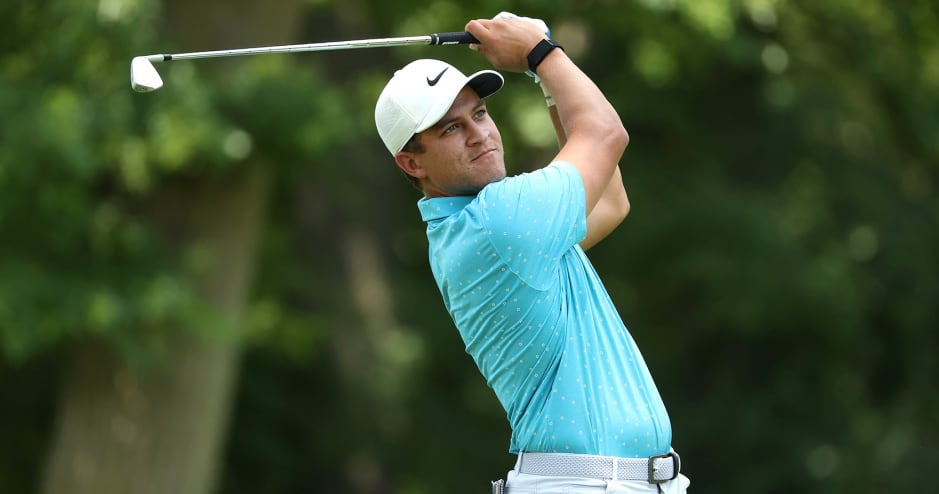
Cameron Champ is one to watch this week at Muirfield Village GC.

Power Rankings: Workday Charity Open
RANK PLAYER COMMENT
15 Jon Rahm
Seven of his 10 numbers in the restart are red, but he's been lapped by better execution. Took last week off to regroup and recharge. Currently second on TOUR in the all-around ranking.
14 Marc Leishman
He's restarted slow, but Muirfield Village sets up as a rebound. Since 2015, he has a pair of fifth-place finishes among four top 15s. Leads TOUR in Strokes Gained: Approach-the-Green.
13 Cameron Champ
The COVID-19 testing protocol that forced a WD from Travelers added rest in advance of a T12 at the RMC where he was second in Strokes Gained: Off-the-Tee. T14 at Colonial previously.
12 Kevin Streelman
The hot-and-cold veteran deserves this expectation after a solo second at TPC River Highlands where he's had success. Same goes at Muirfield Village with three top 10s among five top 20s.
11 Rickie Fowler
Experienced some validation with his swing enhancements with a T12. His 58 GIR was a personal best since he hit 61 GIR the 2016 Wyndham. Twice a groomsman at Muirfield Village.
10 Viktor Hovland
Among 31 in the field as of midday Monday who played in each of the first four events of the restart. He recorded top 25s in each. Led RMC in Strokes Gained: Tee-to-Green and proximity.
9 Matt Kuchar
He's comfy here. Prior to an uncharacteristically poor showing at Muirfield Village last year, he went 11-for-11 from 2007-2018 with a win, a T2 and another three top fives among 10 top 15s.
8 Matthew Wolff
Modified outlooks aren't quantifiable, but the runner-up finish at Detroit GC in the afterglow of his renewal is. His birdies-or-better clip via GIR of 62.00 percent was TOUR's highest since 2014.
7 Xander Schauffele
Not immune to getting tripped up by big numbers, but he delivers too often to worry about it in the long-term. Sits 10th in Strokes Gained: Tee-to-Green, seventh in adjusted scoring.
6 Gary Woodland
Power, precision and putting. Also prone to slumps, albeit short-lived, so expectations are high at Muirfield Village where he has a pair of top 10s and another two top 25s.
5 Brooks Koepka
Solo seventh in last start at tricky Harbour Town. Led field in distance of all drives and Strokes Gained: Off-the-Tee. Also T6 in GIR. Rested since as a precautionary measure for COVID-19.
4 Justin Thomas
His record at Muirfield Village is a microcosm of his week-to-week. Two top 10s and three missed cuts in his last five trips. Also 2-for-3 with a pair of top 10s since play resumed.
3 Patrick Cantlay
In unique position of playing an official event on the same course on which he'll be defending next week. Flashed little rust en route to a T11 at the Travelers. Led field in fewest putts (106).
2 Justin Rose
Second in all-time earnings at Muirfield Village, the 2010 Memorial champ also has a pair of seconds among seven top 10s. Reopened 2019-20 with a T3 at Colonial and a T14 at Harbour Town.

1 Hideki Matsuyama
Already a winner at Muirfield Village (2014) and with another pair of top 10s and a T13 on the course, now gets greens that will remind him of the pace familiar in his native Japan.
Jordan Spieth, Jason Day, Patrick Reed, Collin Morikawa and Phil Mickelson will be among the notables reviewed in Tuesday's Fantasy Insider.
Neither tournament at Muirfield Village will host fans, but those who compete in both will be tackling different tests. How the club and tournament officials pull it off will be fascinating. Logically, it's easier to transition from easy to hard in such a short period of time. In fact, it's probably the only sequence that can allow it at this level of the sport.
Muirfield Village's primary rough will begin at three-and-a-half inches for the Workday. It could exceed four inches when the 120-man field for the traditional invitational convenes for the Memorial. The bentgrass greens, which normally are prepped to run at a PGA TOUR-long 13 feet-plus on the Stimpmeter for the Memorial are expected to range in the vicinity of just 11 feet for the Workday. While the average square footage (5,000) cannot change in one week, nor can the undulations on them, for golfers who will be pegging it in both, slicker surfaces could present at least one day of adjustment in the nightcap of the doubleheader. A read on a putt this week likely will be different on the same putt next week. Slower greens also introduce fresh hole locations not possible during the Memorial.
Tee to green, the challenge essentially is the same. Muirfield Village allows long hitters room to move it. With slower greens this week, guys should be paid off to play aggressively, so the bunters among them will be keen to find fairways. That's never is a problem on this track, but they still probably don't mind that Rocket Mortgage Classic champion Bryson DeChambeau is taking his first week off of the restart. (DeChambeau won the Memorial in 2018.)
Returnees will see newly positioned fairway bunkers on six holes and three new tees. For the Workday, the par-3 eighth, par-5 11th and par-5 15th holes will tip at an aggregate 64 yards longer than what once was familiar. The stock par 72 can stretch to 7,456 yards, but it's unlikely to reach that maximum during any round, instead leaving some of the length for the Memorial.
After a toasty opener with a daytime high in the mid-90s, a slight but gradual cooling will extend into the weekend. The tradeoff is an elevated threat for rain and storms every day. Wind also could freshen with the energy. If weather becomes an issue, the good news for those with plans to play Memorial is that they already will have traveled to the next tournament.
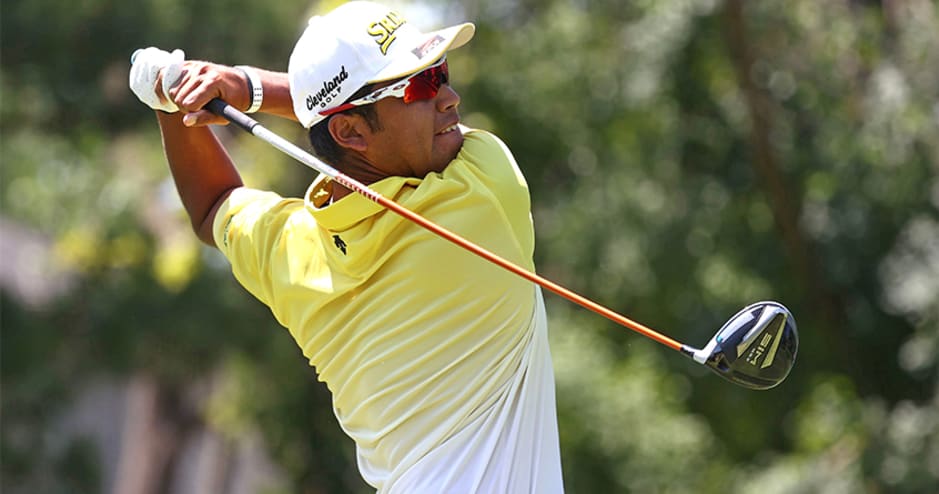
Hideki Matsuyama is one to watch this week at the Workday Charity Open.
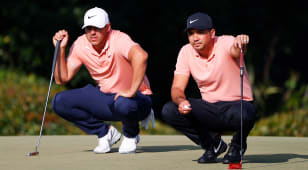
Featured Groups: Workday Charity Open
First of two events at Muirfield Village includes Koepka-Thomas-Day grouping
The PGA TOUR announced today the four featured groupings for Thursday-Friday at the Workday Charity Open, to be contested at Muirfield Village GC in Dublin, Ohio.
The Workday Charity Open is a one-year, full-field FedExCup event contested at Muirfield Village GC the week immediately preceding the Memorial Tournament. Thanks to title sponsor Workday, and the support of Muirfield Village GC and the Memorial Tournament host, Jack Nicklaus, the tournament fills the week vacated by the cancellation of the John Deere Classic, which will return to the PGA TOUR schedule in 2021.
Full groupings and starting times for the first two rounds of the Workday Charity Open will be released officially at approximately noon ET on Tuesday, July 7.
HOW TO FOLLOW
Television: Thursday-Friday, 3 p.m.-6 p.m. ET (Golf Channel). Saturday-Sunday, 1 p.m.-3 p.m. (Golf Channel), 3 p.m.-6 p.m. (CBS).
PGA TOUR LIVE: Thursday-Friday 6:45 a.m.-6 p.m. (featured groups), Saturday-Sunday 7:00 a.m.-3 p.m. (featured groups). Saturday-Sunday 3 p.m.-6 p.m. (featured holes).
Radio: Thursday-Friday, 12 p.m.-6 p.m. Saturday-Sunday 1 p.m.-6 p.m. (PGA TOUR Radio on SiriusXM and PGATOUR.com/liveaudio).
FEATURED GROUPS
Justin Thomas, Brooks Koepka, Jason Day
• Thomas, No. 2 in the FedExCup standings, has two top-10s since the season resumed (T10/Charles Schwab Challenge, T8/Heritage)
• Koepka is making his first start since withdrawing before the start of the Travelers Championship out of an abundance of caution following his caddie testing positive for COVID-19.
• Day, who resides just outside of Columbus, has made one cut in four starts since the season resumed (T46/Travelers Championship)
Patrick Cantlay, Phil Mickelson, Jordan Spieth
• Cantlay, who will be defending his Memorial Tournament title next week at Muirfield Village, has not missed a cut in 15 starts since the 2019 Zurich Classic of New Orleans, tied for the longest active streak on TOUR (Tyrrell Hatton, Paul Casey)
• In his most recent start, Mickelson held the 36-hole lead at the Travelers Championship before finishing T24, his first start since turning 50 on June 16
• Spieth enters the week No. 95 in the FedExCup standings; since 2009, he is one of only two players to stand outside the top 50 with six weeks remaining and finish the Regular Season inside the Wyndham Rewards Top 10, accomplishing the feat in 2013
Patrick Reed, Matthew Wolff, Rickie Fowler
• Reed has one win (WGC-Mexico Championship) and one runner-up (ToC) in 12 starts on the season
• Wolff held a three-stroke lead heading into the final round of last week’s Rocket Mortgage Classic before finishing second to Bryson DeChambeau
• Fowler enters the week No. 84 in the FedExCup standings and has never finished the season worse than 43rd in his career (2010-present)
Viktor Hovland, Jon Rahm, Gary Woodland
• Hovland has finished in the top 25 at each of the four events since the season resumed (T23/Charles Schwab Challenge, T21/Heritage, T11/Travelers Championship, T12/Rocket Mortgage Classic)
• Rahm is currently No. 24 in the FedExCup standings and qualified for the TOUR Championship in each of his first three seasons on TOUR
• With five top-10s in 11 starts, Woodland enters the week No. 38 in the FedExCup standings

Sleeper Picks: Workday Charity Open
Kyle Stanley … The 32-year-old has survived only six of 16 cuts this season, but he's 126th in the FedExCup thanks in part to a T24 two weeks ago at TPC River Highlands. For the week, he landed inside the top 20 in most measurements of his game off the tee and into greens, but that's been his profile throughout his career. It's paid handsomely at Muirfield Village where he has a pair of podium finishes among three top 10s, including a playoff loss just two years ago. He deserves attention again due to that success in conjunction with the familiarity of the sightlines and slower greens.
Cameron Tringale … A solid first half of the Rocket Mortgage Classic triggered thoughts of the Diaper Dimension but a third-round 72 thwarted a realistic run at his first victory on the PGA TOUR. He settled for a share of 30th place. That there were signs of something special at all suggests that he's under the influence of the imminent birth of his first child. His irons were dialed in at Detroit GC. With slower greens than usual at Muirfield Village this week, piling up the scoring opportunities will be first priority.
Adam Long … When 13 of 23 career cuts made result in a top 25, it's not a reach to define him as a top-25 machine. It also means that he licks his chops on weekends. As a rookie in 2018-19, his third- and fourth-round scoring averages were lower than his averages for each of the first two rounds. This season, he's currently 37th on TOUR in final-round scoring average, but he's also 20th in the second round. So, the key is simply getting to the weekend, which is, well, not always that simple. However, if he strikes his irons with the precision that yielded a T24 at the Travelers Championship, you won't be surprised. He led the field at TPC River Highlands in proximity to the hole.
Henrik Norlander … Shadowed by Bryson DeChambeau's statistically historic week at Detroit GC was the Swede's own triumvirate of pacesetting analytics. No one split more than Norlander's 48 fairways hit, scored better in Strokes Gained: Approach (+8.29) and no one was more efficient in getting up and down for par (15 of 16). All of that outbalanced below-average putting as he manufactured a T12. He arrived at Muirfield Village with nine consecutive red numbers in tow.
Richy Werenski … While he didn't close the Rocket Mortgage Classic as well as he opened, his T21 easily was his best finish of the restart. And he's yet to rest. In addition to three appearances on the PGA TOUR since play resumed, he stayed warm in a Korn Ferry Tour event. And he's yet to miss a cut. He's also been known to go on a heater. Ranked T2 in fairways hit, T8 in greens in regulation and eighth in proximity at Detroit GC to frontload his signature confident putting.
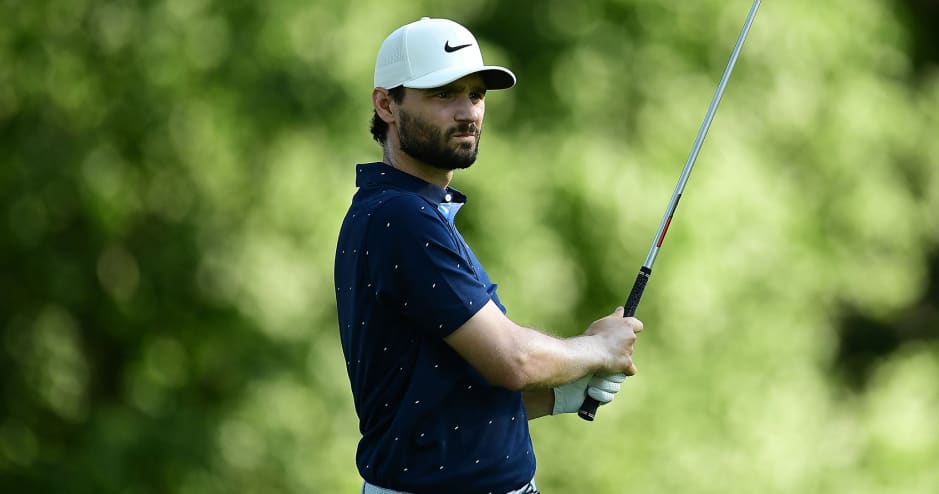
Kyle Stanley finished T24 at TPC River Highlands two weeks ago.

PGA Tour Nixes Plan to Have Fans at the Memorial Tournament
The event had the approval of state and local officials to host a limited capacity of spectators when it opens in Dublin, Ohio, on July 16, but scrapped those plans citing rising Covid-19 cases.
NYT, Bill Pennington, July 6, 2020
The PGA Tour’s Memorial Tournament, scheduled next week in central Ohio, had hoped to pave the way for spectators to return to golf events during the coronavirus pandemic, and in turn perhaps provide a blueprint for how fans could safely attend other major American sports competitions.
But on Monday, the tour and tournament organizers announced they were scrapping plans to allow as many as 8,000 fans per day at the event. The rise in Covid-19 cases nationwide, and in Ohio, were the primary factors in the decision.
“While we embraced the opportunity to be the first PGA Tour event to welcome the return of on-site fans — and be a part of our nation’s collective re-emergence from the Covid-19 crisis, we recognize the current increase in positive Covid-19 cases across the country, and our ultimate responsibility,” Dan Sullivan, the tournament’s executive director, said in a statement.
Jay Monahan, the tour commissioner, referred to “the broader challenges communities are facing,” and said the focus was now on “the health and safety of all involved.”
In recent weeks, several PGA Tour players and their caddies have tested positive for the virus, which has caused a handful of elite golfers to withdraw from tournaments.
The Memorial, hosted since the mid-1970s by Jack Nicklaus and set to begin on July 16, is one of the tour’s featured events and always boasts a strong field of top golfers. It is one of Tiger Woods’s favorite events, which he has won five times. Woods, who has not played on the PGA Tour since February, is expected to make his return to the circuit at next week’s tournament.
Since June, the Memorial Tournament had the approval of state and local officials for a limited number of spectators — about 20 percent of the usual capacity — at the Muirfield Village GC in Dublin, Ohio. Grandstands and bleachers were not constructed but fans, under specific social distancing guidelines, would have been allowed to watch the competition from various viewing sites on the grounds.
So far, the PGA Tour has held four fan-free tournaments. More than 20 other events are scheduled in 2020, though none currently expect to host fans on-site. That includes the P.G.A. Championship, the first golf major of the season, which will be held in San Francisco from Aug. 6 to 9.
Monahan, in a statement Monday, said that the tour would welcome fans, “when the time is right.”

The Memorial Tournament always boasts a strong field of top golfers. Tiger Woods is expected to return to the tour circuit at the tournament next week

Everyone’s an Antiracist. Now What?
Recognizing that Black people deserve dignity isn’t progress.
NYT, Erin Aubry Kaplan, July 6, 2020
The new unbridled enthusiasm for the cause of Black lives reminds me of the Dr. Seuss fable “Horton Hears a Who.”
A kindly elephant named Horton becomes aware of a whole planet of creatures called Whos living on a single speck of dust. Horton can hear the Whos perfectly, and accepts them as friends and equals. Horton’s friends, who can’t see or hear the Whos, denounce him as crazy, and a few set out to destroy the speck of dust.
It’s only when all the Whos raise their voices in a single chorus — “We are here!” — that they are heard by the larger world: In an instant, Horton’s friends’ skepticism turn into amazement, then into a celebration of the Whos, who they now know are real, and equal.
We are having a Horton moment. White people previously oblivious to the worst kind of racial oppression had their obliviousness shattered by the images of a police officer killing George Floyd.
The dam burst, reality rushed in, and a critical mass of whites and others finally saw — and heard, and felt — Black people as they never had before. Suddenly everyone is paying attention, loudly declaring their support and commitment to anti-racism, almost as if to make up for all the time they’d been in denial or silent.
This is where the Dr. Seuss story happily ends: by virtue of being recognized as equals by the wider world, the Whos are saved. They will never be devalued again.
Unfortunately, we are not living in a Dr. Seuss story. The burgeoning new white consciousness about Black lives, though significant and encouraging, is not an ending, but a beginning.
Recognizing that Black people matter as much as all other Americans is only acknowledging what’s always been true. Embracing Blackness as a something of value and dignity is a baseline for progress, not progress; it is moving into position at the starting line, but it is not the race.
Going from the current enthusiasm to doing the million things that need to be done — simultaneously — to start correcting systemic racism (whoever thought that phrase would trend on social media?) will be daunting, not least because it is unprecedented.
The last large-scale effort aimed at improving Black lives was the war on poverty back in the ’60s, and the backlash to that was swift and relentless. In some ways, we’re still living it. Critics of the war on poverty didn’t object just to money being spent, they objected to the notion of helping Black folks specifically because they were not worth helping, at least not to that degree. The idea of Black well-being being worth only so much became so embedded in our political life, we stopped seeing it. Now, it is coming back into focus.

The burgeoning new white consciousness about Black lives is not an ending, but a beginning.
It has taken a long time to get focused. It’s sobering to realize that the baseline message of Black life mattering has been running for generations, from Sojourner Truth’s anguished question, “Ain’t I a woman?” in 1851 to the Black sanitation workers in Memphis proclaiming, “I Am a Man,” in 1968 to Jesse Jackson’s revision of that declaration with “I Am Somebody” in the ’70s and ’80s, to the hashtag Black Lives Matter in 2013.
Over and over, Black people have asserted the simple but radical truth of their own humanity and worthiness, and over and over, America has not fully heard them. African-Americans kept up the messaging because they’ve had to — they’ve always known it’s Step 1 in our national process of racism recovery, and as anyone in a 12-step program can attest, you can’t make real progress with the higher steps until you get the first one right.
Our recovery has been complicated by the nature of our particular addiction. As a society we’ve been addicted to injustice — from slavery to lynchings to segregation to police brutality — all made possible by our repeated failure to embrace Step 1. Now that we are owning up to that failure, things look to be changing.
But can we change? History and culture are against it. Another one of our great national addictions is convenience, fueled by the uniquely American expectation that things essential for daily living be made cheap, easy and painless.
Racism is a form of convenience, in the sense that it’s designed to make life easier for its beneficiaries. So is white privilege — the phenomenon of not having to think about the costs of oppression, or about Black people at all.
Antiracism requires the opposite: engagement. We are starting to see it in the demands for police reforms, in the growing white rejection of symbols of white oppression like Confederate monuments and flags, even figures of presidents.
But this is all part of Step 1. Being truly antiracist will require white people to be inconvenienced by new policies and practices, legal and social, that affect everything in everyone’s daily lives, from jobs to arts and publishing.
It’s one thing to declare your support for Black Lives Matter with a lawn sign and quite another to give up segregated schools, or always seeing yourself and people like you as the center of the moral universe. The privilege to not engage is one that many may be loath to give up, even if they believe engagement is the right thing to do.
And yet the most optimistic part of me says that it could be that what has stood for so long is simply falling away. It could be that the latest Black assertion of “We are here” will be the one that breaks through with cumulative force of years of such assertions, opening a floodgate that will remain open not because whites allow it, but because it was supposed to be open all along.
If that happens, the road to recovery will not be just an ideal, but a straight line we can actually see.
Wuhan: City of silence
Looking for answers in the place where coronavirus started
bbc.co.uk, By John Sudworth
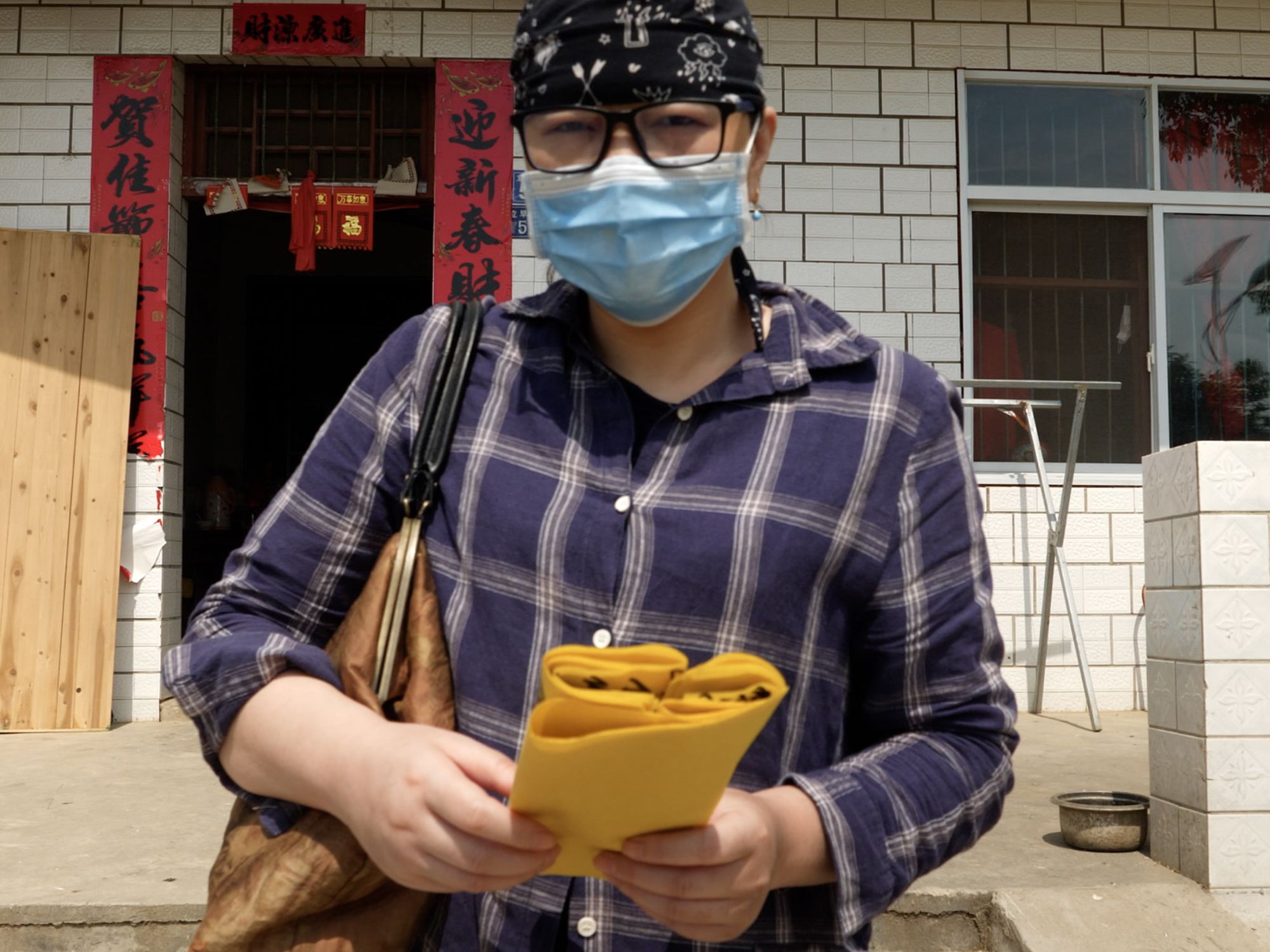
In a small room, in a village on the outskirts of Wuhan, an elderly woman is chanting quietly and tapping out time on a table. Opposite her, another woman is crying softly. In early February, her 44-year-old brother died from coronavirus, and she cannot forgive herself.

After the ceremony, Ms Wang - she doesn't want to use her full name - says that the shaman received a message from beyond the grave. Her brother, Wang Fei, had absolved her of any blame. “Feifei doesn't hold me responsible,” she says, referring to him by the name the family has used since childhood. “He was trying to comfort me and persuade me to accept his death.”
Her brother died on a Covid ward, unable to see visitors; his last days lived out in a series of desperate text messages.
“I feel so tired,” he wrote in one of them. “This disease has dragged on for too long.”
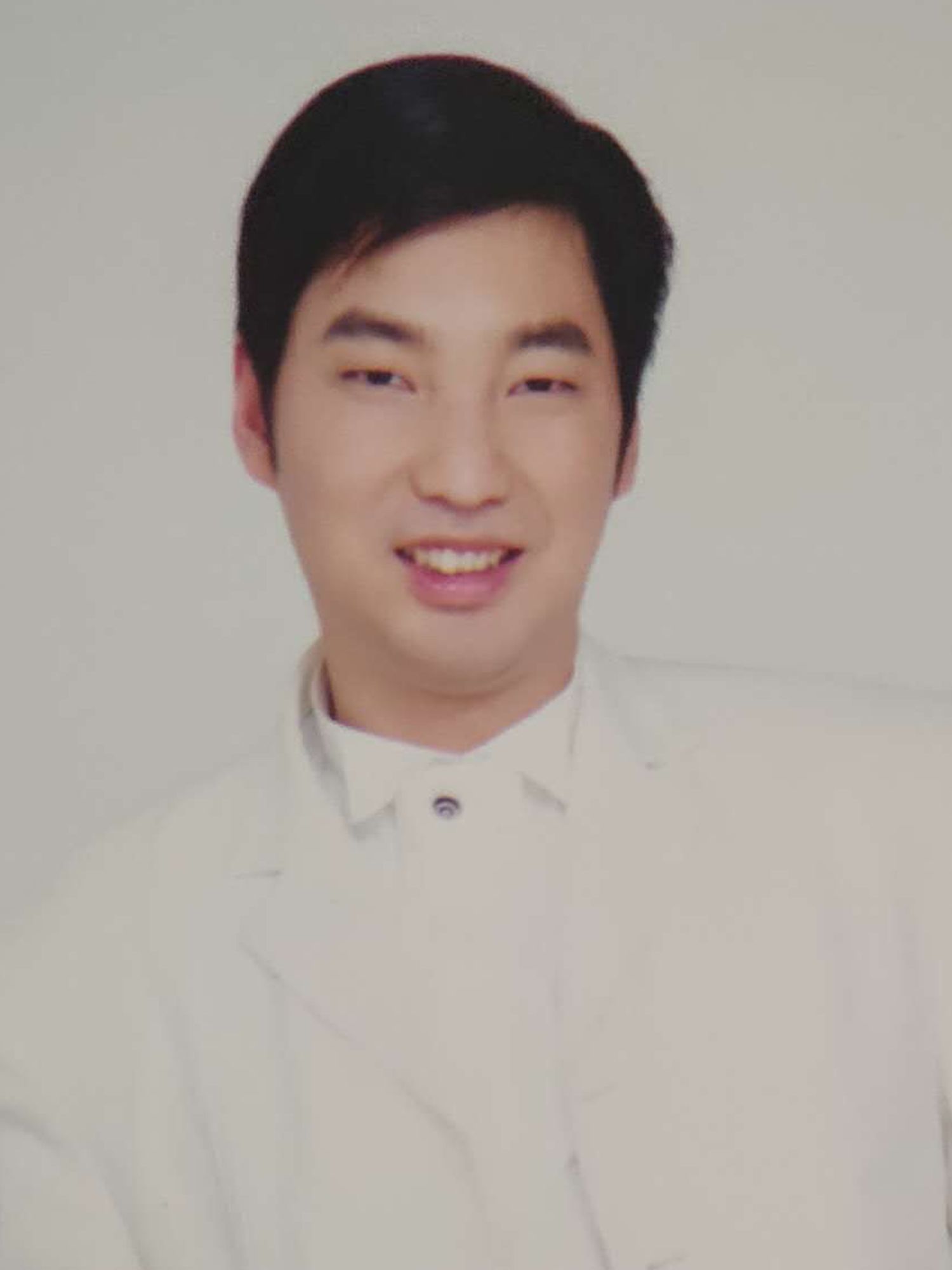
Ms Wang’s guilt is a product of one of the cruellest aspects of this global pandemic – the enforced isolation of sufferers from their families.
“I couldn’t go to the hospital to take care of him,” she tells me. “When I heard he’d died, I just couldn’t accept it. My family’s been broken into pieces.”
She wants answers about her brother’s treatment - whether he was given proper care, and whether more could have been done to save him.
But Ms Wang has been told by the police not to speak to the foreign media, and her choice to ignore that warning carries some risk.
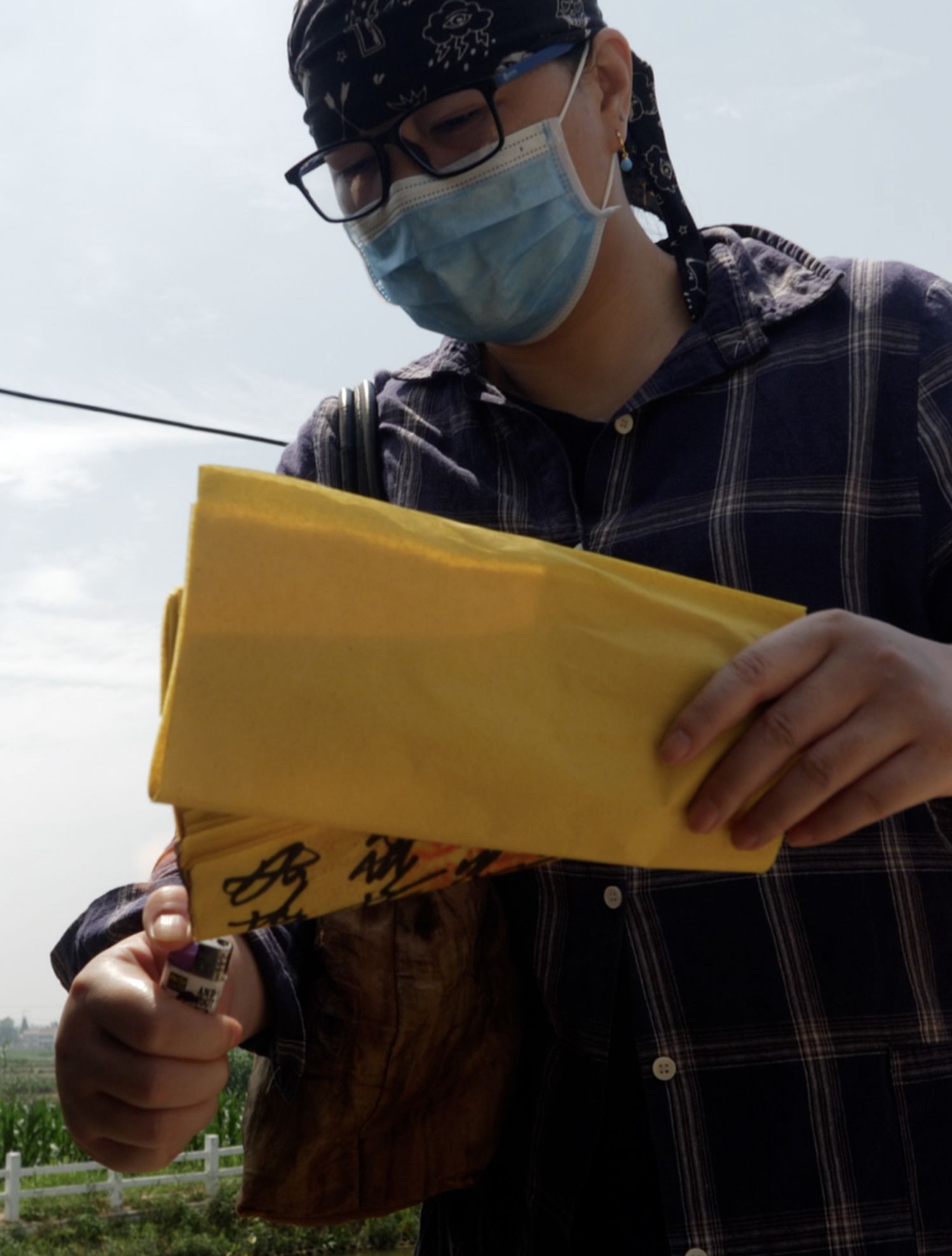
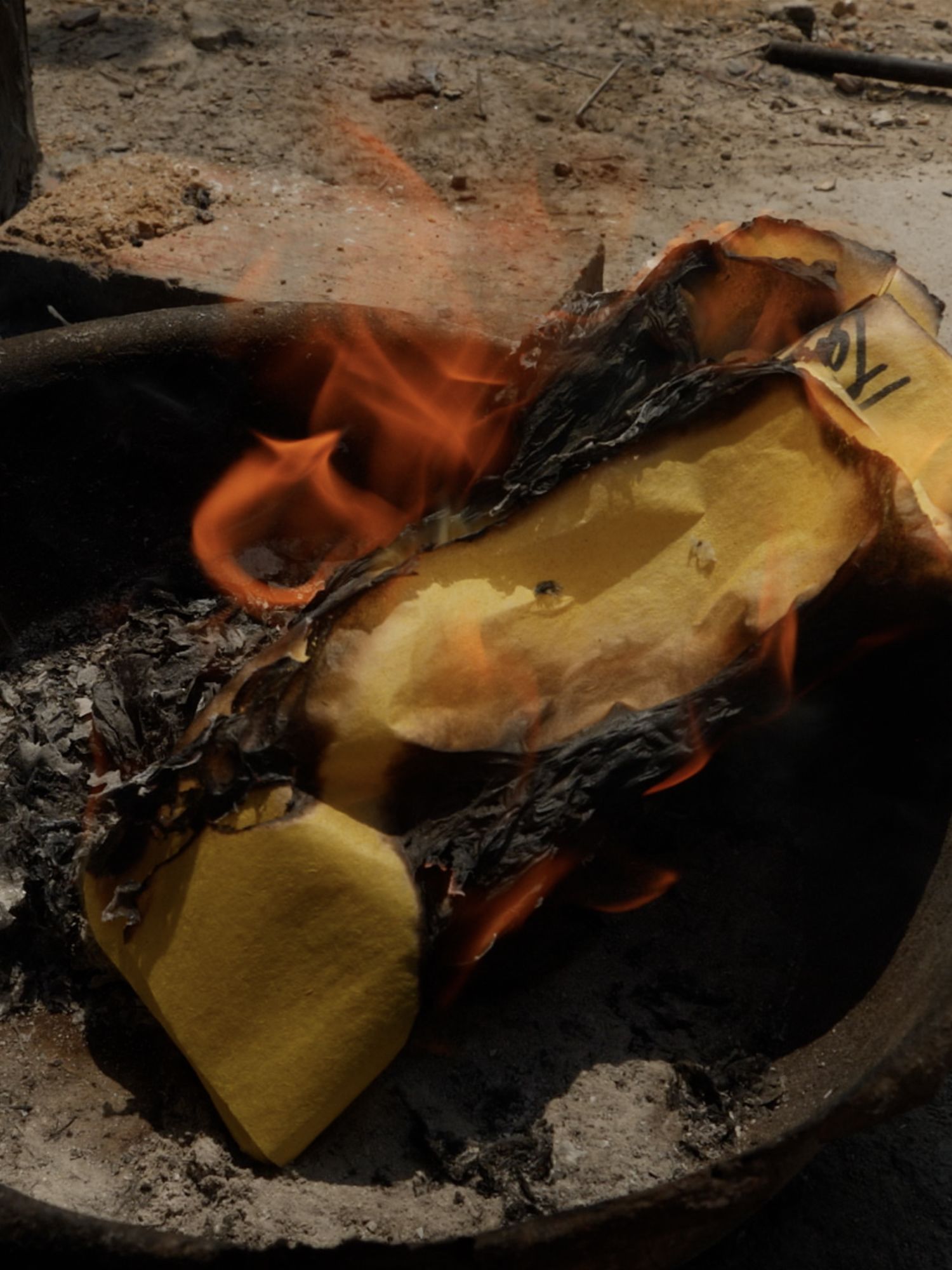
Ms Wang sets fire to papers with prayers written on them in an offering to her brother
One woman we arrange to interview arrives with plain-clothes policemen in pursuit. When she scrambles into our car, they block our way.
We meet another man in the darkness on the banks of Wuhan’s East Lake. He tells us he’s been visited twice by the police for speaking out about the death of his father.
For victims and journalists alike, asking questions about how and why the outbreak began in Wuhan, and whether it might have been better contained, is not easy. But at the epicentre of this global disaster, the need to ask questions is a necessity, not a choice.
The day in mid-January when Wang Fei began to feel unwell, China's official death toll stood at just three. Today, more than 11 million people have been infected worldwide, at least 500,000 have died - and the virus has forced the lockdown of entire economies.
It is here where the virus was first discovered and the first attempts made to contain it. And it is here, too, where the search for its origin must begin, leading to perhaps the biggest question of them all, and one now at the heart of an escalating propaganda war between Washington and Beijing.
Did the coronavirus – as most scientists think – come from nature, or might it have leaked from a lab?
The descent
Ms Wang says her brother, who worked as a driver, hardly ever left Wuhan. Over the course of his 44 years, the central Chinese city grew from a declining industrial backwater into a booming international business and transport hub. But if Wang Fei’s life coincided with Wuhan’s extraordinary revival, then his final days ran in parallel with its descent into disaster.
In early January, medics had begun to realise that the disease was highly infectious and were implementing their own hospital quarantine procedures.
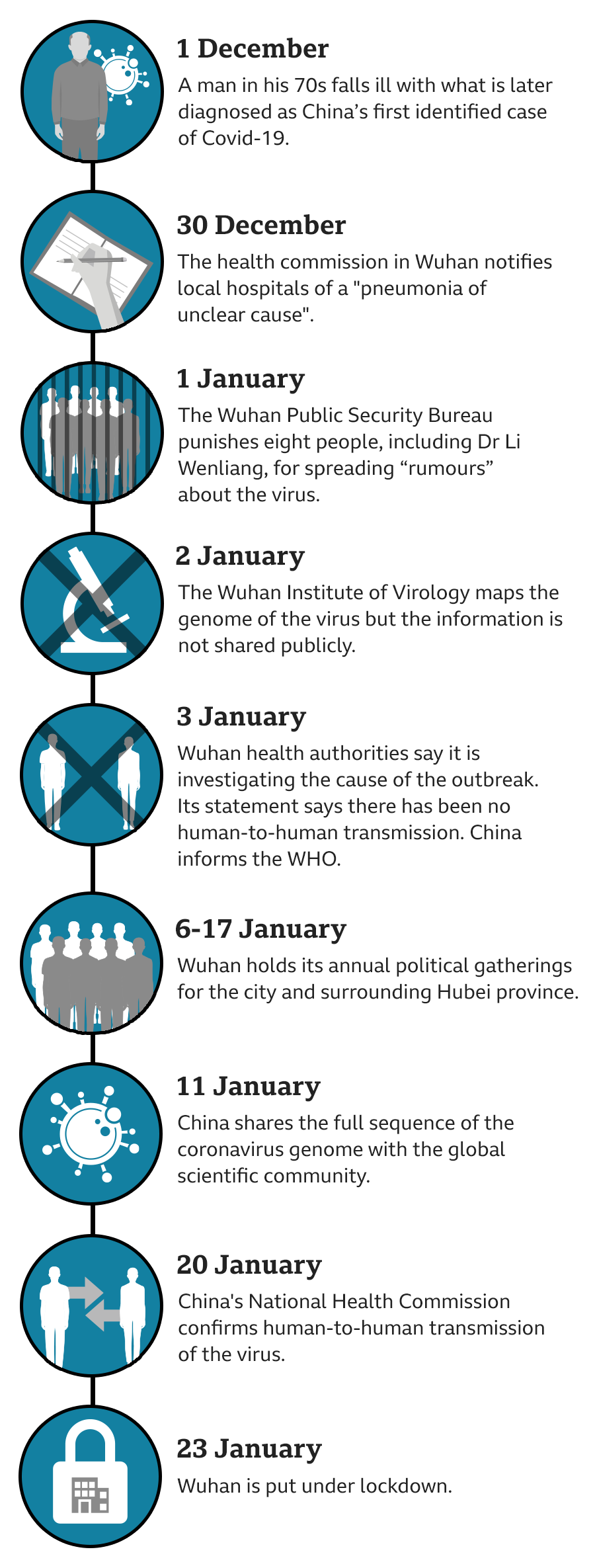
But instead of alerting the public, the authorities were silencing health workers. Li Wenliang, a doctor who tried to warn colleagues to take precautions against infection, was reprimanded and made to sign a confession by the police.
On the weekend of 18 January, with the authorities still insisting the disease was not contagious, Wang Fei began to feel unwell. He went to hospital where he was given paracetamol for his fever and sent home. “They say there’s no human-to-human transmission, but the doctors are all wearing masks,” he told his sister.
She can repeat the exact wording of the official reassurances, even now. “At that time, I was telling him that it is 'controllable and preventable,'” she says. “Only when I look back, I realise the government really didn't give enough warning. Now I know what he really needed was proper medical help. That’s what makes me feel guilty.”
Mr Wang cancelled the family’s plans to celebrate the Chinese New Year holiday, which fell the following weekend.
Instead he spent his days joining long queues outside hospitals. But with too many patients and not enough beds, he would return home exhausted.
“He believed deeply that the country and government loved him,” Ms Wang says, “and that they would protect him.”
On 23 January, Wuhan was put into lockdown. It was the world’s first, and became one of the longest and strictest attempts to contain the spread of the virus. But it came too late to prevent an estimated five million people leaving the city in the run-up to the national holiday.
A few days later, his condition deteriorated and the family called for an ambulance. They were told there were more than 600 people ahead of them in the queue. Seven hours later he was finally admitted to hospital.
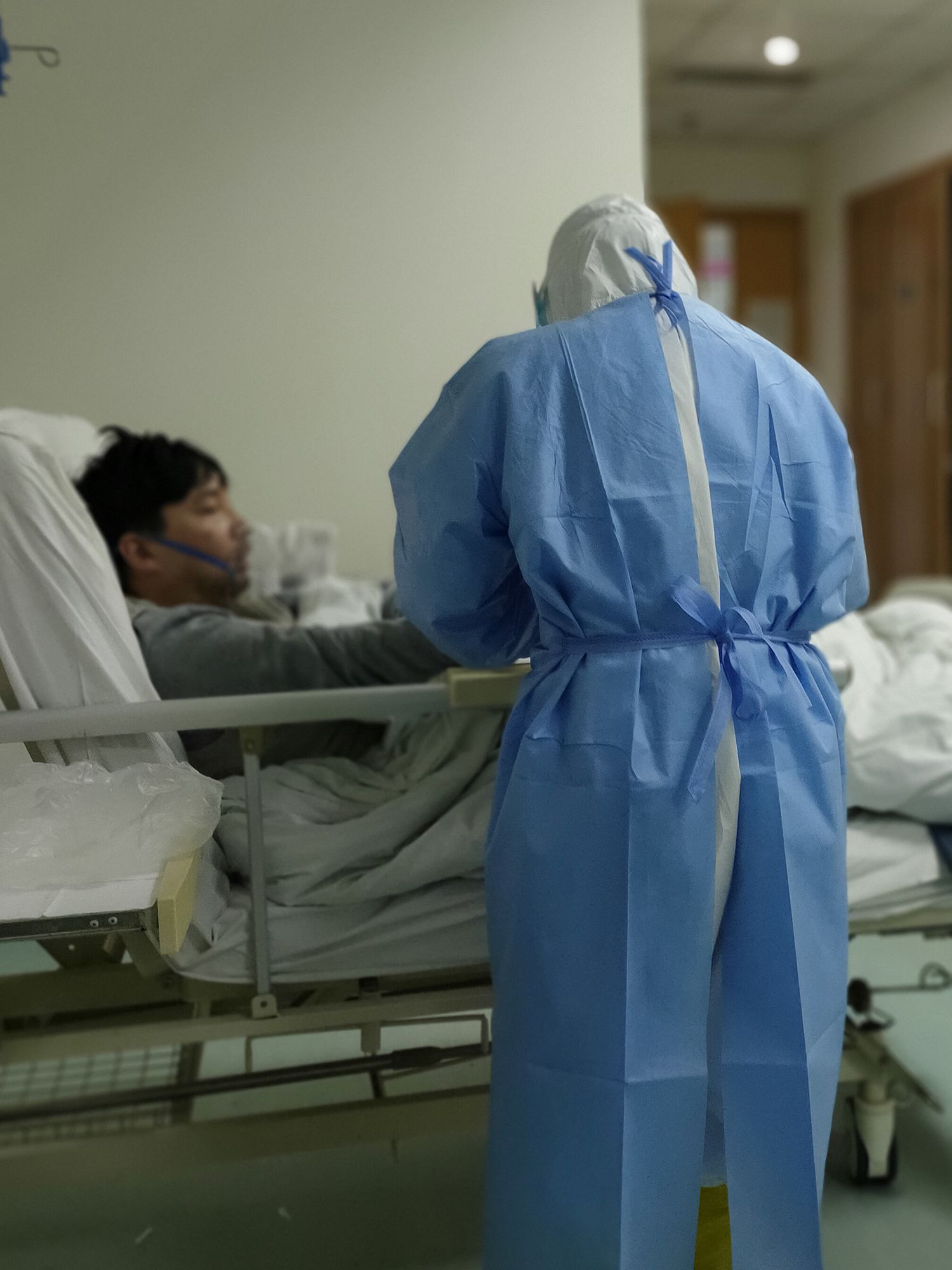
Mr Wang found himself in a health system that was now totally overwhelmed. He texted his sister, complaining about the difficulty of getting staff to attend to his basic needs - such as help with drinking water. He continued to get worse. On 7 February Dr Li Wenliang, the doctor censored by the police, died in the same hospital. Mr Wang's spirits sank even lower. “If even a doctor can't survive,” he told his sister by text, “what chance have I got?”
They are still silencing medics in Wuhan. Outside one hospital, we speak to a nurse who tells us about her experience on the front lines dealing with Covid-19 patients. Afterwards we exchange contact details and she cycles away. Two plain-clothes policemen, who have been watching us, emerge from the side of the street. They run alongside her with their hands on her handlebars, and bring her bike to a halt.
I can see them speaking sternly to her, but by the time I catch up with them, they’ve let her go. She calls a few minutes later and asks us to delete the interview. For her safety we have no choice but to agree.
The control of information, of course, has long been central to China’s system of government. In this case, it is central to the story.
Wuhan’s lockdown was successful in eventually bringing the city’s outbreak under control, but China faces allegations, including from the US government, that delay and cover-up in the early stages made a global crisis inevitable. In the early stages of any disease outbreak, even days can make a big difference to the speed and scale of the spread.
One study has suggested that if it had acted a week earlier, the number of cases in China could have been reduced by 66%. The authorities deny the allegations. They insist that, in the face of a previously unknown disease, their response was swift and point out that it has been commended by the World Health Organization.
The government is now comparing itself favourably to administrations in the West, even overtly mocking them for what it sees as a chaotic and confused response.
And it is silencing those who might challenge that narrative.
While the failings of democratic governments have been comprehensively exposed by a free press, there is no such scrutiny in China. This is a place where even trying to talk openly about your dead brother can bring you to the attention of the police.
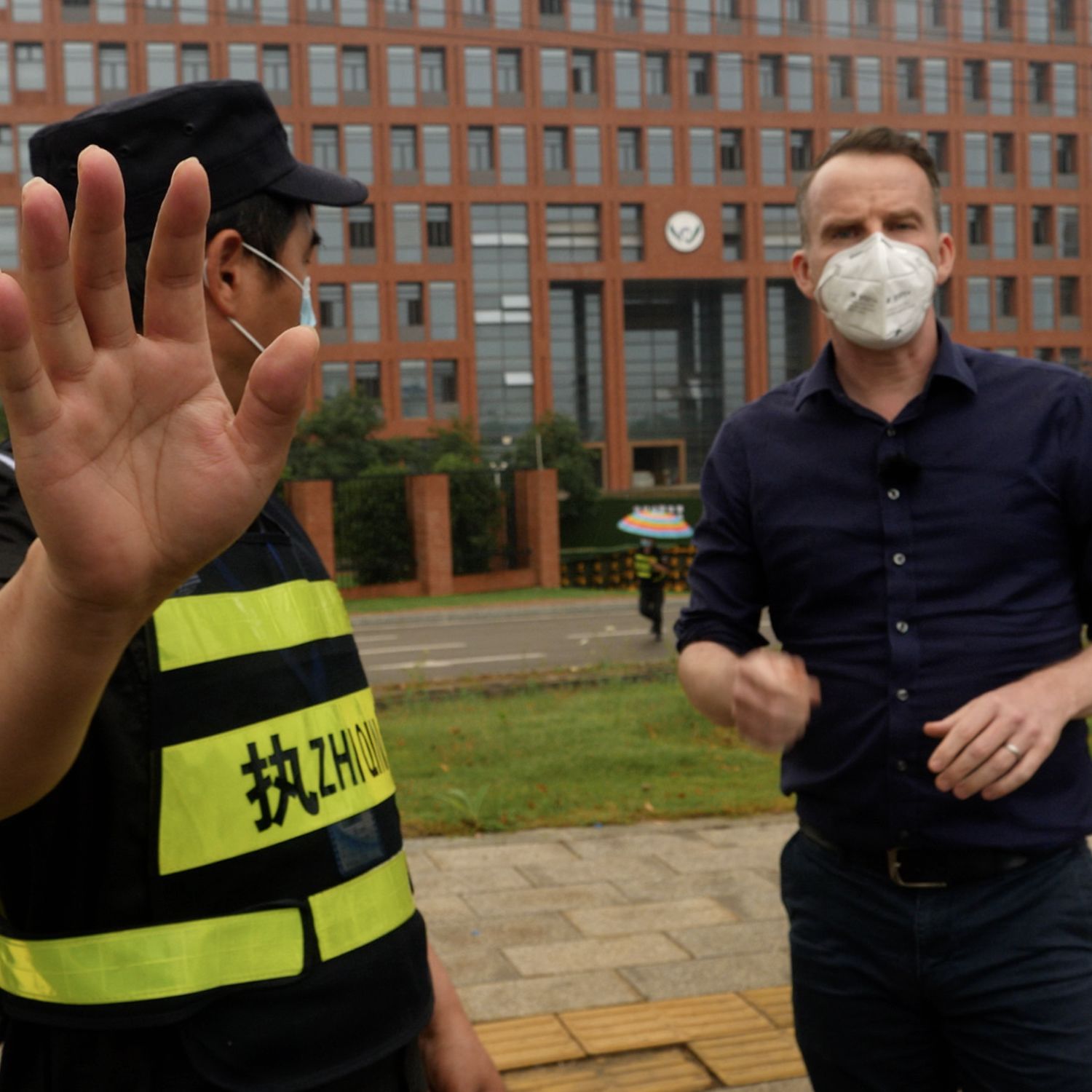
We put in requests to interview parliamentary delegates, senior health officials, academics and doctors - more than 20 people. None of our requests were granted. We sent questions to China’s health commission and its foreign and science ministries about the release of public information in the early days of the crisis. They went unanswered too.
Spillover
Wang Fei lived a short walk from a large market that became an early focus of the unfolding story. Despite its name, the Huanan Seafood Market is known to have had some trade in wild mammals sold there as delicacies. It is now closed.
Initially, it was suspected to be ground zero for the outbreak, the place where the virus made the leap from animals to humans.
Sars-CoV-2 – as it has now been named - belongs to a family of coronaviruses named for their spikey or crown-like surfaces. A vast number of these viruses have been shown to be carried by bats.
Some of them are thought to have the potential to infect humans, either when passed directly from a bat, or after first infecting another animal species – an intermediate host – that then comes into contact with people.
This is, one theory suggests, what triggered another coronavirus outbreak in China which first appeared in November 2002.
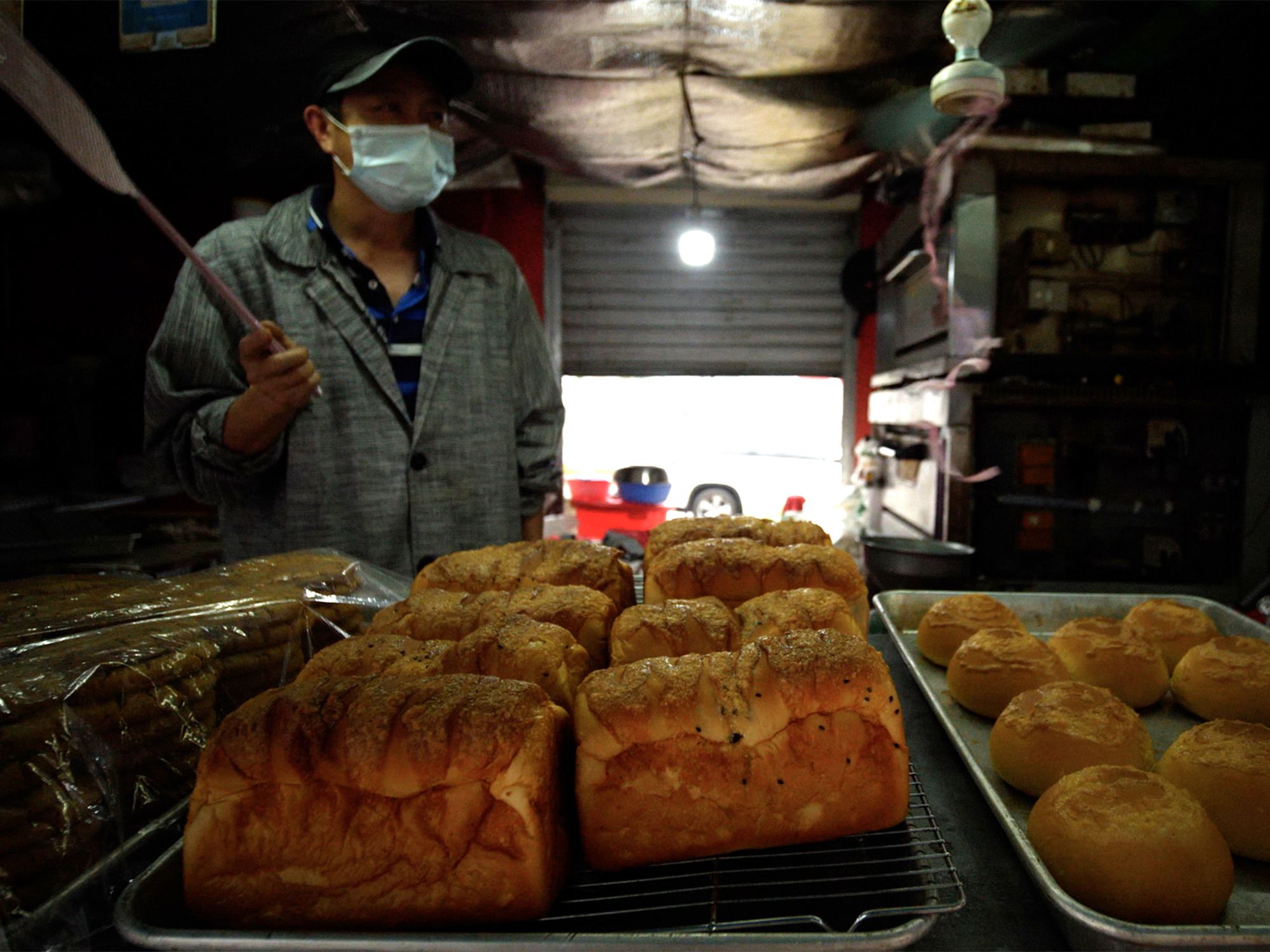
The Sars coronavirus, now known as Sars CoV-1, is thought to have jumped from bats to humans via the civet cat - a small furry mammal sold in the markets of southern China.
After the authorities failed to acknowledge the outbreak for several months, Sars went on to cause 774 deaths worldwide.
Nearly two decades later, the very first cluster of Sars CoV-2 cases appeared in Mr Wang’s Wuhan neighbourhood. One study found around half of them had a connection to the seafood market.
It was no surprise then that there was widespread speculation the virus’s intermediate host might have been among the animals on sale there.
But this theory now appears to have been dismissed by China, following the testing of samples taken from various places inside the market. While traces of the virus were found, none were detected on any of the animal samples. Officials have concluded that the outbreak is likely to have begun elsewhere, and that the crowded market simply helped spread the disease from person to person.
Most scientists remain convinced, though, that somewhere along the line, whether in a market or elsewhere, Sars-CoV-2 will have passed naturally from an animal to a human.
They point to an increasing number of such “spillover” events driven by factors such as population growth and human encroachment on natural habitats.
Dr Yuen Kwok-yung, a microbiologist from Hong Kong University who joined the Chinese National Health Commission fact-finding trip to Wuhan in January, says the “spillover” theory is the most favoured for the origin of this virus. This is not least, he says, because such events have happened so often before, from Sars CoV-1 to other avian-flu pandemics.
“H5N1 was the first wake-up, then Sars, then H7N9 in the Yangtze Delta, and now Sars-CoV-2,” he tells me.
“So, if you ask me what is the highest possibility – it’s that the virus is coming out from markets, markets that are selling wildlife.”
And that’s why, he argues, the trade in wild animals should remain the focus of prevention efforts.
“It is not easy to change culture, but we must,” he says.
Finding the source of the virus is not just a question of academic interest. If Sars-CoV-2 has come from a reservoir of infection in a particular animal species, then of course, it could continue to pose the risk of new outbreaks.
In mid-May, the World Health Organization passed a resolution calling for an international effort to trace the likely intermediate animal host. It has just announced it has been given permission to send a team of investigators to China for this purpose. But scientists agree it may not be an easy task.
We sent a number of questions to the Chinese National Health Commission and the foreign and science ministries about the work already being done in this regard. We asked if any studies had begun to test various animal species that could have spread the virus. We received no answers to our questions.
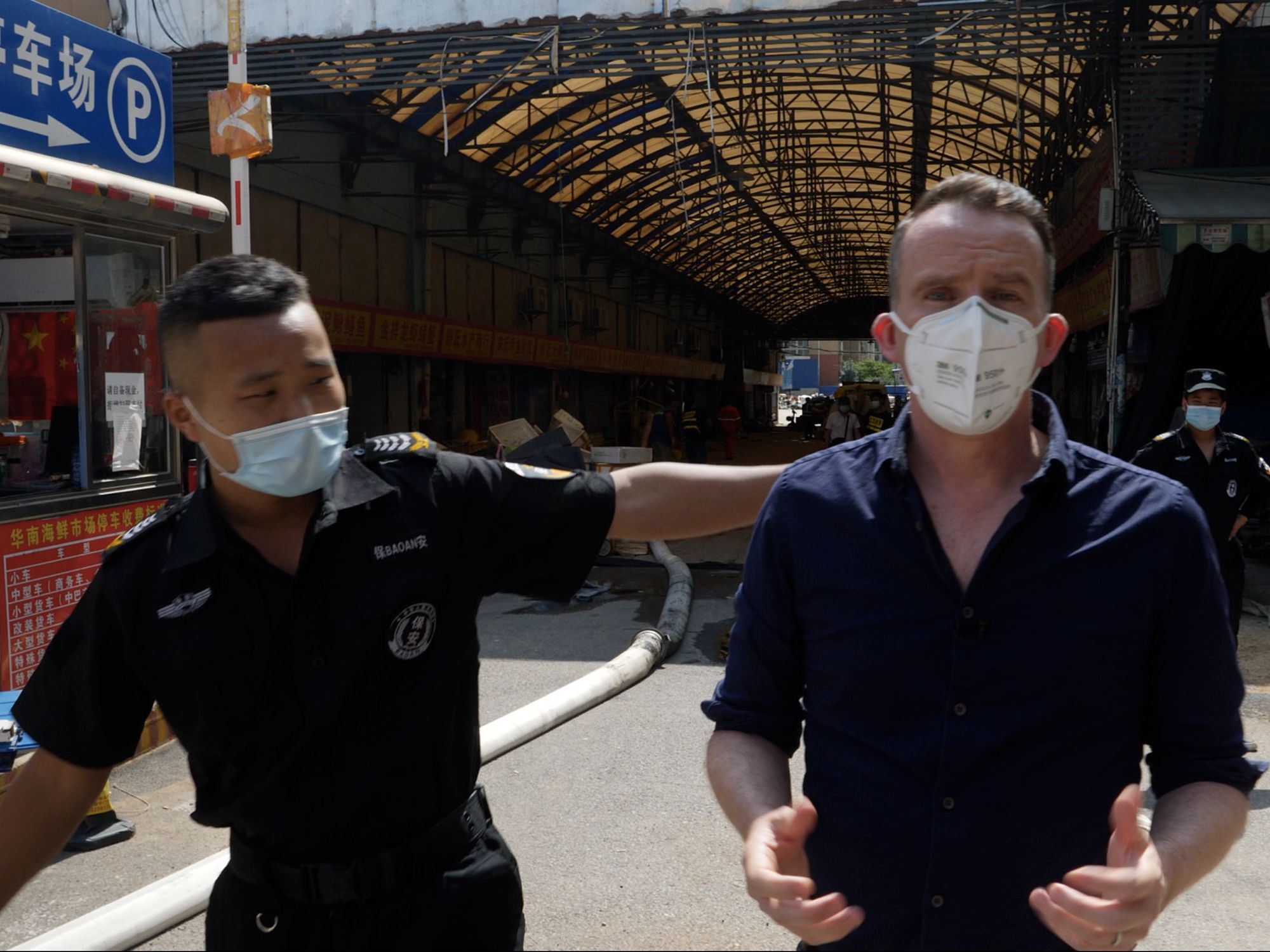
Outside the shuttered Huanan Seafood Market we’re stopped from filming. “I don’t care where you’re from,” a policeman tells me when I explain that I’m a foreign journalist. “China has done a lot to contain the virus. You need to promote positive energy.”
Mapping the virus
As Wang Fei lay dying in hospital, another location in Wuhan, a 40-minute drive from the Huanan Seafood Market, was already becoming the focus of an altogether different theory.
The Wuhan Institute of Virology (WIV) was now at the centre of a growing storm of conspiracy theories, suspicions and allegations that the virus might have leaked from a lab.
They have continued to this day.
The WIV’s modernist, grey concrete and glass structure, set in a leafy campus with a small lake, is clearly visible from the adjacent road.
When we arrive there, we are quickly surrounded by security guards who tell us it’s a sensitive area and call the police.
The institute is the world’s leading authority in the collection, storage and study of bat coronaviruses.
Its researchers are led by star scientist Professor Shi Zhengli – known as “Bat Woman” to her colleagues because of her expertise. They have spent years collecting samples from live bats in remote Chinese caves.
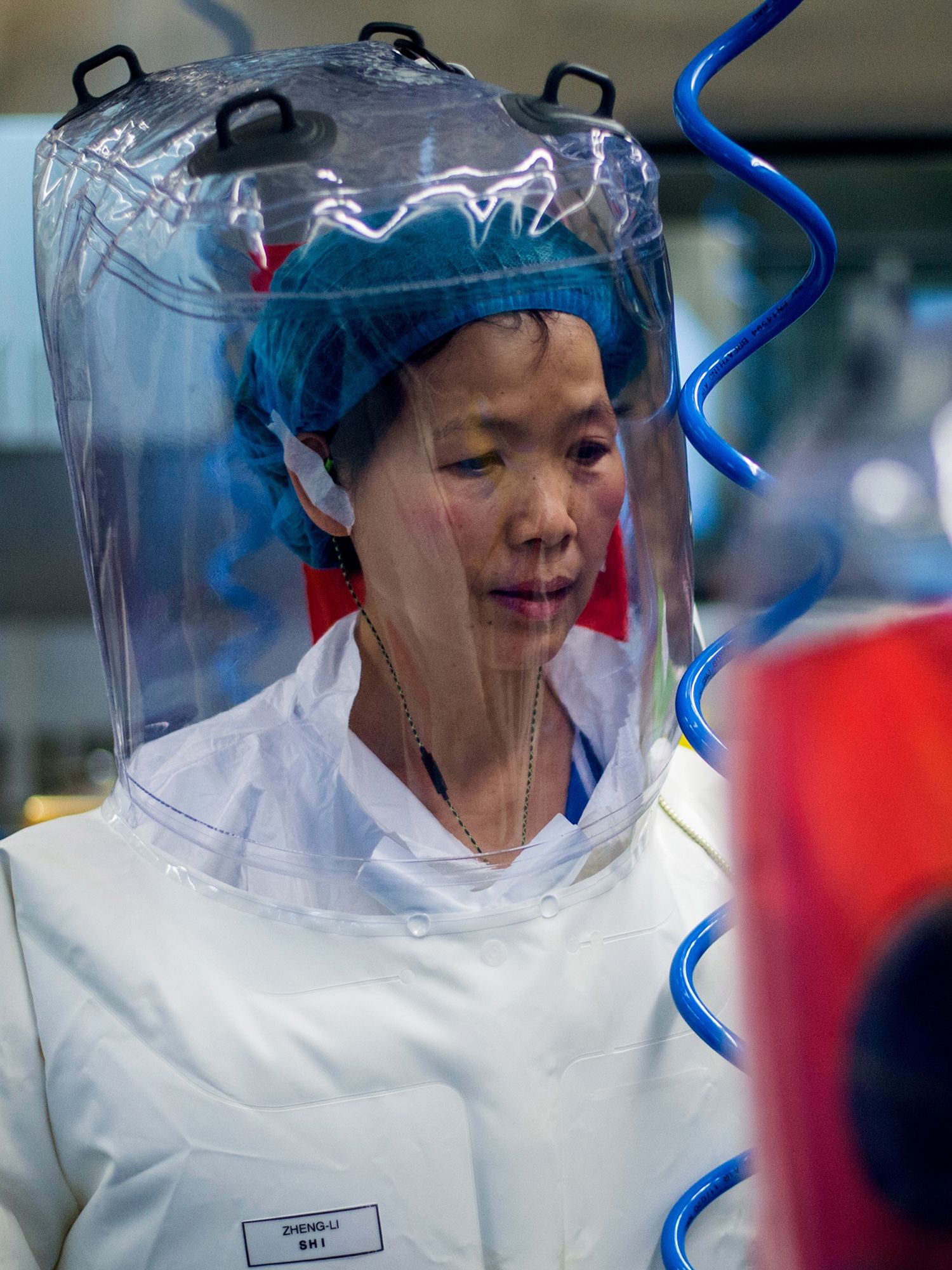
Professor Shi Zhengli in her lab
One recent paper, co-authored by Professor Shi, gives details about hundreds of bat coronaviruses, many of them previously unpublished, unveiling just how many have been gathered.
The research has included the genetic modification of some of these viruses, including the construction of new, chimeric – or hybrid – viruses, in order to examine their potential to infect humans and, potentially, cause pandemics.
It was Professor Shi who discovered and sequenced the genetic code of the nearest known relative of the Sars CoV-1 virus, found inside a bat from a cave in China's Yunnan Province.
Ever since the Sars CoV-1 outbreak, the fear of an even deadlier, more infectious spillover event has been the driving force behind Wuhan's coronavirus research.
Viruses are tiny packages of genetic material wrapped in a protective envelope. Viruses rely on living hosts to help them make more viruses.
They attach to a cell and then invade it via proteins on the surface of this envelope. Coronaviruses use jagged structures called spike proteins which give the viral envelope the appearance of a crown, or corona.
Once inside, the cell's internal "machinery" is hijacked, forcing it to assemble copies.
On 2 January, just three days after becoming aware of the new virus circulating in Wuhan, she also became the first to sequence Sars-Cov-2.
Ironically, it is the genetic make-up of Sars-CoV-2 that has itself helped fuel the lab-leak theory.
Some subsequent studies, including one by Prof Shi, suggest that there is something different about its genome compared to other known coronaviruses of a similar type.
Its spike proteins – the pointy bits of the “crown” that latch onto the cells of an infected host – seem to bind extremely well to human cells.
While most viruses need time to adapt to a new host, Sars-CoV-2 appears to have been highly infectious from the beginning of the outbreak.
One paper compared the new outbreak with the original Sars epidemic. It found that Sars-CoV-2 was already “pre-adapted” for human infection.
The virus’ spike proteins also have a feature, unusual in Sars-type coronaviruses, known as a “furin cleavage site”. These are thought likely to increase the efficiency with which the virus can penetrate the human cells, take them over and replicate inside them.
It is this combination of factors – the WIV’s proximity to the outbreak, the kind of scientific work it was involved in, and the seemingly unusual nature of the virus itself – that have led to the highly controversial alternative to the natural “spillover” theory.
Claims that the virus leaked from a lab first began to circulate on the Chinese internet in early February.
There were unsubstantiated rumours the coronavirus may have passed from a lab-infected animal to the local community, or that one of the WIV researchers may have themselves become accidentally infected, either with a natural virus collected from the wild, or a lab-made one.
Conspiracy theories soon spread further afield, including claims in some foreign newspapers and websites that the virus may have been an engineered “bio-weapon”.
But none of the lab leak theories – animal virus, man-made virus, deliberate or accidental – have been backed up with any concrete proof, relying instead on conjecture and circumstantial evidence.
A group of Indian researchers were some of the first to use the virus’ genome to hint at the possibility of genetic modification in a lab.
But the paper was quickly debunked and was withdrawn.
However unusual the virus appeared to be, there was nothing to prove that its notable features could not have come directly from nature.
In early February, Shi Zhengli herself took to was forced to take to social media in response.
“I, Shi Zhengli, swear on my life that it has nothing to do with our laboratory,” she wrote, adding that those who spread rumours should “shut their stinking mouths”.
Sars-CoV-2 has a series of protein spikes that form a 'corona' or crown
Each protein spike has a number of receptor binding domains (RBD)
The RBD latches on to the ACE-2 receptor of a human cell, infecting the host
The Sars-CoV-2 protein spike also has furin cleavage sites which may increase its ability to infect the host
Meanwhile, Mr Wang was succumbing to some of the same notable qualities of the virus on which such theories were partly based.
It was a pattern of decline now all too familiar to medics everywhere.
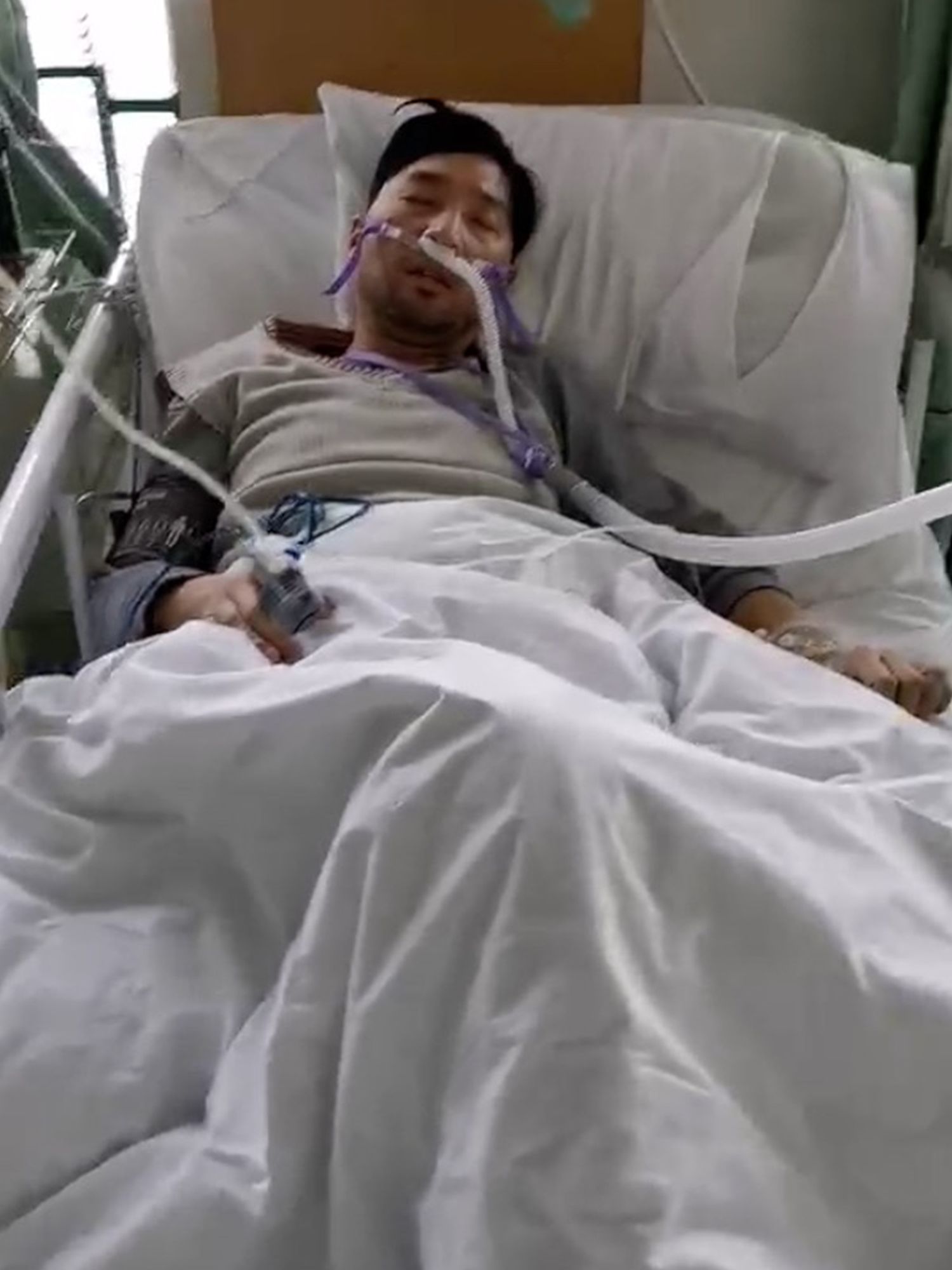
His lungs were being ravaged by the pathogen, filling with fluid and white blood cells, and the oxygen in his blood was plummeting. “My heartbeat rate is 160 per min. My blood oxygen saturation is only 70. It’s killing me,” he texted his sister.
The following day, on 8 February, he sent one last message. “Please save me,” it read, “I can see stars.” He died a few hours later.
Manipulating viruses
On 30 April, the US president waded into the controversy. He was asked by a reporter: “Have you seen anything at this point that gives you a high degree of confidence that the Wuhan Institute of Virology was the origin of this virus?”
“Yes, I have. Yes, I have,” Donald Trump replied.
Other administration officials have weighed in, with Secretary of State Mike Pompeo blaming what he claimed was China’s “history of running sub-standard laboratories”.
But despite the US saying to have “enormous evidence” for a lab leak, none has been provided.
With the theory now central to an escalating geopolitical dispute between the US and China, critics of President Trump’s handling of the response at home see it as a sensationalist smokescreen to deflect domestic blame.
Mindful that they could be drawn into a quagmire of conspiracy and propaganda, some scientists, however, believe that the lab leak question should not be dismissed out-of-hand.
It relates, they say, to one of the major scientific debates of our time and it has implications not just for China but for the US government too.
The work of the WIV, in collecting large numbers of bat coronaviruses and experimenting on them, has not been a lone venture.
It has been part of a major international effort focused on the growing risk of spillover events and the threat of new, human pandemics.
Some of Wuhan’s research has involved collaborations with US scientists and the backing of generous amounts of US funding.
And its creation of chimeric viruses - the stitching together of parts of the genomes of different viruses to make new ones - uses an easily accessible technique commonplace in labs around the world.
Such research has been the subject of an intense disagreement between scientists about the benefits and risks of such research.
Supporters say it can help us to anticipate how viruses might emerge in the wild and has the potential to help with the development of medicines and vaccines.
Those against, say it risks doing the exact opposite.
Manipulating viruses – to make them more infectious or more deadly – could, they say, spark off a man-made pandemic with a lab-made virus.
The risks might include lab workers becoming infected – perhaps unknowingly – when collecting virus samples from animals in the field, when handling animals kept in the lab, or when experimenting with live viruses.
Since the Sars CoV-1 coronavirus outbreak, for example, there have been four separate leaks from labs studying that disease.
Two of the incidents were at the National Institute of Virology in Beijing in 2004.
During one of them, a researcher caught Sars after spending two weeks at the lab. She went on to infect her mother, who died, as well as a nurse, who in turn infected several other people.
The coincidence of a new pandemic coronavirus appearing in the same city as a laboratory devoted to studying them is something that Prof Shi Zhengli appeared to initially acknowledge.
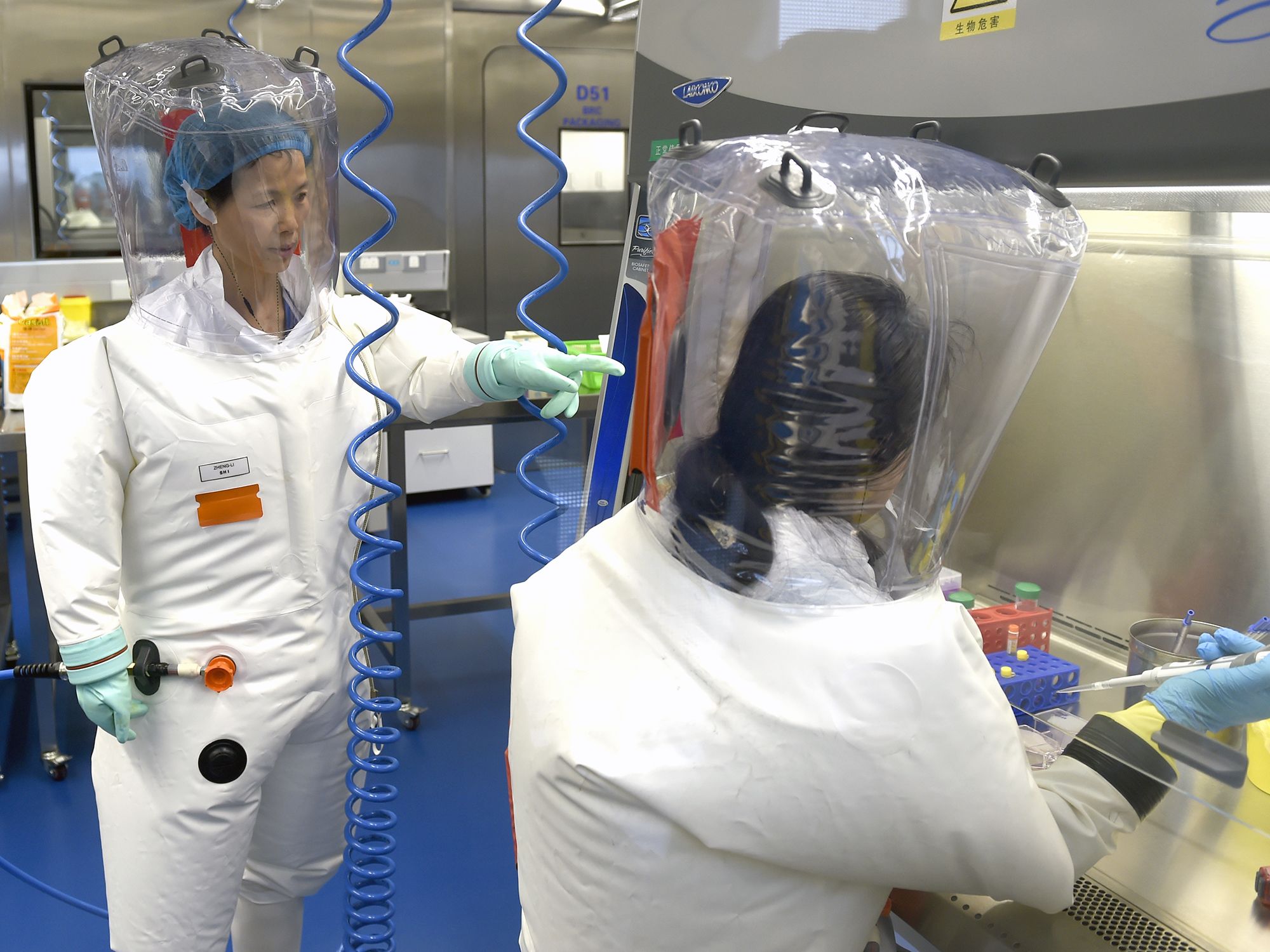
When she learned of the outbreak at the end of December, her thoughts turned to the viruses stored in the institute's freezers.
In an interview with Scientific American,she says she remembers thinking that if coronaviruses had sparked the pandemic: “Could they have come from our lab?”
The debate
While the lab leak theory has smouldered away both online and in Washington political circles, it has largely been dismissed by scientists.
It is a scientific consensus that has, in turn, fed into mainstream media coverage, with now wide acceptance that a natural, spillover event is the most probable cause of Sars-CoV-2.
The dismissal is based not just on the fact that such spillovers have happened before, but on a key piece of evidence that has come from Prof Shi Zhengli herself.
Concerned to rule out her lab’s involvement in the outbreak, according to the Scientific American interview, she began “frantically” searching the experimental records and samples already stored in her lab.
Her February paper reported what she said was the closest match she was able to find.
A virus, which she named RaTG13, collected from a bat in 2013, showed a 96.2% similarity to Sars-CoV-2.
Although that sounds close, the 3.8% genetic difference between the two would, estimates suggest, take decades of evolutionary change to occur in nature.
If Sars-CoV-2 had leaked from her collection of coronaviruses, the lab would have contained either Sars-CoV-2 itself, or something much, much closer related.
“That really took a load off my mind,” Prof Shi told Scientific American. “I had not slept a wink for days.”
But the evidence that has undoubtedly had the most bearing on the discussion about a possible lab leak was contained in a paper published in March in the medical journal, Nature Medicine.
It has become widely accepted as proof that the virus was not made in a lab.
The unusual features of the Sars-CoV-2 spike protein discussed earlier – its high binding affinity to human cells and its furin cleavage site – must have, the authors argue, come from nature.
Their evidence is partly based on the use of sophisticated computer modelling. If a scientist had used such models in advance, they argue, to analyse how strongly the Sars-CoV-2 spike protein might bind to human cells, the results would predict a far weaker bond than actually turns out to be the case.
In other words, a computer would be unable to foresee the binding strength of the virus. Therefore, they argue, no scientist is likely to have set out to create it in a lab.
Furthermore, they imply, to create Sars-CoV-2 in a lab, you’d need to start with a virus with a much closer genetic match than RaTG13, the distant ancestor found in the Wuhan freezer. A new virus cannot be made from a virus that does not exist.
Far more likely, they say, that the virus picked up its notable features while circulating, undetected, in humans or animals for months or years before the outbreak.
“We very carefully considered a potential link to the lab - we did not dismiss this possibility out of hand,” the paper’s lead author Kristian Andersen, a professor of immunology and microbiology at the Scripps Research Institute in the US tells me.
“And it is clear - all the available data is fully consistent with a natural history of Sars-CoV-2. There is no scientific data showing any link to the lab.
“Most theories considering a link to the lab are conspiracy theories,” he adds. “They are exceptionally disruptive to the efforts of getting Covid-19 under control and result in unnecessary human suffering.”
Despite the wide acceptance of the conclusions reached by the Nature Medicine Paper, there are still some scientists who refuse to see it as conclusive proof that the virus wasn’t manipulated in some way.
Nikolai Petrovsky, a professor of medicine at Flinders University in Adelaide and Chairman and Research Director of Vaxine, a company leading Australia's search for a Covid-19 vaccine, believes that laboratory manipulation has to remain under consideration for being behind as a possible explanation for Sars-CoV-2’s “surprising” ability to bind to human cells.
And he rejects the argument that if it wasn’t pre-planned by a computer model, it didn’t happen.
“In science a lot of things are done on the basis of give-it-a-go, and a lot of things happen completely by accident,” he tells me. “You know, a lot of Nobel prizes have been won on the basis of accidents.”
Others refer to Wuhan’s past experiments in which genome segments from different viruses have been stitched together to investigate how spike proteins bind to human cells.
And they point out that there is no way of knowing whether or not Wuhan does in fact have, among the hundreds of coronaviruses it has collected, anything closer in genetic make-up to Sars-CoV-2 than RaTG13.
What’s more, RaTG13 is itself the subject of some speculation.
The BBC has had it confirmed, from the researchers running a respected Chinese database, that it is the same virus as one that the WIV previously referred to as RaBatCov/4991in this paper.
There is no explanation for the change of name, but that 2016 paper makes it clear that the virus appears to be a new strain of Sars-type coronavirus.
Professor Petrovsky says it would be odd if the WIV, given its interest in such viruses, hadn’t continued to work on it. But there is no more mention of it all until this year, when RaBatCov/4991 re-emerged under its new name RaTG13 as the closest known relative of Sars-CoV-2.
Professor Richard Ebright, a microbiologist and biosafety expert at Rutgers University in the US, says there is only one way to conclusively rule out any form of a lab leak. “A credible investigation would need unrestricted access by investigators to facilities, samples, records, and personnel, as well as unrestricted environmental sampling of facilities and serological sampling of personnel,” he tells me.
The US government said in a statement in April that the intelligence community does not believe the virus was modified or created, but the government continues “to rigorously examine emerging information and intelligence to determine whether the outbreak began through contact with infected animals or if it was the result of an accident at a laboratory in Wuhan”.
We put in a request to speak to Professor Shi Zhengli but it was turned down. We sent questions to the WIV asking whether any investigation had been carried out and, if not, whether they’d be willing to allow one. Again, there was no response.
Looking ahead
Wuhan’s lockdown lasted 76 days. Afraid that she might be infected, Ms Wang was too worried to join her mother at home, so stuck it out in the office, surviving on simple meals. She was joined by her brother’s 13-year-old daughter, while his widow, also infected with coronavirus, recovered in hospital.
“I kept writing down memories of my brother,” Ms Wang tells me, “and then posted them on social media in order to ease my empty feelings and hopelessness.”

After the lockdown was lifted on 8 April she emerged into a city that had, through an extraordinary collective effort and the forced ordeal of lockdown, vanquished the virus.
Today, Wuhan is returning to life. But the signs of the lingering economic impact can still be seen. In one of the usually vibrant night-markets people are eating and socialising again, but many of the tables are empty. “Customer numbers are down by two-thirds,” one woman selling boiled frogs tells me.
There are signs of something else here too. Early in the lockdown, in the chaos and confusion of that moment, the censorship controls appeared to briefly vanish.
People vented their anger on social media about the perceived official failings, and their grief, following the death of Dr Li Wenliang.
Today though, a different narrative has taken hold. “China united together to prevent the epidemic,” says another trader, selling yellow-croaker fish on sticks. “But you foreigners don’t know how to protect yourselves.”
And the market customers appear to have absorbed yet another origin theory which has been promoted by Chinese state media and some senior officials.
“I think the virus came from the US,” one woman tells me. “In the early stage of the outbreak, US soldiers were visiting Wuhan. They left early in a chartered plane.”
In the absence of independent evidence, politics and propaganda are filling the vacuum with both the US and China continuing to trade unsubstantiated allegations.
And without it, it is impossible to answer the big questions.
How might a spillover event be better contained next time? And how do we properly balance the benefits of the study of pandemic viruses, in a growing number of virology labs, against the risks?
Scientists who support such work are convinced that Sars-CoV-2 is an incentive to redouble their efforts. “The mission must go on,” Professor Shi Zhengli says, with a plan to sample bat viruses on a much bigger scale. Something Professor Richard Ebright, from Rutgers, calls the “definition of insanity”.
China has, under some diplomatic pressure, agreed to an independent investigation into the international response to the virus, although it is unclear what the remit will be, who will take part, and when it might happen. President Xi Jinping has stressed that it will have to wait until the pandemic is over.
Meanwhile Ms Wang says she intends to continue to fight for answers about her brother’s death. She insists the warnings from the police to keep quiet won’t stop her. “I’m a law abiding citizen,” she says. She does not want us to publish her full name simply to minimise the risk of online abuse, not because she is trying to hide from the authorities.
Sometimes it is in the individual stories that the true, global impact of the virus really hits home. Four months after Wang Fei died, Ms Wang has only just told her mother what really happened.
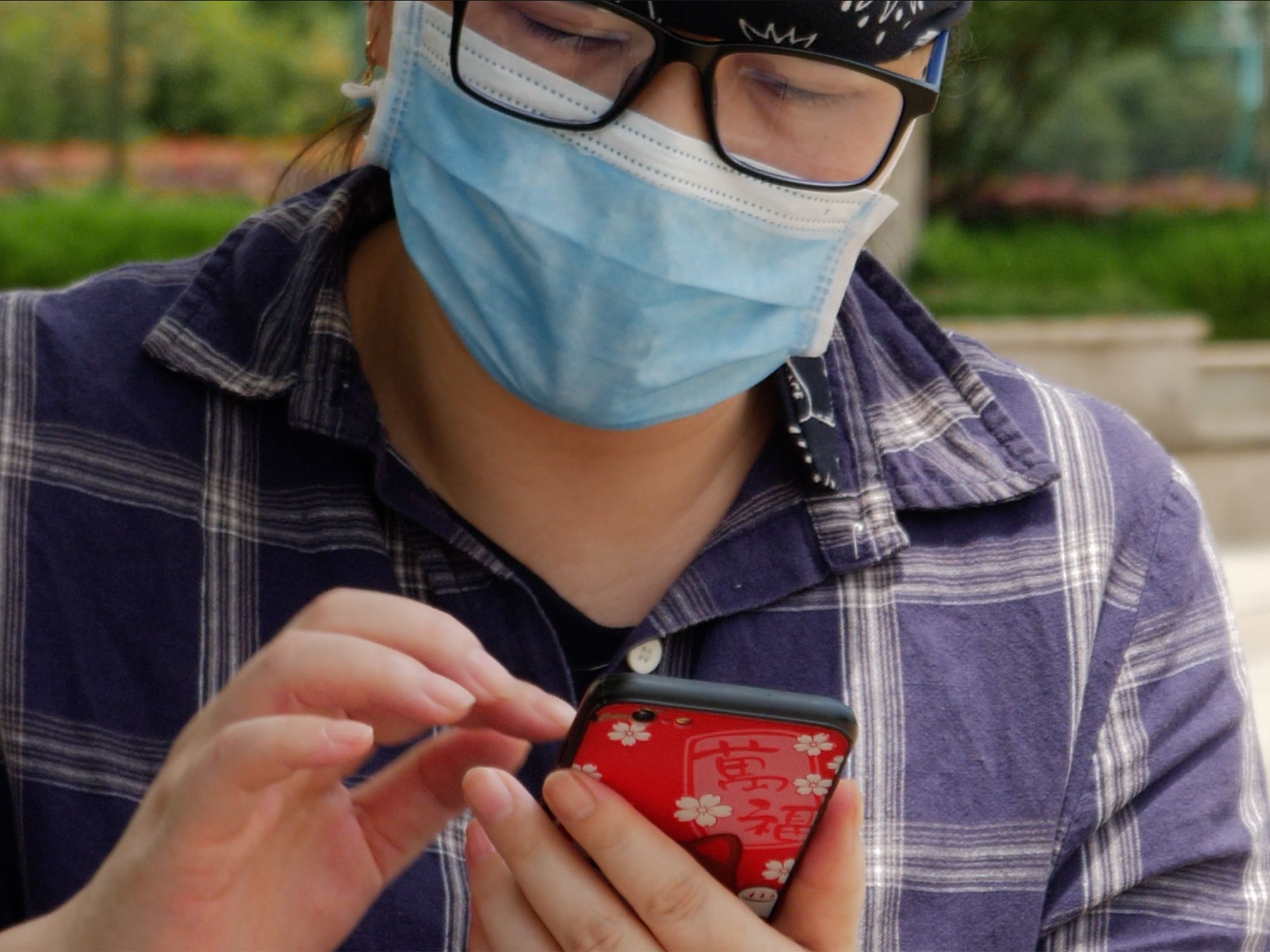
The family, fearing she would be unable to bear the news, allowed her to believe her son was still in quarantine. In the end, they could hide it no longer. “For several days my mum couldn’t fall asleep,” Ms Wang tells me. “A woman born before the founding of our country can’t understand why such a tragedy can happen in modern times.”
People wearing protective face masks wait to enter an Apple store on the first day of New South Wales' further eased coronavirus disease (COVID-19) restrictions in Sydney, Australia, July 1, 2020.
Australia's second largest city heads back into coronavirus lockdown
Colin Packham, Sonali Paul
SYDNEY/MELBOURNE (Reuters) - Lockdown measures were reimposed in Australia’s second biggest city on Tuesday, confining Melbourne residents to their homes unless undertaking essential business for six weeks, as officials scramble to to contain a coronavirus outbreak.
The decision, which affects around 4.9 million people, was announced just hours before the busy border between Victoria, of which Melbourne is the capital, and New South Wales is scheduled to close for the first time in a century.
From midnight on Wednesday, everyone in Melbourne will be required to stay home unless travelling to work, studying, shopping for food or attending medical appointments. Restaurants, cafes and bars will be able to provide takeaway service only, gyms and hair salons closed, household gatherings limited to two people and the current school vacation extended.
Victoria Premier Daniel Andrews said the restrictions were onerous but necessary.
“I would, with the greatest of respect, put it to you getting this virus and dying from it is very onerous too,” he said during a televised media conference.
Public housing residents decry 'lockup' as Australia contains COVID-19 threat
Victoria was responsible for 191 of the 199 new cases reported nationally on Tuesday, the biggest one-day rise since early April. The spike has worried officials, even though the national total of almost 8,800 cases and 106 deaths is far below many other countries.
“We have to be clear with each other that this is not over,” Andrews said. “And pretending that it is because we all want it to be over is not the answer. It is indeed part of the problem. A very big part of the problem.”
Andrews had over the weekend reinstated strict social-distancing orders in more than 30 Melbourne suburbs and put nine public housing towers into complete lockdown because of the recent outbreak. [L8N2EE06H]
Hundreds of police officers and army troops were being deployed to enforce the closure of Victoria’s border with New South Wales from midnight on Tuesday.
The state line is highly porous, stretching hundreds of kilometres. It is heavily used daily by commuters, school children and road freight.
People caught crossing the border without permission via any of the 55 roads, or several river and wilderness crossings, will face penalties including a fine of A$11,000 ($7,700) and six months imprisonment.
A second region in Victoria, where recent COVID-19 cases have been detected and which is home to 44,000 people, will face lockdown restrictions similar to Melbourne.
The border closure and reintroduction of restrictions in Melbourne deal a blow to Australia’s hopes for quick economic recovery as it approaches its first recession in nearly three decades, driven by social distancing restrictions imposed in March.
BORDER CONTROL
For businesses on the border, which last closed during the Spanish flu pandemic in 1919, it also poses an immediate logistics headache.
Daily travel permits will be granted to people who live in border towns and cities but with the closure just hours away, the application system was still being developed.
Kevin Mack, the mayor of Albury, a border town on the NSW side, said with an estimated 50,000 car movements across the state line every day “it will be a nightmare for everyone.”
“About a quarter of my staff like me live in NSW, and cross that border every day to come to work,” said Paul Armstrong, who runs a petrol station in Wodonga, a border town on the Victorian side. “I don’t know if they are going to be able to get in.”
Outside of the border towns, Victoria residents will be able to apply for a permit, but will need to prove a special need for their travel. Freight transporters will be free to cross the border without a permit, but will be subjected to random stops.
Public housing residents decry 'lockup' as Australia contains COVID-19 threat
Paulina Duran, Melanie Burton
SYDNEY/MELBOURNE (Reuters) - Emel Evcin first heard on a phone call with a friend that nearby COVID-19 cases had rendered her Melbourne apartment block quarantined, yet on checking through the curtains, she saw not medical staff but law enforcement.
“I looked outside from my window and no nurses, no cleaners, no food - just lots of cops,” the 42-year-old mother of two told Reuters by phone from her two-bedroom flat. “This is not a lockdown, this is a lockup.”
More than 3,000 public housing residents in nine high-rise blocks entered a fourth full day of lockdown on Tuesday following a surge in COVID-19 cases, as authorities in Australia’s most stricken city try to halt the infection for fear of it spreading rapidly in the densely populated buildings.
Melbourne is the capital of Victoria state, which on Tuesday reported its highest number of new infections at 191.
Victoria closed its border with New South Wales state from late Tuesday, contrasting with easing restrictions in the rest of the country, where new infections are largely confined to returned travellers quarantined in hotels.
Relatively loose social distancing protocols among security staff at such hotels in Melbourne is widely believed to have contributed to the latest spike.
At the Melbourne towers, access roads were taped up and playgrounds and sporting ovals closed, while dozens of police stood guard and helped distribute hampers and food packages delivered by charities, according to a Reuters witness.
Police said they have stationed two officers on every floor of each tower.
Amina Yussuf, an Australian citizen of Somali background living with her seven children in one of the towers said she was shocked and felt traumatised when police prevented her from leaving the building to shop for food for the week on Saturday.
“I told them I wasn’t going far but they wouldn’t let me,” Yussuf said. “It was really shocking, I was scared and very confused. I don’t now how to put it into words.”
Yussuf, Evcin and another resident all told Reuters they thought the situation could have been handled better, with more community consultation.
“This building is not suitable. There is not enough space, not enough ventilation, no fresh air, no sun,” said Evcin, an Australian citizen of Kurdish descent.
Such a sudden and concentrated lockdown, seen first in Chinese epicentre Wuhan, is unprecedented in Australia which prides itself on its civil liberties. It has sparked public outcry that the harshest measures have been applied to some of the city’s poorest residents.
Victoria state’s media spokesperson did not respond to a request for comment ahead of a public briefing.
The government previously said it could not give ample notice of the lockdown because of the urgency of the matter, comparing the tower blocks to “vertical cruise ships”.
Sue Cunningham, Red Cross director for the state of Victoria, said while the situation is very difficult for the police, such a heavy police presence is intimidating for anyone, let alone the towers’ demographic, which includes refugees.
Cunningham also said there had been a spike in calls for support from residents, some of whom said food items did not match their dietary needs.
Matt Tilley, from Food Bank Victoria, said the charity was well practiced in delivering hampers after a busy summer providing food to families affected by recent bush fires.
“We’ve got our packing lines working around the clock,” said Tilley. “It’s like a well oiled machine. I guess this year has given us a lot of practice.”
Australia’s 2nd largest city foils nation’s pandemic success
By ANDY BROWNBILL and ROD McGUIRK, July 7, 2020
MELBOURNE, Australia (AP) — Australia has been among the world’s most successful countries in containing its coronavirus outbreak — with one exception.
The southeastern state of Victoria had some of the nation’s toughest pandemic measures and was among the most reluctant to lift its restrictions when the worst of its outbreak seemed to have passed.
But as most of the country emerges from pandemic restrictions, the virus has resumed spreading at an alarming rate in Victoria’s capital, Melbourne. The city is buckling down with more extreme and divisive measures that have ignited anger and arguments over who is to blame.
Victoria Premier Daniel Andrews said Tuesday that the entire city and some of its surrounds will be locked down again from Wednesday night under tougher restrictions than were imposed during the first shutdown that started in March.
“We are in many respects in a more precarious, challenging and potentially tragic position now than we were some months ago,” Andrews said.
About 3,000 residents of nine public housing high-rise buildings were given just an hour’s notice at the weekend before being prohibited from leaving their apartments for at least five days.
“The amount of police officers makes us feel like we’re criminals,” said a resident of one of the buildings, Nada Osman. “It’s overwhelming. It’s scary. It’s like we’re caged in.”
Forty suburbs that are virus hot spots have been locked down by postal code since last week, with the result that businesses and households in some areas face restrictions while ones across the street from them do not.
“The line has to be drawn somewhere and I think most people can understand that,” Maria Iatrou, whose cafe is restricted to takeout because it is on the wrong side of a suburban border, said before the citywide lockdown was announced.
“But that doesn’t take away any of the frustration and disappointment associated with having to live with these restrictions again because we’re unlucky enough to belong to one of these post codes,” she said.
Victoria authorities had been praised for their aggressive testing and contact tracing. Melbourne researchers developed what they describe as the world’s first saliva test for the coronavirus, a less accurate but more comfortable diagnostic tool than nasal swabs, in an effort to encourage more people to agree to door-to-door testing.
It’s an extraordinary situation that raises questions about how Australia’s second-largest city fell so far behind the rest of the country.
The nation of 26 million people has recorded about 8,500 cases and only 106 deaths from COVID-19.
Most if not all the blame is being directed at lax controls at quarantine centers set up in two Melbourne hotels.
Australian citizens and permanent residents returning from overseas are required to spend 14 days in strict hotel quarantine. Genomic sequencing that identities which virus strains are circulating in specific clusters indicates the city’s expanding outbreak is emerging from hotel quarantine guards and guests.
Critics of the Victoria government blame a decision to use private security contractors to enforce the quarantine.
Sydney, Australia’s largest city, which in the early days of the pandemic had the country’s highest number of daily new cases, chose to use police and the military to provide hotel security, with greater apparent success.
Media reports have alleged security firms charged the Victoria government for hotel guards that were not provided and that guards had sex with quarantined hotel guests and allowed families to go between rooms to play cards.
The Victoria government has largely shut down public debate on what went wrong by appointing a retired judge to hold an inquiry. Government officials maintain it would not be appropriate to make public comment before the judge reports her findings on Sept. 25.
But the government acknowledged infection control failures and has changed its system. State prison workers now oversee hotel quarantine and international travelers are no longer allowed to land at Melbourne airport.
Premier Andrews has defended plans to employ grounded Qantas flight crews to work with the prison guards in the hotel quarantine against union complaints that the crews were offered little training.
“There are very few groups of people who take safety more seriously and know and understand safety protocols and dynamic environments and the need to always go by the book than those who work in our aviation sector,” Andrews said.
Catherine Bennett, an epidemiologist at Melbourne’s Deakin University, said the city could be having similar success as the rest of Australia in virtually eliminating community transmission if not for the hotel quarantine breaches that allowed security guards to bring the virus home to their suburbs.
“We’ve had multiple positive people take the virus home at the same time into extensive multi-household families just after Victoria had relaxed its restrictions,” said Bennett, who lives outside the 40 shutdown suburbs.
“Luck comes into it. You just need one person positive in a setting where it can take off to have a problem. That setting probably exists in cities all around Australia,” she said.
Victoria officials wonder how many of Melbourne’s residents will continue social distancing during their second lockdown as they see the rest of Australia lift restrictions.
Iatrou said the current lockdown has made a “massive difference” in earnings at her cafe in the suburb of Ascot Vale.
She welcomed the Melbourne-wide shutdown because it put her business back in competition with her competitors in previously unrestricted suburbs.
But time would tell whether business would return to the levels of the first nationwide lockdown.
“People are a lot more scared this time around,” Iatrou said.
If customers stayed away though fear of infection or they lacked income, she said: “There’ll be a lot more businesses closing their doors by the end of this.”
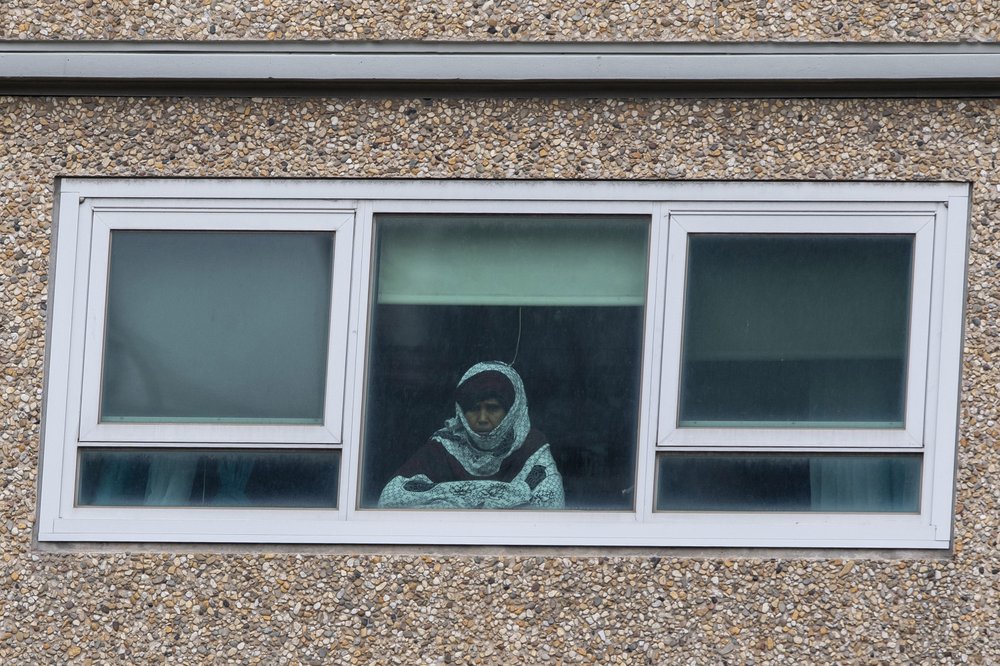
A woman looks out a window from a locked-down public housing tower in Melbourne, Monday, July 6, 2020. As Australia is emerging from pandemic restrictions, the Victoria state capital Melbourne is buckling down with more extreme and divisive measures that are causing anger and igniting arguments over who is to blame as the disease spreads again at an alarming rate.
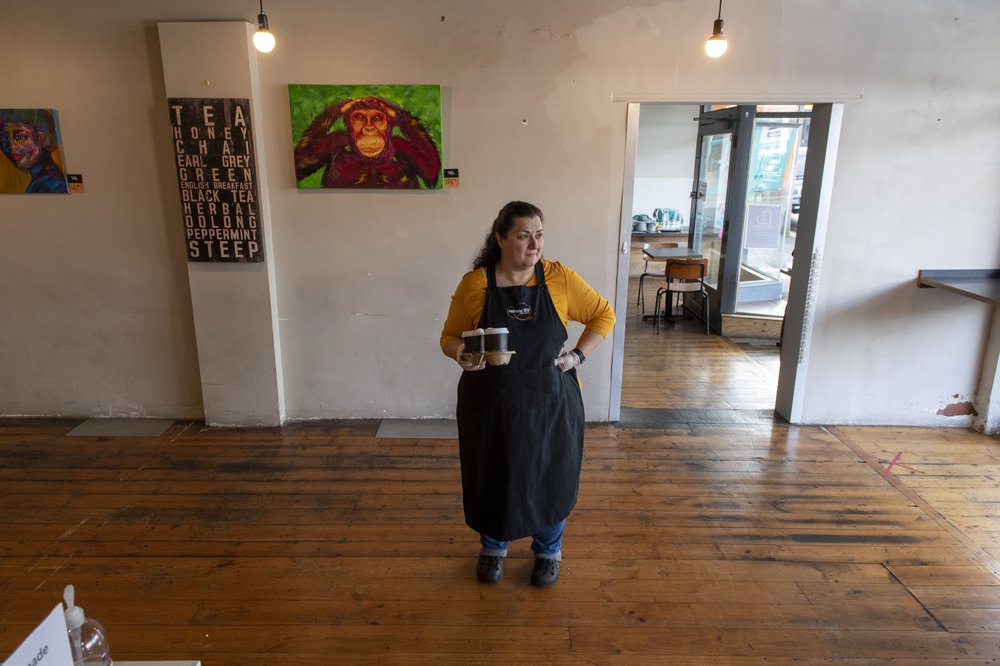
Cafe owner Maria Iatrou stands at her empty coffee shop in Melbourne, Monday, July 6, 2020.
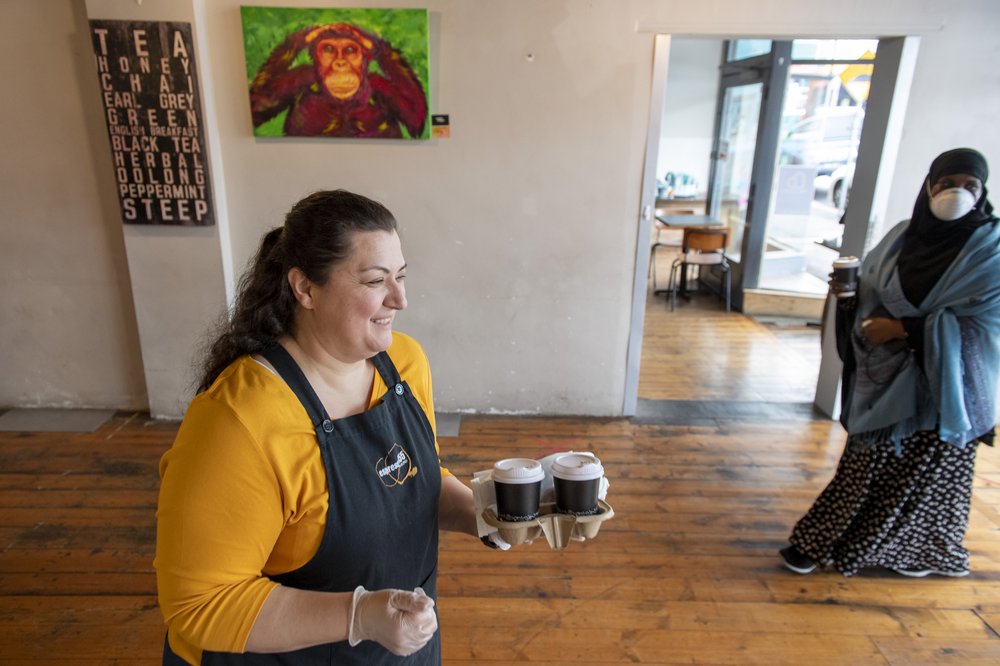
Cafe owner Maria Iatrou, left, serves take-away coffee to customers in Melbourne, Monday, July 6, 2020.
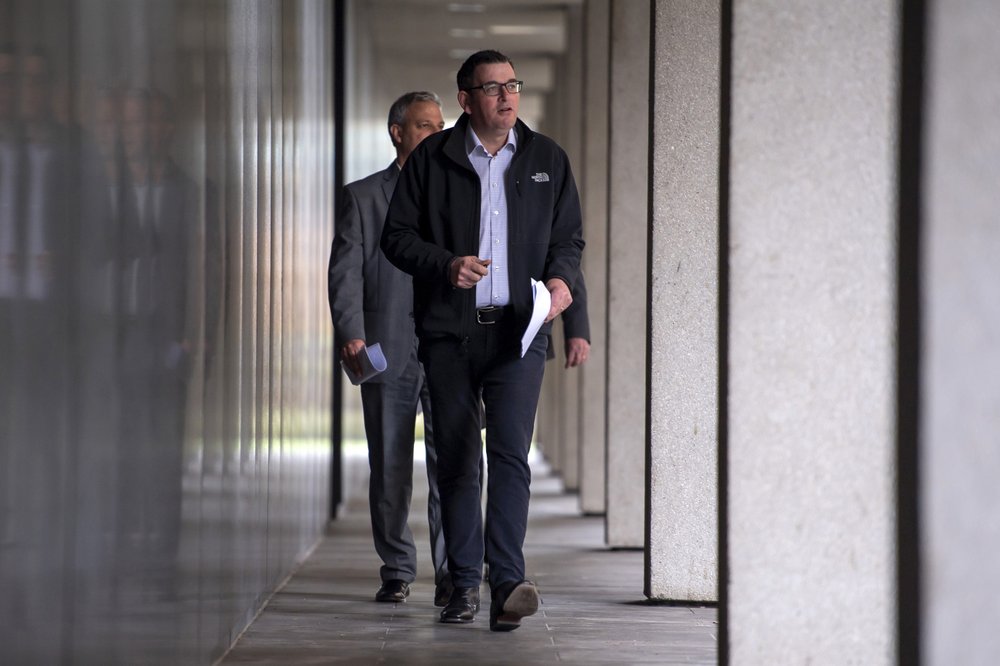
Victorian Premier Daniel Andrews walks to a press conference in Melbourne, Monday, July 6, 2020.
How Much Money Americans Actually Make
NYT, By Lora Kelley and Gus Wezerek, July 2, 2020
How much money do you make?
It’s generally a taboo question. Yet the answer determines so much about our everyday lives and the opportunities available to ourselves and our children.
One conclusion of our Times Opinion series “The America We Need” is perhaps an obvious one: Higher wages — and better benefits — would go a long way to reducing economic inequality. To further that discussion in a less abstract way, we asked Times readers to tell us what they earned in 2019 and whether they thought they were fairly compensated.
Over 1,100 people responded, volunteering to share details of their compensation. They included banking executives in the “one percent,” workers at nonprofits who say they are compensated in nonmonetary personal “fulfillment” and a cashier who longs for a $15 minimum wage. An Uber driver reported that a majority of his earnings were swallowed up by Uber’s commissions and by car upkeep. Dozens of medical residents wrote in telling us they were undercompensated for 80-hour weeks of specialized work.
Bank teller, $25,620
Social media manager, $70,000
Hospital chaplain, $54,500
Librarian, $71,000
Product manager, $120,000
Cook, $24,000
I.T. manager, $179,000
Bank analyst, $70,000
Software engineer, $131,000
Line leader, $42,000
Restaurant manager, $75,000
Camera technician, $30,000
Vocational counselor, $26,000
Dentist, $152,000
Teacher, $80,534
Lawyer, $17,000
Packaging designer, $80,000
Electrical engineer, $90,000
Medical assistant, $19,000
Organizer, $38,000
Surgical resident, $56,000
Speech pathologist, $65,000
Chief financial officer, $185,000
Admissions officer, $49,000
Reporter, $38,000
Drug prevention counselor, $62,000
Architect, $64,000
Financial administrator, $84,000
Museum director, $60,000
Behavioral scientist, $137,000
Construction supervisor, $120,000
Note: Excluding workers in prisons, elderly homes and some members of the military. Includes overtime, tips, commissions and bonuses.·Source: New York Times analysis of 2019 Current Population Survey data from the Center for Economic and Policy Research
Here’s the wage distribution in the United States across different age groups.
Here’s where some readers who responded fit on the chart, including a young software developer who made $131,000 and a 69-year-old vocational counselor who earned $26,000.
Many people felt they were paid too little, and a smaller number felt they were paid too much. But, across sectors, locations, age and income, respondents overwhelmingly said it was hard for them to know whether their compensation was normal or fair. They said that having transparency around pay with their peers could change that. Particularly for female and minority workers, who are too often subject to pay discrimination, not knowing what other people earn makes it harder to feel confident that they’re being treated fairly.
We spoke with dozens of the respondents, whose pay last year ranged from $24,000 to $415,000. In their own words, here are 19 of the readers who shared their salaries and how they felt about them.
All photos were taken by the subjects or people close to them. These accounts, drawn from interviews and submissions, have been edited and condensed. All salaries are self-reported.
Alexandra Parrish made $25,620
She is 27 and works as a bank teller in Missoula, Mont.
When people hear you work in a bank they think you must be set, because they think of Wall Street and big firms and huge companies. But the reality is the actual day-to-day lobby workers really aren’t paid any more than someone who works flipping burgers.
I know it’s a smaller bank, so I wasn’t expecting to make the big bucks. But I was a little surprised to be paid only $12.50 an hour. A bank teller holds a very important position within any financial institution. The country needs a minimum wage of $15. I live in a part of the country where the cost of living is rising every year. Living here for the last eight years I have watched housing prices steadily climb and wages stay stagnant.
I was told growing up to go to college to get a good job. I followed that path. And now I feel a little bit lied to. After graduating I thought that working at a bank would be a huge step up from the grocery store gig I had for three years. You would think that a bank would be a great place to work.
Kerisha Harris made $70,000
She is 37 and lives in Avon, Conn. She works as a social media manager.
I do not think I am compensated fairly for my current role. My current compensation is based on my prior compensation, and I think that automatically puts me behind. I have three kids so I’ve taken time off for their births. Salary history is disproportionately unfair to women, especially women of color, and to working mothers especially. I am all three. Basing salaries on my salary history puts me at a perpetual disadvantage. When employers base compensation on prior salary, which is often already too low, especially for marginalized folks, there’s so much not taken into consideration.
Workers should be able to advocate for what they deserve based on their expertise and experience and all that their job will entail, not their prior salaries. I would like to see a change in the secrecy around compensation. If we don’t start talking about it, nothing will change.
Kristel Clayville, 42
Hospital chaplain in Chicago
$54,500
I get a lot of meaning out of my work, and I think the general economy sometimes thinks that being paid in meaning is sufficient to complement actual salary in ways that don’t help you pay your rent or your mortgage. I think care work is often undervalued and desperately needed.
Danny Gillane, 55
Librarian in Lafayette, La.
$71,000
I have a relatively low-stress job. I’ve been doing this for a long time, and I can afford cheese. My wife and I joke that if I can afford going to a grocery store to buy a wedge of cheese, I’m happy.
David Sexton made $415,000
He is 50 and lives in Newton, Mass. He works as a senior director at a biotechnology company.
My compensation is fair, probably a bit more than fair. There is a scarcity of people in the field who are capable of doing the work, and it’s extremely well compensated. I work on analyzing DNA sequence samples.
I would love it if companies reported on compensation through their entire employee class and not just for the executive management, either through their filings with the S.E.C. or in some other ways with the labor relations board. Traditionally undercompensated people would benefit greatly from that transparency. Workers in general would benefit. I also think it is extremely important to take health care out of compensation. That’s a very bad thing.
Lynn Zhang made $48,000
She is 28 and works as a server and sommelier in Maui, Hawaii.
We all get paid minimum wage, and a lot of my total income last year came from tips. The guest always chooses how much they tip, and tips are largely governed by the guest’s perception of their server. I don’t think that everyone gets tipped the same, but you can’t really tell guests that they’re treating you a way that they shouldn’t or that’s not fair. As a woman of color, I feel that I have to work harder to rebut guests’ perceptions of what I deserve whereas my mostly male, white counterparts do not.
Even though I am a certified sommelier, I feel like I have to push or find strategies to get guests to see me as someone who’s highly knowledgeable about the menu and our wine list. People are more likely to pass over me and ask for someone else. That’s sometimes reflected in my tips. I’m not sure how I could effect changes in my tips. But it just seems like it’s not fair that I have to work harder for the same thing.
Carol Canode, 64
School custodian in Columbus, Ohio
$47,311
I've been with the school district for almost 24 years. I started around $10 an hour back in 1996. I earn a very fair salary. There are other school districts that pay more, but I own my own home and I can take care of myself. Unions are so important for employees to have power and work with employers for fair compensation. We fought very hard to get those unions.
Mark Schettler, 34
Bar manager in New Orleans
$67,000
Coronavirus has changed everything for the nightlife industry. I think I was fairly compensated before. But I don't know if it's necessarily possible to have fair compensation within our industry right now.
Hannah Baptiste made $120,000
She is 29 and lives in Greensboro, N.C. She works as a product manager at a software company.
I work for a software development consultancy called Truss. I am a senior product manager there. I just started less than a month ago. At my previous company I was doing the same job as people with titles that were below mine and people whose titles were above mine. It was a startup and it was like, move fast and break things and worry about everything later. That can lead to resentment. It’s not healthy emotionally or mentally to work in an environment where you’re always wondering whether you’re being valued. And when there’s transparency, you’re not wondering.
Where I work now, there is transparency around everyone’s salary. My new base salary there is $145,000. There are pay bands for every level, and my boss told me exactly how they came up with the pay bands. I think that employees benefit the most from that level of transparency. It helps lead to a really good company culture that’s not toxic.
I’m being paid fairly. And I feel very blessed. The fact that I make more money than most people in this country frankly is not something I ever want to lose sight of. I would love to make more money so that I could support more people in my family, and so I could support more people in my community.
Ronald Gizzi, 63
Senior counsel at an energy company
$300,000
I would like my compensation to reflect the value I bring to the organization. It’s hard to know whether I’m compensated fairly for my work because of the lack of transparency with respect to compensation. It’s not talked about. I do not know what my colleagues earn.
Amanda Hanzlik, 30
Cook in Minneapolis
$24,000
I’m paid much better than many people who work in food service. I receive tips, which is not common for many who work in kitchens. I’m going back to work next week, but I’ve been getting federal unemployment during the pandemic. I’m making more money now than I ever have.
Fernando Javier Rodriguez, 40
I.T. manager in Manhattan
$179,000
I moved here from Argentina. There was a learning curve. One thing I learned is that the same position in different cities is completely different, because the cost of living is so different. I was working for some time in Ohio. When I got the notification that it was going to be moved to New York, they gave me a $30,000 increase.
Jo Anne Fordham, 66
Writer and writing coordinator
$50,000
Compensation has two sides to it: One is recognition for the work you do, and the other is actual money. I live in the Deep South, and it’s impossible to fix my broken central air-conditioning on my salary.
Yishu Dai made $70,000
She is 24 and lives in Brooklyn. She works as an analyst at a bank.
My salary is competitive within my industry given my years of experience, but I sometimes feel overcompensated for what I do compared to those who do more difficult jobs like sanitation work.
My salary was determined, in part, by salary negotiation. Not every industry provides that kind of leverage for workers. My mother, for instance, does caregiving. And I don’t think salary negotiation is a thing. There are so many jobs that are either physically demanding or psychologically demanding that really don’t give the same type of benefit of negotiation to people applying.
When I was applying for my current job, I applied with several employers. They all gave different salary numbers, and that helped me figure out what range would be reasonable and competitive for me to ask for. The ability to talk about salaries and negotiation is very valuable for employees. Transparency would help workers be aware of what they could demand.
Hugo Walker made $28,500
He is 60 and works as a grocery store maintenance person in Lexington, Ky.
I work the closing shift at a Whole Foods. Sweeping, changing trash, cleaning the bathrooms, cleaning up spills and that sort of thing. I had to apply numerous times for this job. I guess they’re pretty selective. Last month I was the employee of the month, and that was pretty exciting. I enjoy working here. It’s a great crew of people who work really hard.
I’ve been working here for just over a year. I started off with the wage of $15 an hour. After a year working here, I was able to get another dollar an hour. So I’m making $16 now. I was really happy because that helped toward the rent increases I’ve had in the past few years. We’re not getting our hazard pay anymore. That was great while it lasted.
I still pay at least 50 percent of my take-home pay for my apartment every month, and that’s before my utility bills. I’m definitely not starving. But at the same time I’m not able to save a whole lot of money. I’ve never owned a home. My take-home pay isn’t enough to qualify for a mortgage, and home prices are going up, up, up around here. I think local cost of living should be a contributing factor not just in starting rates but also annual pay increases.
Richard Falzone, 25
Line leader at a plastics company in Boston
$42,000
I’d like to see collective ownership. I am generally in favor of lower-level people getting stocks and things. I think that’s a really good way to incentivize good work and treat people fairly.
Gaby Mlynarczyk, 52
Bartender and restaurant manager in Los Angeles
$75,000
In general men get paid more than women in my industry. It’s humiliating to get backlash when you ask your boss for an extra 50 cents or dollar per hour for the job that you do. I think sharing the profits with workers would make workers feel valued and give them a certain amount of ownership.
Jay Highfill made $236,000
He is 60 and lives in Overland Park, Kan. He works as a senior director at a consulting firm.
I make more money than I ever thought I’d make. The only real issue I have with my pay is that I have to accept the risk that comes with that reward. I’m in a job that is at high risk of being turned over. I’ve been unemployed four times. Another reason for the higher pay is that it’s hard work, and you’re away from your family for most of the week. I travel to my clients four days a week about 45 to 48 weeks a year.
I’m a work force consultant. Employers might disagree with me, but I think transparency actually benefits employers more than the employees. I’m not convinced employees will make more money with transparency. But with transparency employers are really forced to administer their wages in a compliant manner, in an honest way, and think about how they want to administer pay.
Sivan Mehta made $131,000
He is 25 and works as a software engineer in Seattle.
I think I am compensated very well. I am paid fairly relative to my immediate peers, and I think I have an about average salary for someone with three years of experience as a software engineer in Seattle.
In general, I would prefer salary ranges to be public for all roles. That would make it easier for people, especially those in historically disadvantaged negotiating scenarios, to negotiate higher salaries. As a man who graduated without debt from an expensive private school, I have all of the power in the world in negotiating my salary. But I recognize that’s not the case for everyone. People who don’t have the same privileges as me don’t have nearly the same set of opportunities. I don’t think there’s any reason for companies to hide compensation data unless they want to take away leverage power from workers.
Rescue workers are seen at the site where a bus carrying students plunged into a reservoir, in Anshun, Guizhou province, China July 7, 2020.
Toll rises from rain storms in China as student bus plunges into reservoir
SHANGHAI (Reuters) - A bus carrying high school students plunged into a reservoir on in southwest China on Tuesday, as days of torrential rain triggered flood warnings across large parts of the country and disrupted the first day of national college exams.
In the central city of Wuhan, where the coronavirus epidemic first erupted in December, a record-breaking 426 millimetres (16.8 inches) of rain fell on Sunday, the official China Daily reported, and authorities were using giant pumps to remove water from the flooded roads.
State broadcaster CCTV said the students on a bus that crashed into a reservoir in the city of Anshun in southwestern Guizhou province had been on their way to sit the college entry exams. The number of casualties had still to be confirmed.
But as of last Friday, there were 119 people dead or missing nationwide as a result of the rains storms, while the emergency ministry estimated economic losses to be in excess of 40 billion yuan ($5.70 billion).
Guizhou, Anhui, Hunan and Hubei provinces were expected to record 250-280 millimetres (10-11 inches) on Tuesday, according to the China Meteorological Administration.
With nearly 11 million students set to sit their college exams, the weather agency warned parents to heed forecasts and prepare school journeys carefully.
Exams in some parts of Anhui province were postponed as a result of the worst flooding for 50 years, the local government reported.
The city of Qianjiang in the central province of Hubei became the first city to issue a Level I flood response alert on Monday after roads and farmland were inundated.
Authorities in Hubei and neighbouring Hunan province have also issued orange flood alerts - the second highest - with some rivers 2-3 metres higher than warning levels, according to water ministry data.
($1 = 7.0207 yuan)
Local residents are rescued by Japan Self-Defense Force soldiers using a rubber boat on a flooded road, caused by heavy rain in Omuta, Fukuoka prefecture, southern Japan July 7, 2020 in this photo taken by Kyodo.
Japan boosts rescue efforts as it warns of more rain in flood-hit areas
TOKYO (Reuters) - Japan on Tuesday warned of more heavy rain on the southwestern island of Kyushu and bolstered rescue operations as the death toll in flood-hit areas reached at least 50 and about a dozen people were reported missing.
The government said it would double rescue and relief personnel as heavy rain destroyed homes and caused landslides in what is shaping up to be Japan’s worst natural disaster since Typhoon Hagibis killed 90 people in October.
“The rain front is expected to remain until the ninth (of July), and rain is expected over a wide front stretching from western to eastern Japan,” Chief Cabinet Secretary Yoshihide Suga told a regular press briefing.
Police, Self-Defense Force and Coast Guard units are carrying out search and rescue efforts, said Suga, urging people to take the necessary precautions to keep safe.
Images aired by public broadcaster NHK showed swollen rivers, destroyed homes and roads covered in landslides.
Kyodo News reported 71 landslides across 12 prefectures, citing the land ministry, and said more than 1.3 million people had been ordered to evacuate.
Prime Minister Shinzo Abe said the government would double rescue and relief personnel, from day-earlier levels, to 80,000.
Some companies in the region have temporarily halted operations but Suga said he did not expect major disruptions to supply chains, as happened two years ago when deadly floods also hit Kyushu.
The government will continue to liaise with local firms, Suga said, adding: “We want to quickly take the necessary steps such as support for small and mid-sized firms depending on the situation ahead.”
Carmakers Toyota Motor and Mazda Motor, and electronics conglomerate Panasonic Corp all halted operations at certain plants on Monday due to heavy rains.
Mazda resumed work at its Hiroshima and Hofu plants on Tuesday and Panasonic said its sensor plant in Kagoshima was operating normally on Tuesday.
Toyota said it would keep all three of its Kyushu plants closed on Tuesday after halting production the previous evening for safety reasons.
Death toll from flooding in Japan reaches 55, dozen missing
By MARI YAMAGUCHI, July 7, 2020
TOKYO (AP) — Soldiers used boats to rescue residents as floodwaters flowed down streets in southern Japanese towns hit by heavy rains that were expanding across the region on Tuesday. At least 55 people have died and a dozen remain missing.
Pounding rain since late Friday in the southern region of Kyushu has triggered widespread flooding. More rain was predicted in Kyushu and the western half of Japan’s main island of Honshu as the rain front moved east.
In Fukuoka, on the northern part of Kyushu, soldiers waded through knee-high water pulling a boat carrying a mother, her 2-month-old baby and two other residents.
“Good job!” one of the soldiers said as he held the baby up to his chest while the mother got off the boat, Asahi video showed. Several children wearing orange life vests over their wet T-shirts arrived on another boat.
An older woman told public broadcaster NHK that she started walking down the road to evacuate, but floodwater rose quickly to her neck. Another woman said, “I was almost washed away and had to grab a electrical pole.”
The Fire and Disaster Management Agency said 49 victims were from riverside towns in Kumamoto prefecture. Another victim was a woman in her 80s found inside her flooded home in another prefecture.
About 3 million residents were advised to evacuate across Kyushu, Japan’s third-largest island.
Tens of thousands of army troops, police and other rescue workers mobilized from around the country worked their way through mud and debris in the hardest-hit riverside towns along the Kuma River. Rescue operations have been hampered by the floodwater and continuing harsh weather.
Japan is at high risk of heavy rain in early summer when wet and warm air from the East China Sea flows into a seasonal rain front above the country. In July 2018, more than 200 people, about half of them in Hiroshima, died from heavy rain and flooding in southwestern Japan.
In Kuma village in Kumamoto prefecture, dozens of residents took shelter under a roofed structure in a park with no walls or floor. They sat on blue tarps spread on the dirt ground, with no partitions. The village office’s electricity and communications had been cut.
Among the fatalities were 14 residents of a nursing home next to the Kuma River, known as the “raging river” because it is joined by another river just upstream and is prone to flooding. Its embankment collapsed, letting water gush into the nursing home.
A man walks on heavily damaged road following a heavy rain in Kumamura, Kumamoto prefecture, southern Japan Monday, July 6, 2020. Rescue operations continued and rain threatened wider areas of the main island of Kyushu.
Japan Ground Self-Defense Force search missing persons at the site of a mudslide in Tsunagi town, Kumamoto prefecture, southwestern Japan, Tuesday, July 7, 2020. Floodwaters flowed down streets in southwestern Japanese towns hit by deadly rains that were expanding across the region Tuesday.
Japan Self Defense Force members rescue residents on a boat on a flooded road hit by heavy rain in Omuta, Fukuoka prefecture, southern Japan Tuesday, July 7, 2020.
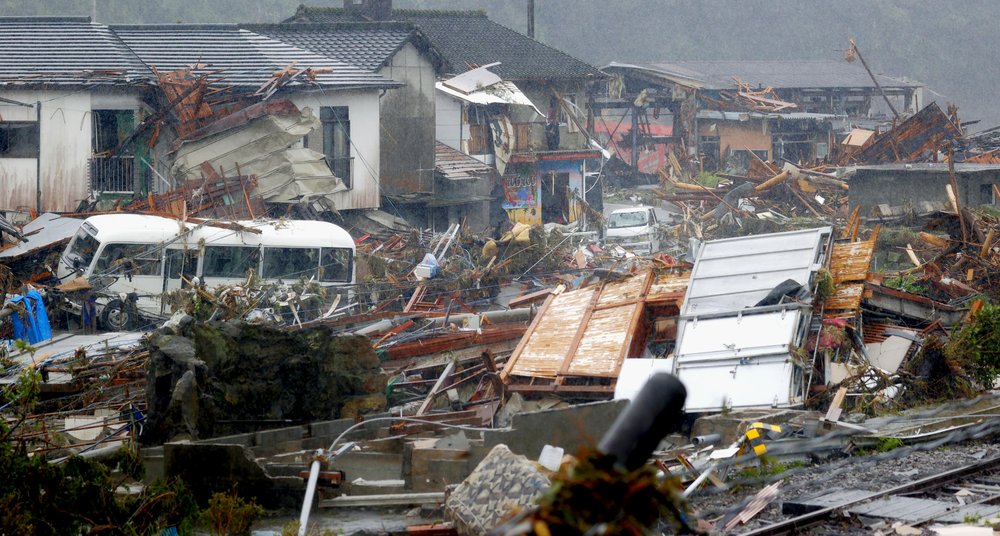
Debris is scattered at a residential area hit by heavy rain in Kumamura, Kumamoto prefecture, southern Japan Tuesday, July 7, 2020.
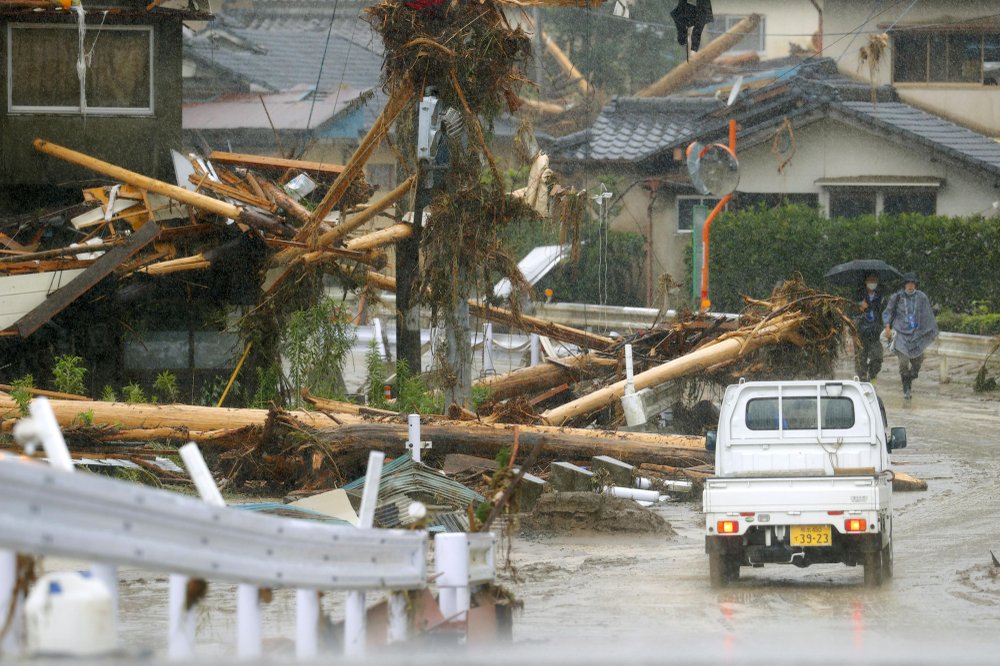
Debris are seen on a residential area hit by heavy rain in Kumamura, Kumamoto prefecture, southern Japan Tuesday, July 7, 2020.
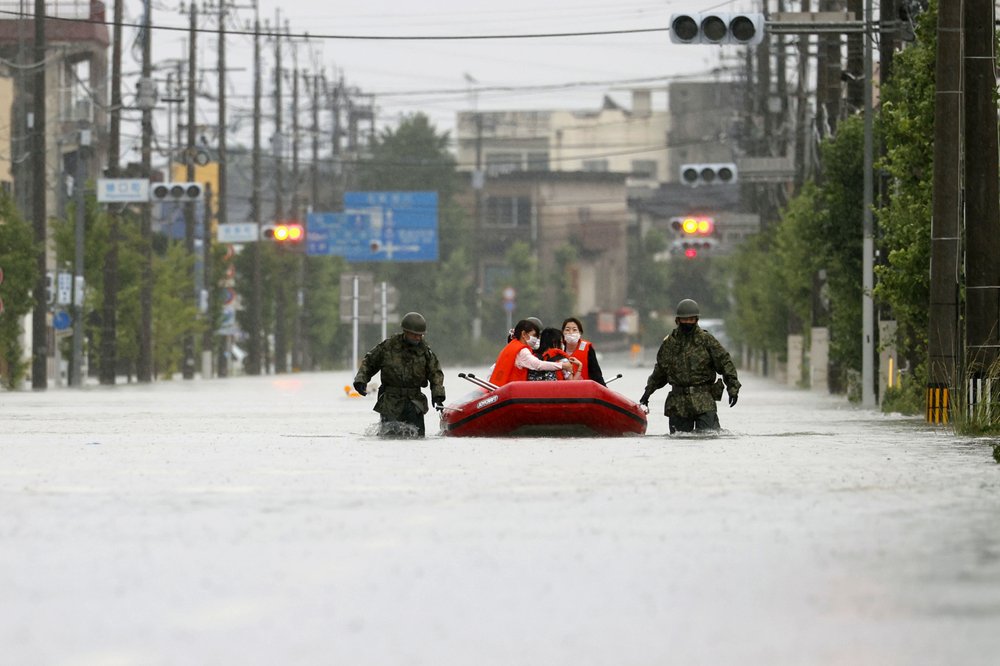
Japan Self Defense Force members rescue residents on a rubber boat on a flooded road hit by heavy rain in Omuta, Fukuoka prefecture, southern Japan Tuesday, July 7, 2020.
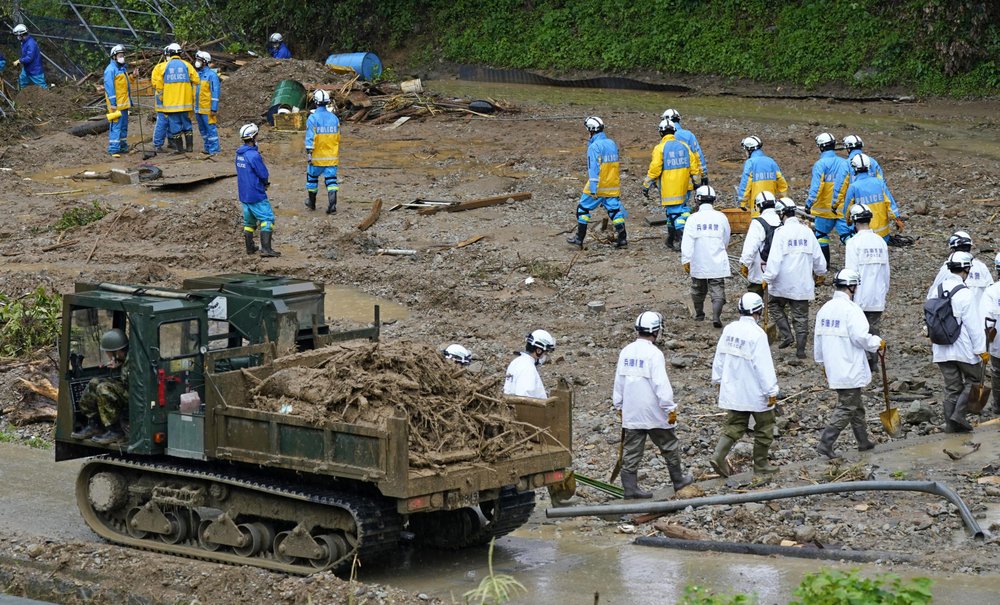
Police officers continue a search operation for missing persons at the site of a mudslide in Tsunagi town, Kumamoto prefecture, southwestern Japan, Tuesday, July 7, 2020. Floodwaters flowed down streets in southwestern Japanese towns hit by deadly rains that were expanding across the region Tuesday.
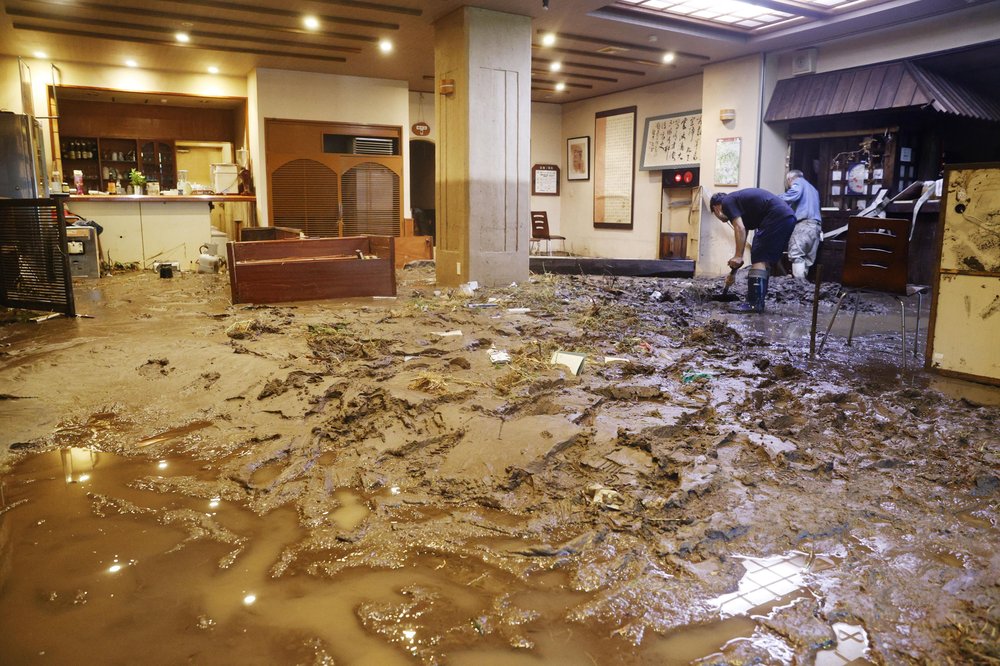
The lobby of a hot-spring hotel is covered with mud after flooding caused by heavy rain in Hita city, Oita prefecture, southwestern Japan, Tuesday, July 7, 2020.
A person walks past a banner showing North Korean and U.S. flags ahead of the North Korea-U.S. summit in Hanoi, Vietnam, February 25, 2019.
U.S. envoy arrives in S.Korea as North Korea rejects talks
Hyonhee Shin
SEOUL (Reuters) - A U.S. envoy arrived in South Korea on Tuesday in an effort to renew stalled nuclear talks with North Korea, hours after it issued a statement saying it has no intention of sitting down with the United States and told South Korea to “stop meddling”.
U.S. Deputy Secretary of State Stephen Biegun, who has led working-level talks with the North Koreans, landed at a U.S. military base south of Seoul, media reported, and was due to meet South Korean officials on Wednesday and Thursday.
Earlier on Tuesday, Kwon Jong Gun, director general for U.S. affairs at North Korea’s foreign ministry, accused South Korea of misinterpreting a North Korean statement dismissing an “untimely rumour” about another summit between North Korean leader Kim Jong Un and U.S. President Donald Trump.
North Korea said on Saturday it did not feel the need for a new summit, days after South Korean President Moon Jae-in, who had offered to mediate between Kim and Trump, suggested the two leaders meet again before the U.S. elections in November.
“It is just the time for (South Korea) to stop meddling in others’ affairs but it seems there is no cure or prescription for its bad habit,” Kwon said in a statement carried by the North’s official KCNA news agency.
“Explicitly speaking once again, we have no intention to sit face to face with the United States.”
Trump and Kim met for the first time in 2018 in Singapore, raising hopes for a negotiated end to North Korea’s nuclear programme. But their second summit, in 2019 in Vietnam, and subsequent working-level negotiations fell apart.
Yang Moo-jin, a professor at the University of North Korean Studies in Seoul, said Kwon’s statement reflected lingering inter-Korean tension and North Korea’s view that nuclear issues should be discussed only with the United States.
“It also suggested that North Koreans would ditch the past concept of negotiations where the South played a broker role, and won’t return to the table without major U.S. concessions,” Yang said.
Biegun said last week there was time for both sides to re-engage and “make substantial progress” but the novel coronavirus pandemic would make an in-person summit difficult before the U.S. presidential elections on Nov. 3.
The coronavirus complicated Biegun’s visit in a more personal way as well.
A newspaper reported that because of the outbreak, the envoy would not be visiting a Korean chicken soup restaurant that has been a regular stop on previous visits, and instead had arranged for the dish to be prepared at the U.S. ambassador’s residence.
Last month, North Korea abruptly raised tensions with South Korea and blew up a joint liaison office, just on its side of the border, before just as suddenly suspending plans for unspecified military actions.
Comments
Post a Comment