Derek Chauvin, 44, was charged with murder/manslaughter of George Floyd..."Am I next?"...5,200 German companies operate in China, employing more than 1 million people...
Good morning, it's 4:13 a.m. KST/8:13 p.m. GMT previous night, Saturday, May 30, 2020.














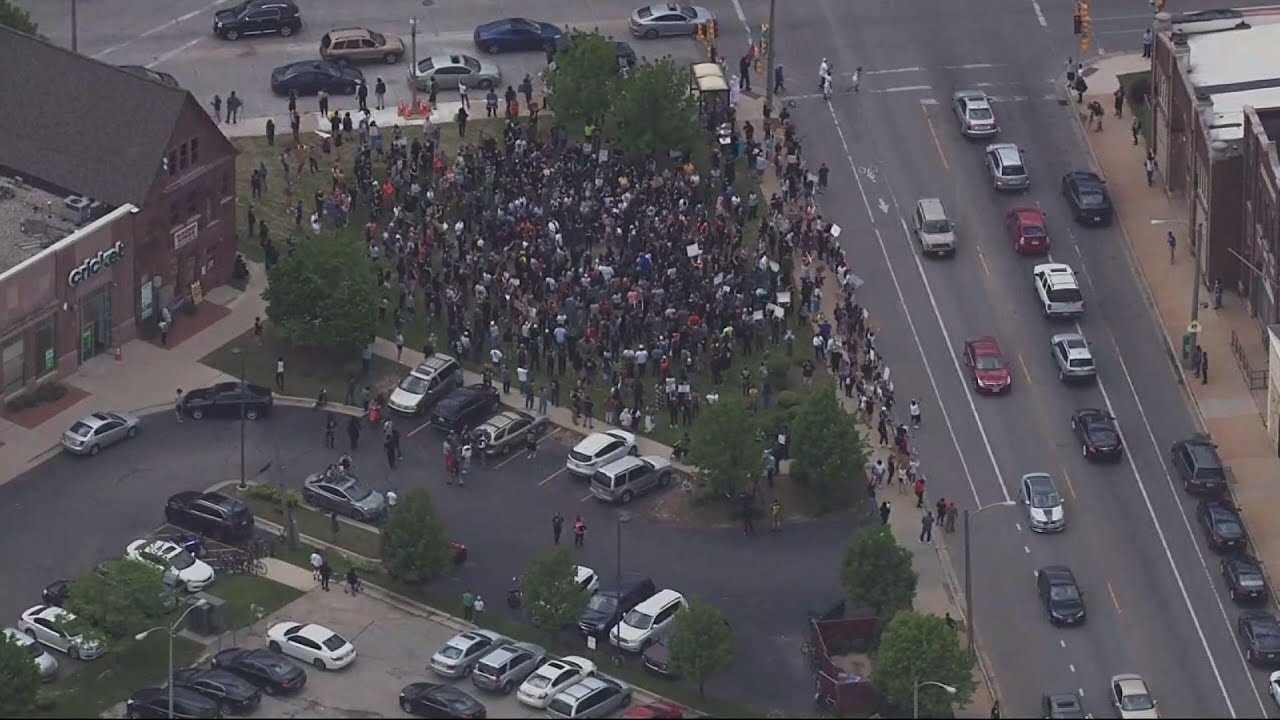












At KBO last night, Dinos (17-4) lost to Lions (9-13) 4:5, Giants (10-11) lost to Bears (13-8) 2:4, Twins (15-6) defeated Tigers (11-11) 6:2, Wiz (9-12) lost to Heroes (11-11) 1:5 and Eagles (7-15) lost Wyverns (5-16) 6:8.
(6:36 a.m. KST/10.36 p.m. GMT) Just returned home after two rounds of walk at Onam Lake Park (one round is 3,400 metres). Ice giants: Uranus는 천왕성, Neptune은 해왕성, Pluto는 명왕성입니다. It's a great feeling after four rounds of walk in two days (Friday & Saturday).
(10:54 a.m. KST/12:54 a.m. GMT) Woke up from 2~3 hour sleep.
Hi, again. It's 2:35 a.m. KST/6:35 p.m. GMT previous night, Sunday, May 31, 2020. For coronavirus cases, there are 6,051,665 with 368,667 deaths. Top 20 nations are U.S. 1,803,766, Brazil 469,510, Russia 396,575, Spain 286,308, U.K. 272,626, Italy 232,664, France 186,924, Germany 183,149, India 181,775, Turkey 162,120, Iran 148,950, Peru 148,285, Chile 94,858, Canada 90,161, China 89,564, Mexico 84,627, Saudi Arabia 83,384, Pakistan 66,457, Belgium 58,186 and Qatar 55,262.
The Latest: South Korea has 39 new cases
The Latest on the coronavirus pandemic. The new coronavirus causes mild or moderate symptoms for most people. For some, especially older adults and people with existing health problems, it can cause more severe illness or death.
TOP OF THE HOUR:
— Two United Nations peacekeepers serving in Mali have died of COVID-19.
— New Orleans likely to reopen more slowly than rest of Louisiana.
— Russian government acknowledges deaths of likely COVID-19 victims.
— New York City to begin reopening on June 8, governor says.
___
SEOUL, South Korea -- South Korea reported 39 new cases of the coronavirus, most of them in the densely populated Seoul metropolitan area, where officials have found more than a hundred infections linked to warehouse workers.
Figures from South Korea’s Centers for Disease Control and Prevention on Saturday brought national totals to 11,441 cases and 269 deaths. At least 12 of the new cases were linked to international arrivals.
KCDC director Jeong Eun-kyeong said during a virus briefing Friday afternoon that at least 102 infections have been linked to workers at a massive warehouse operated by Coupang, a local e-commerce giant that has seen orders spike during the epidemic.
The company has been criticized for failing to implement proper preventive measures and enforce distance between employees, with virus discovered on the safety helmets, laptops, keyboards and other equipment they share.
Health workers have also found at least 266 infections linked to nightclubs and other entertainment venues in the Seoul metropolitan area, which saw huge crowds in early May as officials eased social distancing guidelines.
The resurgence in infections have alarmed officials as millions of children have been returning to schools nationwide.
While shutting nightspots and public spaces to slow the spread of the virus, government officials have so far maintained the phased reopening of schools, expressing hope that the recent transmissions could be contained quickly.
___
BEIJING — China reported four new confirmed cases of coronavirus on Saturday, all brought from outside the country and no new deaths.
Just 63 people remained in treatment and another 401 were under isolation and monitoring for showing signs of having the virus or of testing positive for it without showing any symptoms.
China has reported a total of 4,634 deaths among 82,999 cases since the virus was first detected in the central Chinese industrial city of Wuhan. Although virtually everyone still wears masks in public, most offices, shops and restaurants have re-opened, although the economic fallout from months of lockdown in most of the country have left millions unemployed and, combined with a worsening trade dispute with the U.S. and drop in global demand, it remains unclear how many jobs will return.
___
Health officials said Friday that they were seeking to “inform mass numbers of unknown people” after a person who attended crowded pool parties over Memorial Day weekend at Missouri’s Lake of the Ozarks tested positive for COVID-19.
Camden County Health Department said in a release that the resident of Boone County in mid-Missouri tested positive on Sunday after arriving at the lake area a day earlier. Officials said there have been no reported cases of the virus linked to coronavirus in residents of Camden County, where the parties seen in videos and photos posted on social media took place.
Because “mass numbers of unknown people” need to be notified, the officials released a brief timeline of the person’s whereabouts last weekend, including stops at a bar called Backwater Jacks, a bar and restaurant that has a pool, as well as a dining and pool venue called Shady Gators and Lazy Gators.
Backwater Jacks owner Gary Prewitt said previously in a statement that no laws were broken, though the images appeared to show people violating Republican Gov. Mike Parson’s state order requiring social distancing.
Parson allowed businesses and attractions to reopen May 4, but the state order requires 6-foot (2-meter) social distancing through at least the end of May.
___
UNITED NATIONS — The United Nations secretary-general has announced the deaths of two U.N. peacekeepers from COVID-19.
Antonio Guterres made the announcement at a ceremony Friday, which is the International Day of U.N. Peacekeepers, saying both peacekeepers were serving in Mali. The U.N. said one was from Cambodia and the other from El Salvador.
Guterres said the COVID-19 pandemic has changed almost everything, but not “the service, sacrifice and selflessness” of the more than 95,000 men and women serving in the U.N.’s 13 peacekeeping missions around the world.
According to the U.N. peacekeeping department, there have been 137 confirmed cases of COVID-19 in U.N. peacekeeping operations, with the greatest number by far — 90 cases — in Mali. The deaths are the first from the virus among peacekeepers.
More than 3,900 U.N. staffers have died on duty since 1948. That includes more than 100 U.N. peacekeepers killed in Mali since 2013 when the mission began in the aftermath of a French-led military operation to oust Islamic extremists from power.
___
NEW ORLEANS — New Orleans will likely ease restrictions on gatherings and businesses more slowly than the rest of Louisiana, a city health official said Friday.
Democratic Gov. John Bel Edwards is expected to announce Monday whether Louisiana will further ease restrictions when current emergency orders expire June 5.
But New Orleans — where huge Mardi Gras crowds in late February are suspected of contributing to a deadly COVID-19 outbreak — will likely move more slowly than the state, city health department director Jennifer Avegno said.
“New Orleans has to be more careful,” Avegno said during a live-streamed news conference. “Because what happens regionally affects us more than it does a lot of other places. Not just regionally within Louisiana but regionally within the Gulf South.”
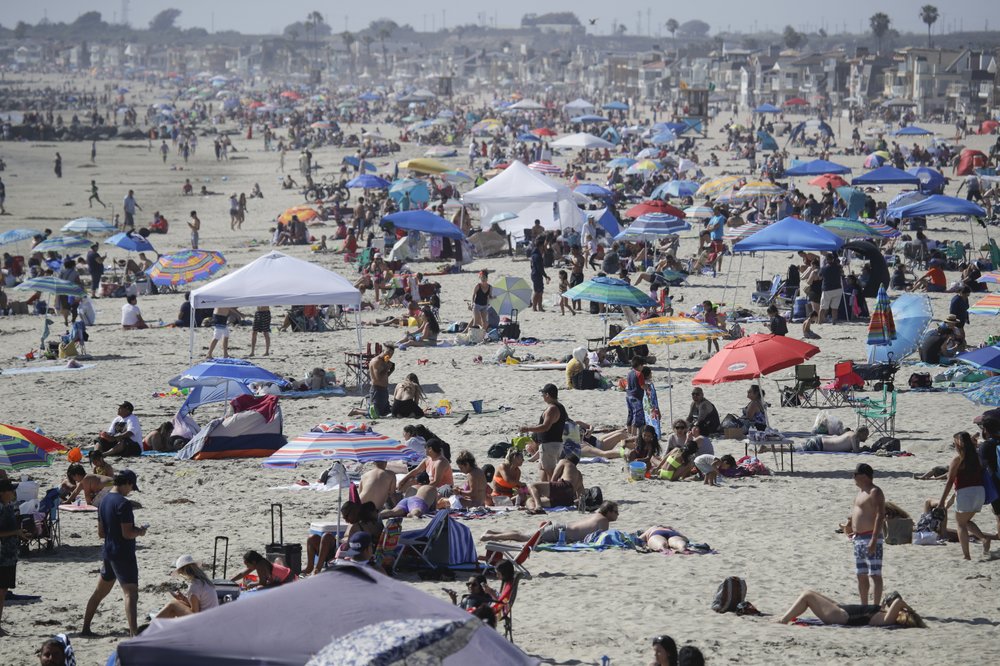
One concern she cited was large Memorial Day gatherings along the Gulf Coast in Florida, Alabama and Mississippi that might have included New Orleans residents. She noted a photo of large gatherings on a northwest Florida beach.
“There is no social distancing. This kind of sight gives public health folks a whole lot of heartburn,” Avegno said.
City officials want more time to collect and analyze data to determine the effect of New Orleans residents’ visits to such Memorial Day events before further loosening restrictions.
___
ORLANDO, Fla. — Universal Orlando plans to reopen its hotels to guests on June 2, more than two months after they were closed to help prevent the spread of the coronavirus.
In a statement Friday, Universal said the hotels will be carefully managed in phases, and will reopen with a range of best practice and hygiene procedures.
Guests staying in the resort hotels will be able to visit Universal’s theme parks on June 3 and 4, before they fully reopen to the public on June 5.
SeaWorld plans to reopen on June 11 and Walt Disney World announced it will begin reopening in phases on July 11.
___
MOSCOW — The Russian government has presented updated coronavirus statistics to include deaths of those who tested positive for the virus but died of other causes.
Friday’s announcement by Deputy Prime Minister Tatyana Golikova followed criticism from some Russian and Western experts who alleged that Russian authorities were under-reporting COVID-19 deaths for political reasons.
Golikova said 1,675 people died of COVID-19 in April. Of that number, 1,136 deaths were directly caused by COVID-19, while the remaining 539 people tested negative but had symptoms indicating they most likely died of the virus. In addition, Golikova said 1,038 others tested positive for the virus but died of other causes.
If all those deaths are attributed to COVID-19, the nation’s total toll for April would be 2,713 or nearly 60% more than the previously announced number.
Golikova said Russia was closely following the World Health Organization’s guidance on registering coronavirus deaths.
___
ROME — Italy’s health ministry has reported no critical coronavirus infection spikes in any region, giving a positive go-ahead for the planned June 3 reopening of Italy to inter-regional travel by Italians and Europeans alike.
The ministry on Friday issued a region-by-region breakdown of infection rates over the past week. The weekly report is part of Italy’s post-lockdown strategy to keep a close eye on infection rates and the ability of the national health system to respond to any new COVID-19 clusters in the onetime European epicenter of the pandemic.
The report said regions such as hard-hit Lombardy still showed a complex, high level of virus circulation, but said the situation was coming under control. The ministry recommended “caution, especially in the moment in which the frequency of movement of people across the national territory increases.”
Also Friday, Lombardy’s regional governor was interrogated by prosecutors investigating the failure of authorities to lock down Alzano Lombardo and other towns in Bergamo province after the first positive case there was registered Feb. 23. It took two weeks for the government to lock down all of Lombardy, allowing the virus to spread exponentially and kill thousands.
___
LAS VEGAS — Bleak numbers show the economic impact of Nevada casino and business closures because of the coronavirus pandemic.
With most businesses and all casinos shuttered through April, state regulators reported Friday that monthly gambling tax revenues were down nearly 100% compared with a year ago. Tourism officials tallied fewer than 107,000 visitors to Las Vegas during the month, down 97% from a year ago.
Democratic Gov. Steve Sisolak this week lifted closure orders on more businesses and said gambling can resume on June 4. McCarran International Airport in Las Vegas reported handling less than 4% of the passengers in April than it did in April 2019.
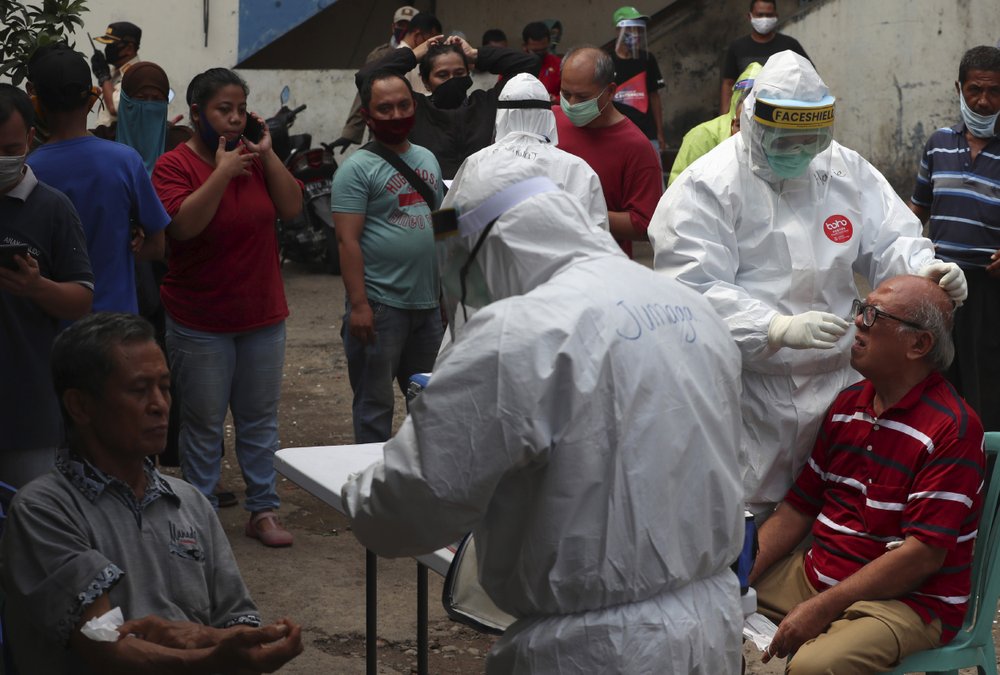
People look on as health workers take nasal swab samples during a mass testing for the coronavirus conducted at a market in Jakarta, Indonesia, Friday, May 29, 2020.
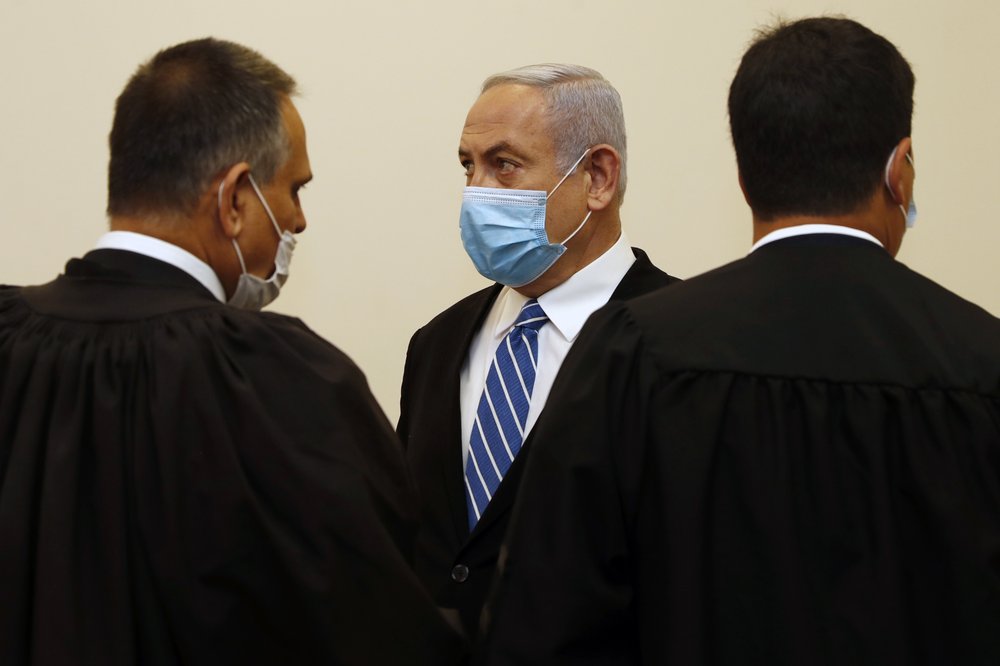
Israeli Prime Minister Benjamin Netanyahu, center, wearing a face mask in line with public health restrictions due to the coronavirus pandemic, stands with his lawyers inside the court room as his corruption trial opens at the Jerusalem District Court, Sunday, May 24, 2020. He is the country’s first sitting prime minister ever to go on trial, facing charges of fraud, breach of trust, and accepting bribes in a series of corruption cases stemming from ties to wealthy friends.
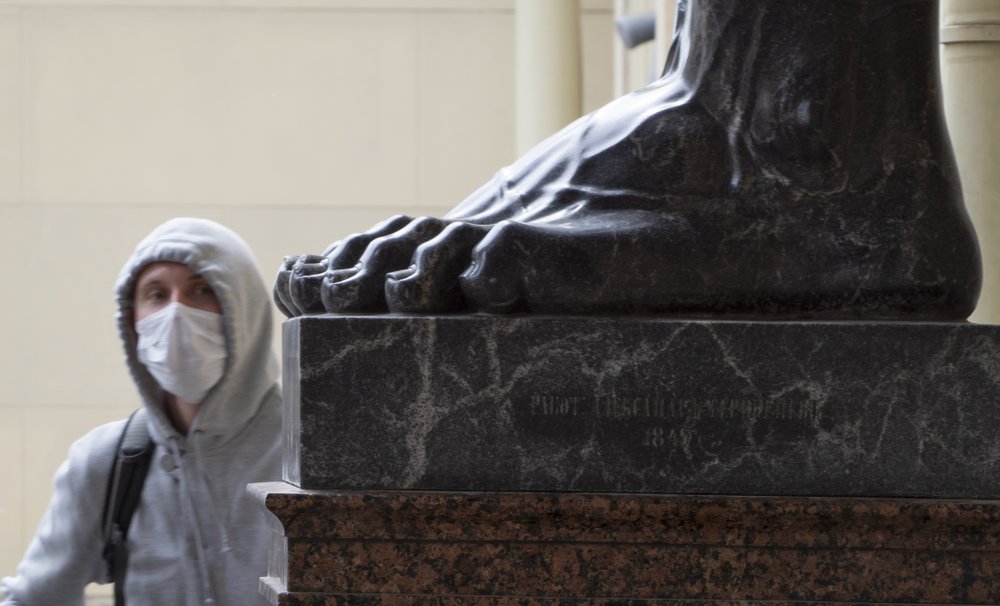
A man wearing a face mask to protect against coronavirus looks at the feet of a famous sculpture of Atlas at the State Hermitage museum amid the ongoing COVID-19 pandemic in St.Petersburg, Russia, Thursday, May 28, 2020.
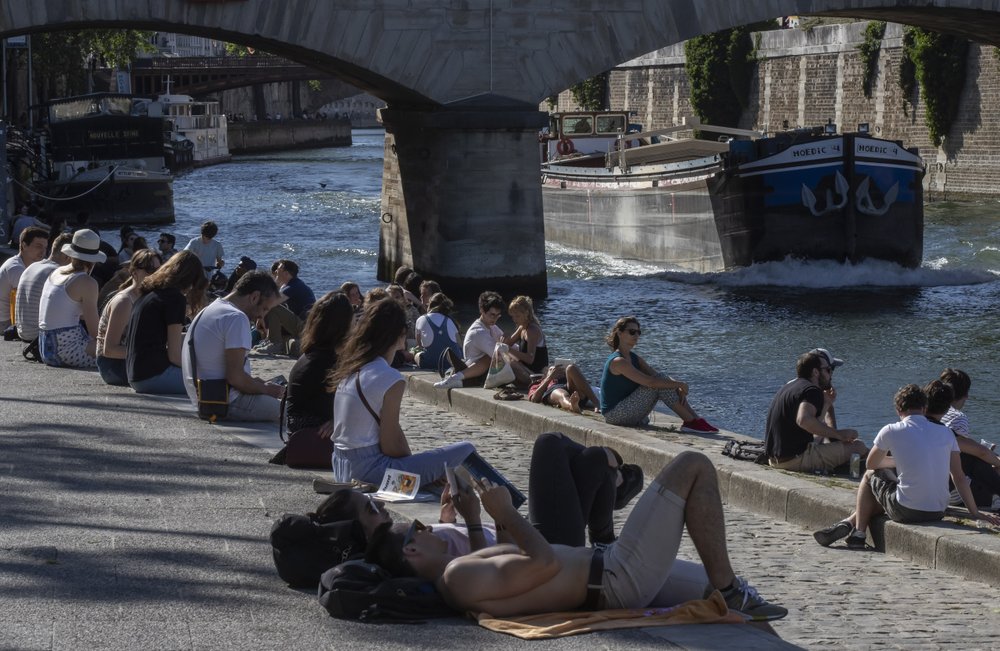
People stroll along the Seine river banks in Paris, Thursday, May 28, 2020, as France gradually lifts its Covid-19 lockdown. France's Prime Minister Edouard Phillippe announced Thursday that bars, restaurants and parks will reopen with restrictions from June 2.
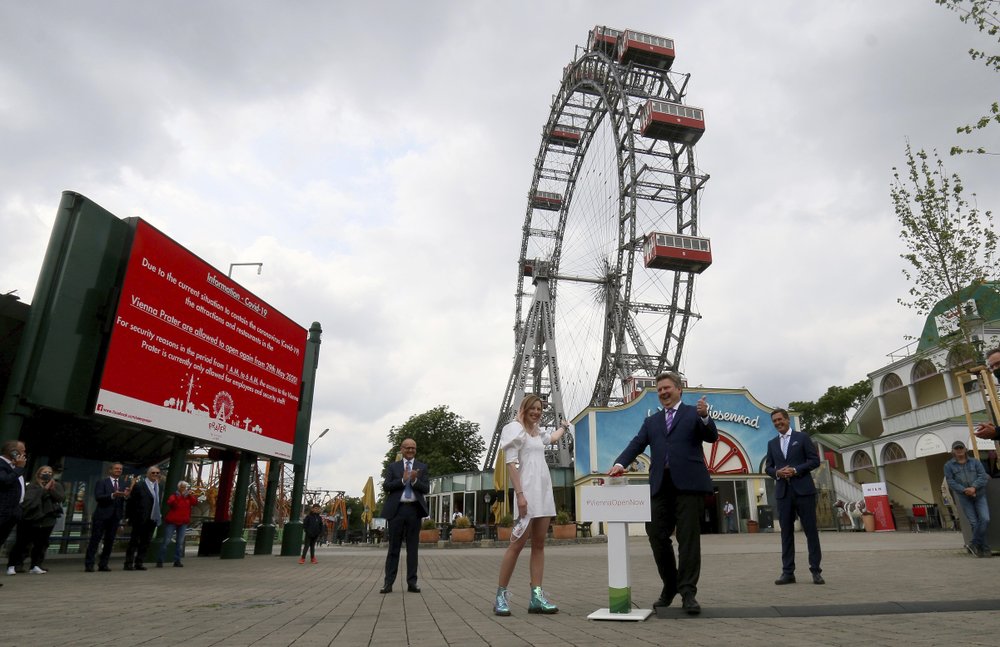
The Mayor of Vienna Michael Ludwig, center, presses a button to restarts the giant Ferris Wheel to symbolically signal the resumption of tourism in Austria in Vienna, Austria, Friday, May 29, 2020. Amusements are open again in Austria as part of relaxing the restrictions to slow the coronavirus and the COVID-19 disease.
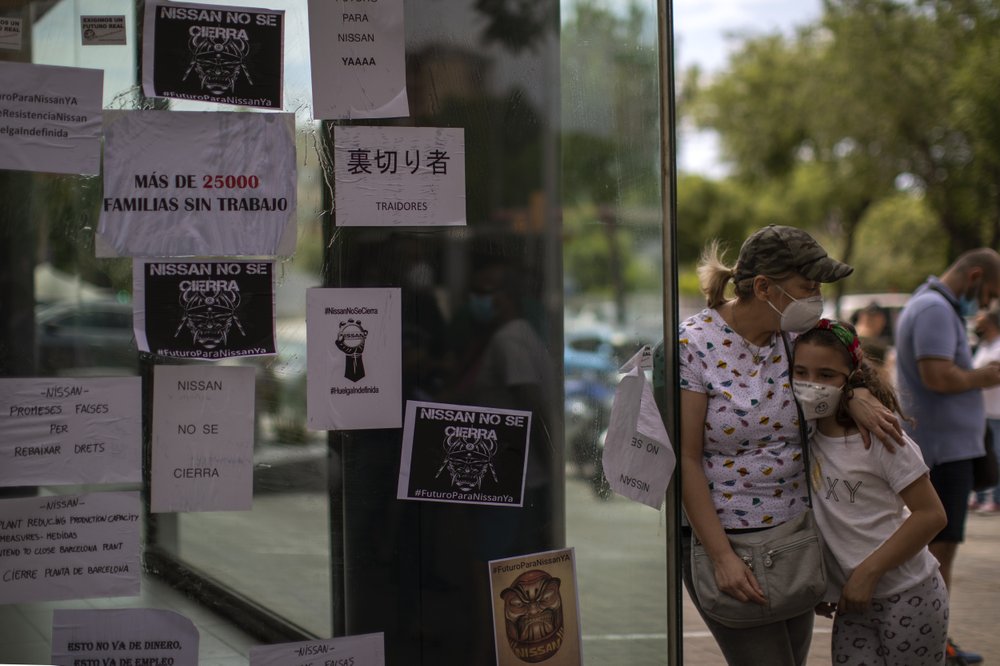
A woman and her daughter stand next to the window of a a car dealerships covered by leaflets during a protest in Barcelona, Spain, Friday, May 29, 2020. Employees in Spain of Japanese giant Nissan took to the streets for the second day in a row to protest the closure of three Barcelona plants as the carmaker scales down its global production. Hundreds of workers have surrounded at least four of Nissan's car dealerships on Friday in or around the northeastern city, covering their windows with leaflets reading "Nissan betrays 25,000 families" and "We will keep fighting" among others.
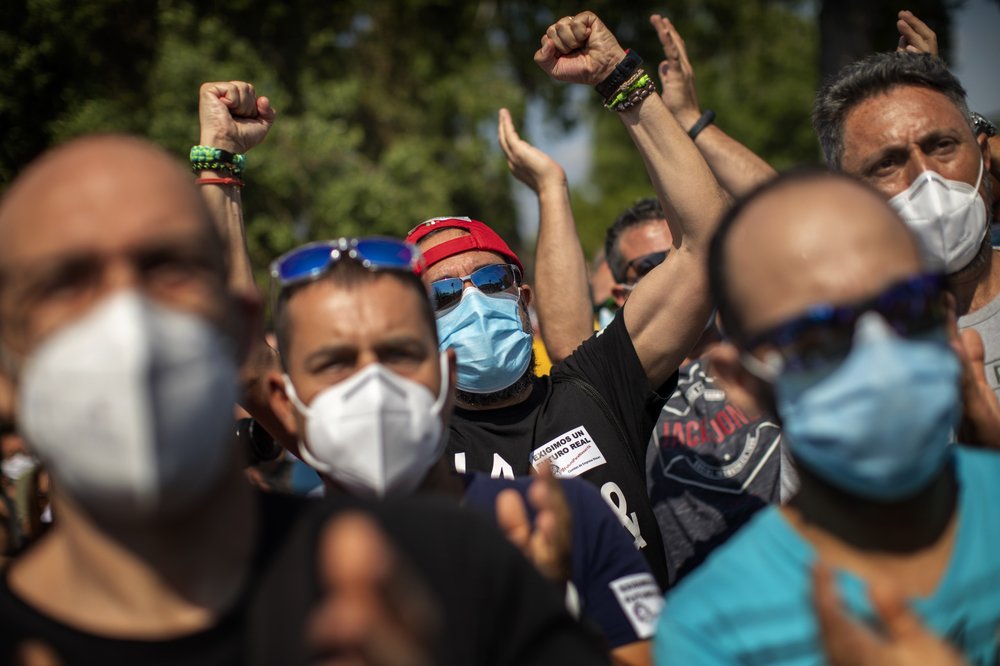
Nissan workers react during a protest outside their factory in Barcelona, Spain, Thursday, May 28, 2020. Japanese carmaker Nissan Motor Co. has decided to close its manufacturing plans in the northeastern Catalonia region, resulting in the loss of some 3,000 direct jobs.
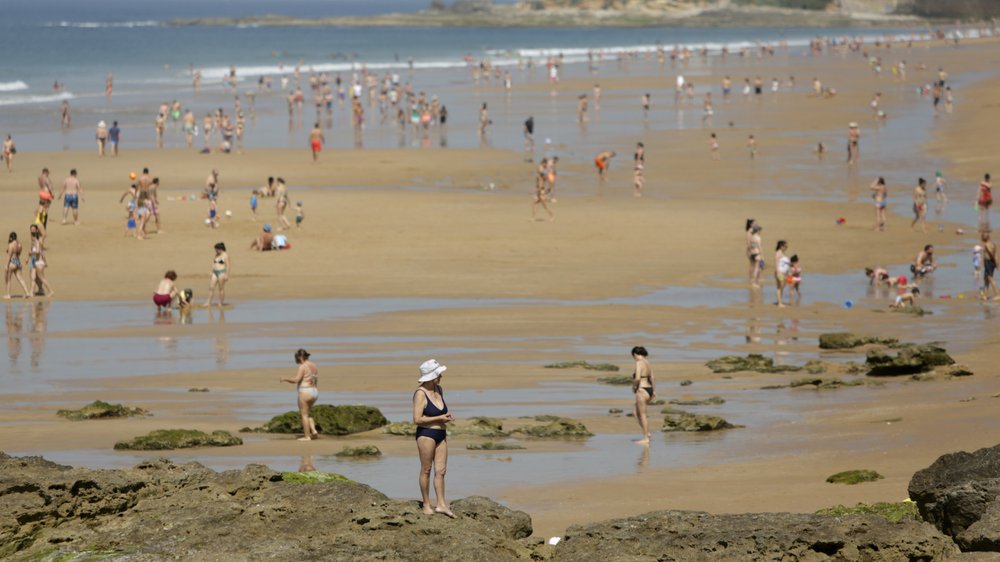
People walk along the water at the Carcavelos beach, outside Lisbon, Tuesday, May 26, 2020. As the government eases the coronavirus lockdown rules, people have been allowed back on the beaches with recommendations to keep social distance. Portugal is experience temperatures above average, reaching 30C in Lisbon.
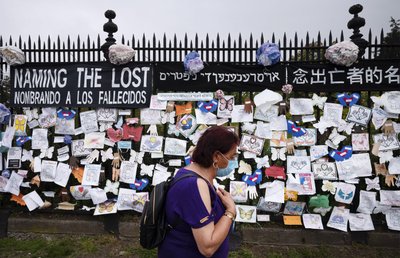
A woman passes a fence outside Brooklyn's Green-Wood Cemetery adorned with tributes to victims of COVID-19, Thursday, May 28, 2020, in New York. The memorial is part of the Naming the Lost project which attempts to humanize the victims who are often just listed as statistics.
South Korean Ends Yearlong Tower Protest After Samsung Apologizes
After 355 days perched atop a Seoul traffic tower, Kim Yong-hee, who says he was fired for labor activism, climbed down.
NYT, CSH, May 29, 2020
SEOUL, South Korea — A South Korean man who spent 355 days at the top of a slender traffic-camera tower in a protest against Samsung ended his demonstration on Friday after the company apologized and agreed to resolve his grievances.
The man, Kim Yong-hee, 60, climbed the 82-foot tower near Samsung’s headquarters in Seoul on June 10, demanding that the tech giant apologize and offer compensation for what he called its illegal decision to fire him 25 years ago for union activism. He chose his midair protest site, overlooking the busiest intersection in the South Korean capital, to highlight his grievance against the country’s most powerful conglomerate.
“I hope my struggle helps Samsung build a new management-labor relationship,” Mr. Kim told the South Korean news media after climbing down on Friday.
He decided to end his protest after Samsung agreed to meet some of his demands. But other than the apology, the details of the signed agreement between Samsung and Mr. Kim’s representatives were not disclosed.
“The company expresses its apology to Mr. Kim Yong-hee for not resolving the issue sooner and also offers a word of consolation to his family,” Samsung said in its apology sent to the news media. “We will continue to try to communicate with the society in a humble attitude.”
Samsung’s apology was part of a broader attempt to address growing pressure to reform its management.
Mr. Kim atop the 82-foot tower in Seoul last month.
This month, Lee Jae-yong, Samsung’s vice chairman and son of its chairman, Lee Kun-hee, apologized for corruption scandals that have bedeviled his conglomerate, declaring that he would be the last of his relatives to lead Samsung. The heir is on trial on charges of bribing Park Geun-hye, the country’s former president, who was impeached and ousted for corruption and abuse of power.
Mr. Lee — known as J.Y. Lee in the West — also apologized for “all those who have been hurt in labor issues,” renouncing Samsung’s decades-old “no union” philosophy and vowing to respect its workers’ right to organize independent labor unions. Samsung’s tight control of labor activism was often cited as a key reason the company was able to grow so rapidly while other conglomerates, like Hyundai, were often crippled by militant labor activism at their work sites.
But in two court rulings in December, 39 people — most current or former Samsung managers — were convicted of illegally conspiring for years to sabotage efforts to organize independent unions at two Samsung affiliates and their subcontractors, and of plotting to keep the conglomerate free of union activism. Several top Samsung figures were sent to prison.
Mr. Kim said Samsung had fired him in 1995 for trying to organize an independent labor union. Since then, his life has been an endless series of sit-ins and hunger strikes near the company’s headquarters, demanding his job back, compensation and an apology.
“This is my last stand against that evil behemoth,” he said in an April interview from atop the tower, explaining why he had decided to climb it.
Kim Yong-hee, center, who was fired from Samsung, was welcomed by supporters after climbing down from a traffic camera tower in Seoul on Friday
Volunteers from the Chinatown Block Watch neighborhood patrol group pose for pictures before patrolling in Chinatown during the outbreak of the coronavirus disease (COVID-19) in New York City, New York, U.S., May 17, 2020.
U.S. Asians, harassed over coronavirus, push back on streets, social media
Richard Chang
NEW YORK (Reuters) - A spike in harassment of Asian-Americans since the coronavirus pandemic began has led community activists in the United States to fight back - forming street patrols, rallying on social media, and supporting each other online.
Asians of varying national backgrounds have suffered a surge of attacks this year, which activists linked to the pandemic’s emergence in China. Some said they feared harassment could worsen in a U.S. election year, with U.S.-China tensions ratcheting up over trade, Hong Kong and the coronavirus.
“When China is made the enemy, people who look like Chinese are the enemy. The economy is tanking, people are dying. They’re angry and fearful and want to take it out on Asian Americans even more,” said Russell Jeung, professor of Asian-American studies at San Francisco State University.
Since March 19, over 1,800 cases of harassment related to the coronavirus pandemic have been reported to Stop AAPI Hate, a website Jeung created with two advocacy groups.
Nine out of 10 victims were targeted because of their race, with 37% of incidents taking place in public areas, the organization said. Verbal harassment and shunning occurred in over 90% of the cases. Victims were physically assaulted, or coughed or spat on, in some 15% of cases.
Some of the harassment has taken place inside of stores, Jeung said, adding that Stop AAPI Hate is working with retailers to figure out how to ensure safe access for customers.
The New York City Commission on Human Rights this week launched a multilingual campaign to combat COVID-19-related discrimination after it received over 350 such complaints from Feb. 1 to May 15. Of these, 133, or 37%, targeted Asians. That compared with just 11 complaints of discrimination targeted at Asians during the same period in 2019.
The FBI has warned of a rise in hate crimes against Asian-Americans since the coronavirus pandemic began, according to media reports citing internal documents.
SOLIDARITY ON STREETS
In some Chinatowns, volunteer patrols are forming to protect residents and confront harassers. The Guardian Angels, with patrols in over 130 cities worldwide, are recruiting in U.S. Asian communities for the first time in 41 years. Members include seniors and women, who are often targets of abuse.
“It’s boring at home. I might as well do something,” said laid-off dental assistant Sara Chin. The 46-year-old also patrols with New York’s Chinatown Block Watch.
“Our mission is to observe, record and report,” said Leanna Louie, a San Francisco businesswoman who started patrol group United Peace Corp. In eight weeks, it has filed 24 reports, including medical response incidents, auto burglaries, theft and shoplifting, leading to three arrests, she noted.
“We can break the old habits, old patterns and outdated stereotypes,” Louie said. “We have assisted in aiding the community to step out of the shadows and feel more empowered.”
The San Francisco Police Department has expanded its presence on foot and in cars around the city to act as a deterrent against such crimes, it said in a statement.
In New York, flyers and posters emblazoned with the words ‘Don’t be cruel’ were created by Shirley Ng and her friends for display on Chinatown storefronts, with pointers on how to report a crime.
“I don’t have to wait for support. It’s my community,” said Ng, an events assistant at the Asian American Legal Defense and Education Fund.
‘STARKLY SIMILAR’
The campaigns recall the Pan-Asian U.S. civil rights movement in 1982, when Japan was blamed for the Detroit auto industry’s downturn, said Helen Zia, a journalist-activist at the forefront of that wave.
Vincent Chin, a 27-year-old draftsman celebrating his upcoming wedding, was brutally beaten that year by two disgruntled autoworkers and died. The court sentence of a $3,000 fine and three years’ probation, with no jail time, sparked outrage in the community and beyond.
“When he was attacked and killed it was very clear it was because of what he looked like. Japan was labeled as the enemy. We’re so starkly similar today,” Zia said.
Tech-savvy millennials are leading today’s social media response.
“My generation has no problem being loud,” digital entrepreneur Bing Chen, 32, said at a virtual rally by non-profit Act To Change on May 18, Vincent Chin’s birthday.
Hashtags like #RacismIsAVirus and #UnapologeticallyAsian are being shared and printed on T-shirts. #HATEISAVIRUS, created in late March by three millennials who connected via Instagram, is now a non-profit organization. It raised $16,000 in a virtual rally last week for small businesses hurt by the pandemic, said co-founder Tammy Cho, 25.
The hashtags “try to capture the rising Asian-American pride that has bubbled to the surface during COVID-19,” said Filipino-American Jeremiah Abraham, who heads Tremendous Communications, a marketing company focused on Asian-American entertainment.
Broadway actor Diane Phelan cited the #MeToo worldwide campaign against sexual harassment as an inspiration.
“We want to harness the power of social media as the #MeToo movement has, especially when we can’t march and rally,” she said.
Minneapolis police officer charged with murder in George Floyd case
Carlos Barria
MINNEAPOLIS (Reuters) - The white Minneapolis policeman who pinned an unarmed black man with a knee to the throat before the man died was arrested and charged with murder, a prosecutor said on Friday, after three nights of violent protests rocked the Midwestern city.
Derek Chauvin, the officer seen on a bystander’s cellphone video kneeling on George Floyd’s neck on Monday before the 46-year-old man died, has been charged with third-degree murder and manslaughter, Hennepin County Attorney Mike Freeman told a news briefing.
Factbox: Killing of Minnesota black man in 'I can't breathe' case sparks U.S. protests
Biden calls for 'real leadership' after Trump alludes to violence after police killing
See more stories
“He is in custody and has been charged with murder,” Freeman said of Chauvin. “We have evidence, we have the citizen’s camera’s video, the horrible, horrific, terrible thing we have all seen over and over again, we have the officer’s body-worn camera, we have statements from some witnesses.”
The cellphone footage showed Floyd repeatedly moaning and gasping while he pleaded to Chauvin, kneeling on his neck, “Please, I can’t breathe.” After several minutes, Floyd gradually grows quiet and ceases to move.
Chauvin and three fellow officers at the scene were fired on Tuesday from the Minneapolis Police Department. The city identified the other officers as Thomas Lane, Tou Thao and J Alexander Kueng.
Freeman said the investigation into Chauvin - who, if convicted, faces up to 25 years in prison on the murder charge - was ongoing and that he anticipated charges against the other officers. He said it was appropriate to charge “the most dangerous perpetrator” first.
Earlier on Friday, Minnesota Governor Tim Walz called for an end to the violent protests, which have included arson, looting and the burning down of a police precinct, while promising a reckoning with the racial inequities behind the unrest.
“None of us can live in a society where roving bands go unchecked and do what they want to, ruin property,” Walz said. “We have to get back to that point of what caused this all to happen and start working on that.”
The protests, which threatened to stretch into a fourth night, have been driven in part by a lack of arrests in the case.
Responding to a reporter’s question about why the officers were not arrested sooner, Freeman stressed that charges in similar cases would typically take nine months to a year.
“This is by far the fastest we’ve ever charged a police officer,” said Freeman. “We entrust our police officers to use a certain amounts of force to do their job, to protect us. They commit a criminal act if they use that force unreasonably.”
Tennis - Australian Open - Fourth Round - Melbourne Park, Melbourne, Australia - January 26, 2020 Cori Gauff of the U.S. celebrates during her match against Sofia Kenin of the U.S.
'Am I next?' Tennis star Gauff joins chorus of protest after Minneapolis death
NEW YORK (Reuters) - Teenage tennis phenomenon Coco Gauff released a video protesting killings of African-Americans in the United States on Friday, joining a chorus of outrage across the country that followed the death of an unarmed black man in Minneapolis.
Minneapolis police officer Derek Chauvin was charged on Friday with murder in the death of 46-year-old George Floyd after cellphone footage of the white officer kneeling on Floyd’s neck prompted a wave of protests.
Sixteen-year-old African-American Gauff said on Twitter this week she would "always use my platform to help make the world a better place," and on Friday called for action from others in a TikTok video posted to her Twitter account here
“This is why I am using my voice to fight against racism,” the caption reads, as the video cuts to images of Floyd and Ahmaud Arbery, an unarmed black man whose shooting in Brunswick, Georgia, was also captured on video. Three white men were charged in his death earlier this month.
Gauff’s video also includes a photo of Trayvon Martin, a black teenager whose killing helped spark the “Black Lives Matter” movement.
The words, “Am I next?” appear on screen, as Gauff, wearing a black hoodie, faces the camera and raises her hands.
“I am using my voice,” the caption concludes, “Will you use yours?”
Gauff joins numerous other athletes, including basketball stars LeBron James and Lisa Leslie, who have spoken out following Floyd’s death.
Gauff seized the tennis spotlight at last year’s Wimbledon, where she defeated her idol Venus Williams in the first round and made it through to the fourth.
She backed up that performance with strong showings at the 2019 U.S. Open and 2020 Australian Open, ultimately breaking into tennis’ top 50 at the age of 15.
updated
Officer who knelt on George Floyd’s neck charged with murder
By AMY FORLITI and TIM SULLIVAN, May 29, 2020
MINNEAPOLIS (AP) — The white Minneapolis police officer who pressed his knee into George Floyd’s neck was arrested Friday and charged with murder, as authorities imposed overnight curfews to try to stem violent protests over police killings of African Americans that have spread from Minneapolis and other U.S. cities.
Protesters smashed windows at CNN headquarters in Atlanta, set a police car on fire and struck officers with bottles. Large protests in New York, Houston and other cities were largely peaceful — even in Minneapolis, where thousands marched downtown as the city’s 8 p.m. curfew ticked past and encircled a police precinct station.
“Prosecute the police!” some chanted, and “Say his name: George Floyd!” There was no violence, but some protesters sprayed graffiti on nearby buildings. Elsewhere in the city, forces fired tear gas and rubber bullets to drive back crowds of protesters.
It wasn’t clear if — or how — authorities would enforce the curfew, amid sharp questions about city and state leaders mishandling the crisis. The curfew came one night after protesters burned a police precinct station, and barriers were erected around at least two police precincts before nightfall.
Derek Chauvin, 44, was charged with third-degree murder and second-degree manslaughter. He also was accused of ignoring another officer who expressed concerns about Floyd as he lay handcuffed on the ground, pleading that he could not breathe as Chauvin pressed his knee into his neck. Floyd, who was black, had been arrested on suspicion of using a counterfeit bill at a store.
Chauvin, who was fired along with three other officers who were at the scene, faces more than 12 years in prison if convicted of murder.
An attorney for Floyd’s family welcomed the arrest but said he expected a more serious murder charge and wants the other officers arrested.
Prosecutor Mike Freeman said more charges were possible, but authorities “felt it appropriate to focus on the most dangerous perpetrator.”
Meanwhile, Minneapolis Mayor Jacob Frey declared a curfew from 8 p.m. to 6 a.m. Friday and Saturday, with exceptions for emergency responders, the homeless and those seeking medical care.
“I know that whatever hope you feel today is tempered with skepticism and a righteous outrage,” Frey said in a statement. “Today’s decision from the County Attorney is an essential first step on a longer road toward justice and healing our city.”
Protests also spread across the U.S., fueled by outrage over Floyd’s death and years of police violence against African Americans. Demonstrators clashed with officers in New York and blocked traffic in Houston and San Jose, California. In Atlanta, demonstrators jumped on police cruisers, set one police car ablaze and broke windows at CNN’s headquarters, where hundreds were confronting police.
On Monday, police were trying to put Floyd in a squad car when he stiffened and fell to the ground, saying he was claustrophobic, a criminal complaint said. Chauvin and Officer Tou Thoa arrived and tried several times to get the struggling Floyd into the car.
At one point, Chauvin pulled Floyd out of the car’s passenger side, and Floyd, who was handcuffed, went to the ground face down. Officer J.K. Kueng held Floyd’s back and Officer Thomas Lane held his legs while Chauvin put his knee on Floyd’s head and neck area, the complaint said.
When Lane asked if Floyd should be rolled onto his side, Chauvin said, “No, staying put is where we got him.” Lane said he was “worried about excited delirium or whatever.”
An autopsy said the combined effects of being restrained, potential intoxicants in Floyd’s system and his underlying health issues, including heart disease, likely contributed to his death. It revealed nothing to support strangulation as the cause of death.
There were no other details about intoxicants, and toxicology results can take weeks. In the 911 call that drew police, the caller describes the man suspected of paying with counterfeit money as “awfully drunk and he’s not in control of himself.”
After Floyd apparently stopped breathing, Lane again said he wanted to roll Floyd onto his side. Kueng checked for a pulse and said he could not find one, according to the complaint.
In all, Chauvin had his knee on Floyd’s neck for 8 minutes, 46 seconds, including nearly three minutes after Floyd stopped moving and talking, the complaint said.
Chauvin’s attorney had no comment when reached by The Associated Press.
The prosecutor highlighted the “extraordinary speed” in charging the case just four days after Floyd’s death and defended himself against questions about why it did not happen sooner. Freeman said his office needed time to gather evidence, including what he called the “horrible” video recorded by a bystander.
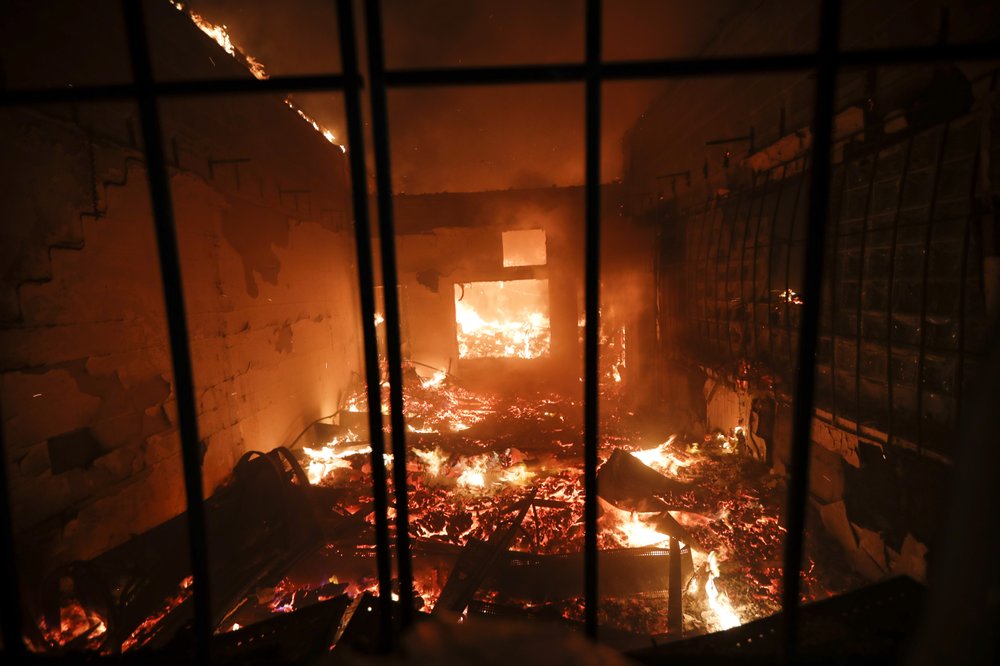
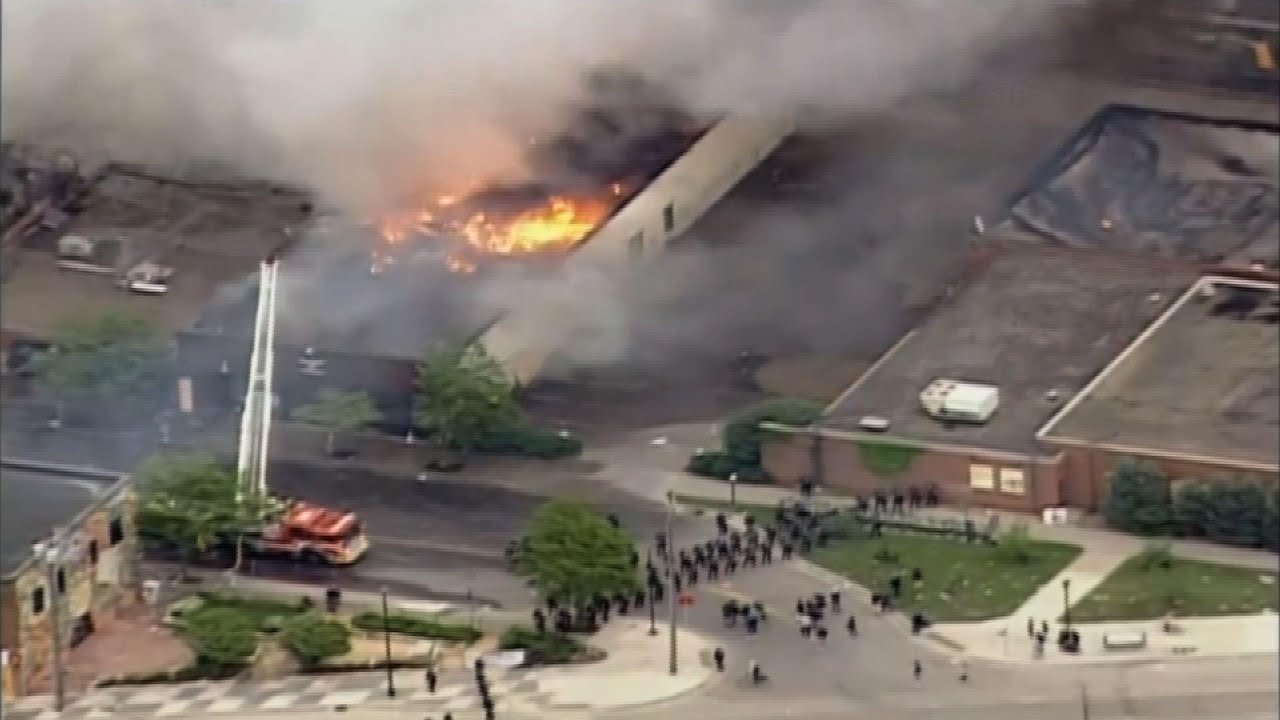
It was not immediately clear whether Chauvin’s arrest would quiet the unrest, which escalated again Thursday night as demonstrators burned a Minneapolis police station soon after officers abandoned it.
News of the arrest came moments after Minnesota Gov. Tim Walz acknowledged the “abject failure” of the response to the protests and called for swift justice for the officers. Walz said the state had taken over the response to the violence.
“Minneapolis and St. Paul are on fire. The fire is still smoldering in our streets. The ashes are symbolic of decades and generations of pain, of anguish unheard,” Walz said. “Now generations of pain is manifesting itself in front of the world — and the world is watching.”
President Donald Trump threatened action, tweeting “when the looting starts, the shooting starts,” which prompted a warning from Twitter for “glorifying violence.” Trump later said he was referring to shooting that had happened during the protests.
Later, the president said he’d spoken to Floyd’s family and “expressed my sorrow.”
Trump called video of the arrest “just a horrible thing to witness and to watch. It certainly looked like there was no excuse for it.”
The governor faced tough questions about the National Guard’s slow response, saying city leaders were in charge. But Walz said it became apparent as the 3rd Precinct station burned Thursday night that the state had to step in.
“You will not see that tonight, there will be no lack of leadership,” Walz said Friday.
A visibly tired and frustrated Frey, the Minneapolis mayor, took responsibility for evacuating the police precinct, saying it had become too dangerous for officers.
Nearly every building in a shopping district a couple blocks from the abandoned police station had been vandalized, burned or looted. National Guard members carrying assault rifles lined up at some intersections, keeping people away from the police station. Dozens of volunteers swept up broken glass in the street.
Dean Hanson, 64, who lives a nearby subsidized housing apartment, said his building lost electricity overnight. Residents were terrified as they watched mobs loot and burn their way through the neighborhood, he said.
“I can’t believe this is happening here,” Hanson said. “It was pure hell.”
Dozens of fires were also set in St. Paul, where nearly 200 businesses were damaged or looted.
Attorney Benjamin Crump, who is representing Floyd’s family, asked to take custody of Floyd’s body for an independent autopsy.
The doctor who will do the autopsy is Michael Baden, former chief medical examiner of New York City, who was hired to do an autopsy for Eric Garner, a black man who died in 2014 after New York police placed him in a chokehold and he pleaded that he could not breathe.
State and federal authorities also are investigating Floyd’s death.
The owner of a popular Latin nightclub said Floyd and Chauvin both worked as security guards there as recently as last year, but it’s not clear whether they worked together. Chauvin served as an off-duty security guard at the El Nuevo Rodeo club for nearly two decades, and Floyd had worked there more recently for about a dozen events featuring African American music, Maya Santamaria told the AP.
Santamaria, who recently sold the venue, said Chauvin got along well with the regular Latino customers but did not like to work the African American nights. When he did, and there was a fight, he would spray people with mace and call for police backup and half-dozen squad cars would soon show up, something she felt was “overkill.”
Minneapolis cop who knelt on man’s neck charged with murder
By AMY FORLITI and TIM SULLIVAN, May 30, 2020
MINNEAPOLIS (AP) — The white Minneapolis police officer who knelt on George Floyd’s neck was arrested and charged with murder Friday, and authorities imposed an overnight curfew to try to stem three nights of often-violent protests that left dozens of stores burned and looted.
Derek Chauvin, 44, was charged with third-degree murder and second-degree manslaughter in the case. He was also accused of ignoring another officer at the scene who expressed concerns about the black man as he lay handcuffed on the ground, pleading that he could not breathe. Floyd had been arrested on suspicion of using a counterfeit bill at a small grocery store.
An attorney for Floyd’s family welcomed the arrest, but said he expected a more serious murder charge and wants all four officers involved to be arrested.
Hennepin County Attorney Mike Freeman said more charges were possible. He said the investigation into the other three officers continues, but authorities “felt it appropriate to focus on the most dangerous perpetrator.”
Meanwhile, Minneapolis Mayor Jacob Frey declared a curfew from 8 p.m. to 6 a.m. on Friday and Saturday. The order said no one can be out in public except emergency responders and people seeking medical care, fleeing danger or those who are homeless.
“I know that whatever hope you feel today is tempered with skepticism and a righteous outrage,” Frey said in a statement. “Today’s decision from the County Attorney is an essential first step on a longer road toward justice and healing our city.”
According to the criminal complaint, Chauvin allegedly disregarded the concerns of another officer, who wanted to roll Floyd onto his side as he was being held down.
The papers also said that an autopsy revealed nothing to support strangulation as the cause of death. The exam concluded that the combined effects of being restrained, potential intoxicants in Floyd’s system and his underlying health issues, including heart disease, likely contributed to his death. Floyd’s family was seeking an independent autopsy.
Police were trying to put Floyd in a squad car when he stiffened up and fell to the ground, saying he was claustrophobic, the complaint said. Chauvin and officer Tou Thoa arrived to help and tried several times to get the struggling Floyd into the car, it said.
At one point, Chauvin pulled Floyd out of the car’s passenger side, and Floyd, who was handcuffed, went to the ground face down. Officer J.K. Kueng held Floyd’s back, and officer Thomas Lane held his legs, while Chauvin put his knee on Floyd’s head and neck area, the complaint said.
When Lane asked if Floyd should be rolled onto his side Chauvin said, “No, staying put is where we got him.” Lane said he was “worried about excited delirium or whatever,” and Chauvin replied, “That’s why we have him on his stomach,” according to the complaint.
After Floyd apparently stopped breathing, Lane again said he wanted to roll Chauvin onto his side. Kueng checked for a pulse and said he could not find one, the complaint said.
In all, Chauvin had his knee on Floyd’s neck for 8 minutes, 46 seconds, including nearly three minutes after Floyd stopped moving and talking, according to the complaint.
Chauvin’s attorney had no comment when reached by The Associated Press.
Freeman, whose home has been picketed by protesters, highlighted the “extraordinary speed” in charging the case just four days after Floyd’s death, but also defended himself against questions about why it did not happen sooner. He said his office needed time to put together evidence, including what he called the “horrible” video recorded by a bystander.
All four officers at the scene of Floyd’s arrest on Monday were fired the next day. After the charges were announced, protesters outside government offices chanted, “All four got to go.”
It was not immediately clear whether Chauvin’s arrest would quiet the unrest, which escalated again Thursday night as demonstrators burned a Minneapolis police station soon after officers abandoned it.
Protests also spread across the U.S., fueled by outrage over Floyd’s death, and years of violence against African Americans at the hands of police. Demonstrators clashed with officers in New York and blocked traffic in Columbus, Ohio, and Denver.
News of the arrest came moments after Minnesota Gov. Tim Walz acknowledged the “abject failure” of the response to the protests and called for swift justice for the officers. Walz said the state had taken over the response to the violence.
“Minneapolis and St. Paul are on fire. The fire is still smoldering in our streets. The ashes are symbolic of decades and generations of pain, of anguish unheard,” Walz said. “Now generations of pain is manifesting itself in front of the world — and the world is watching.”
President Donald Trump threatened action, tweeting “when the looting starts, the shooting starts,” which prompted a warning from Twitter for “glorifying violence.” Trump later said he was referring to shooting that had happened during the protests.
The governor faced tough questions after National Guard leader Maj. Gen. Jon Jensen blamed a lack of clarity about the Guard’s mission for a slow response. Walz said the state was in a supporting role and that it was up to city leaders to run the situation. Walz said it became apparent as the 3rd Precinct was lost that the state had to step in. Requests from Minneapolis and nearby St. Paul for resources “never came,” he said.
“You will not see that tonight, there will be no lack of leadership,” Walz said.
On Friday morning, nearly every building in a shopping district a couple blocks from the abandoned police station had been vandalized, burned or looted. National Guard members carrying assault rifles were lined up at some intersections, keeping people away from the police station. Dozens of volunteers swept up broken glass in the street.
Dean Hanson, 64, lives in a subsidized housing unit nearby, which is home to many older residents. He said his building lost electricity overnight, and residents were terrified as they watched mobs of people loot and burn their way through the neighborhood.
“I can’t believe this is happening here,” he said. “It was pure hell.”
Dozens of fires were also set in St. Paul, where nearly 200 businesses were damaged or looted.
A visibly tired and frustrated Frey, the Minneapolis mayor, took responsibility for evacuating the police precinct, saying it had become too dangerous for officers.
Attorney Benjamin Crump, who is representing Floyd’s family, asked to take custody of Floyd’s body to have an independent autopsy performed. Crump said that talk of a heart condition or asthma was irrelevant because Floyd was walking and breathing before his contact with police.
The doctor who will do the autopsy is Michael Baden, former chief medical examiner of New York City, who was hired to do an autopsy for Eric Garner, a black man who died in 2014 in New York after he was placed in a chokehold by police and pleaded for his life, saying he could not breathe.
State and federal authorities are also investigating Floyd’s death.
The owner of a popular Latin nightclub said Floyd and Chauvin both worked as security guards at the club as recently as the end of last year, but it’s not clear whether they worked together. Chauvin worked at the El Nuevo Rodeo club as an off-duty security guard for nearly two decades, but Floyd had only worked there more recently for about a dozen events featuring African American music, Maya Santamaria told The Associated Press.
Santamaria said if Chauvin had recognized Floyd, “he might have given him a little more mercy.”
Santamaria, who recently sold the venue, said Chauvin got along well with the regular Latino customers but did not like to work the African American nights. When he did, and there was a fight, he would spray people with mace and call for police backup and half-dozen squad cars would soon show up, something she felt was “overkill.”
In this Monday, May 25, 2020, frame from video provided by Darnella Frazier, a Minneapolis officer kneels on the neck of a handcuffed man who was pleading that he could not breathe in Minneapolis. Four Minneapolis officers involved in the arrest of a George Floyd who died in police custody were fired Tuesday.
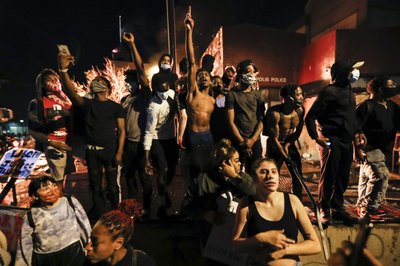
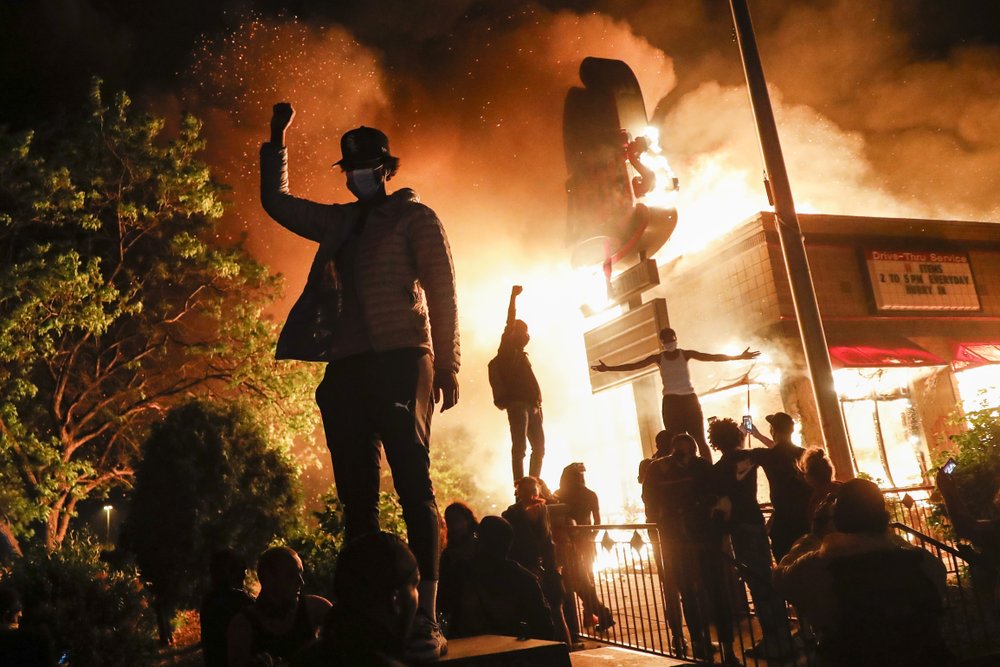
Protestors demonstrate outside of a burning Minneapolis 3rd Police Precinct, Thursday, May 28, 2020, in Minneapolis. Protests over the death of George Floyd, a black man who died in police custody Monday, broke out in Minneapolis for a third straight night.
A protester carries a U.S. flag upside down, a sign of distress, next to a burning building Thursday, May 28, 2020, in Minneapolis.
Protesters angered by the death of a black man torch a Minneapolis police station that the department abandoned.
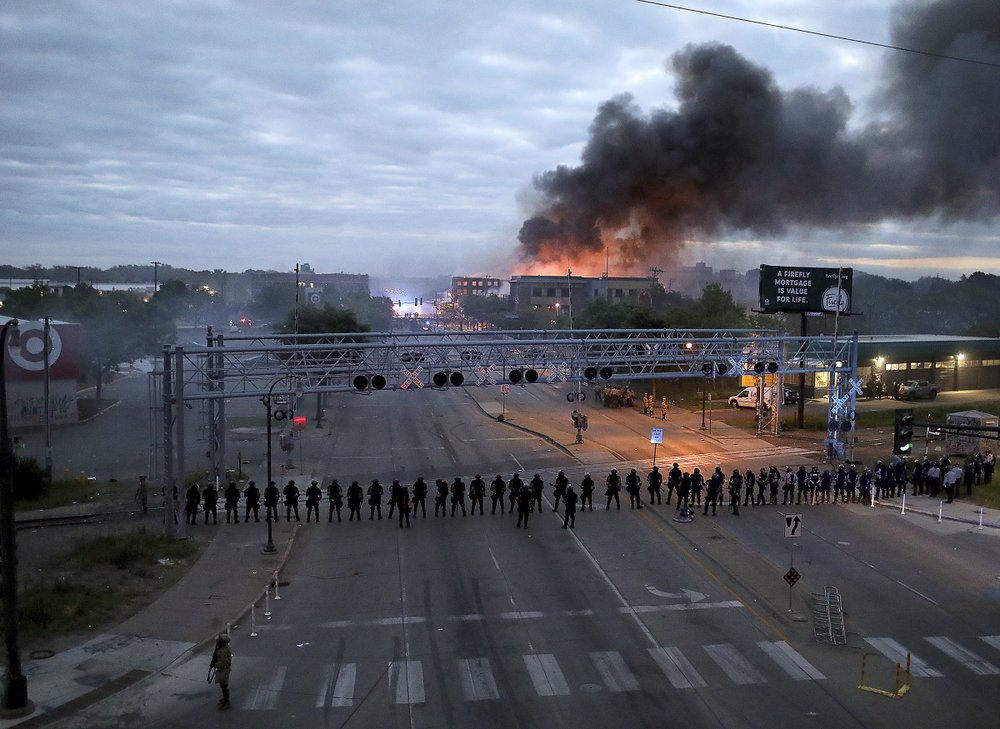
Law enforcement officers amassed along Lake Street near Hiawatha Ave. as fires burned after a night of unrest and protests in the death of George Floyd early Friday, May 29, 2020 in Minneapolis. Floyd died after being restrained by Minneapolis police officers on Memorial Day.
Protestors demonstrate outside of a burning fast food restaurant, Friday, May 29, 2020, in Minneapolis.
A protestor sprays graffiti on a wall near the Minneapolis 3rd Police Precinct, Thursday, May 28, 2020, in Minneapolis.
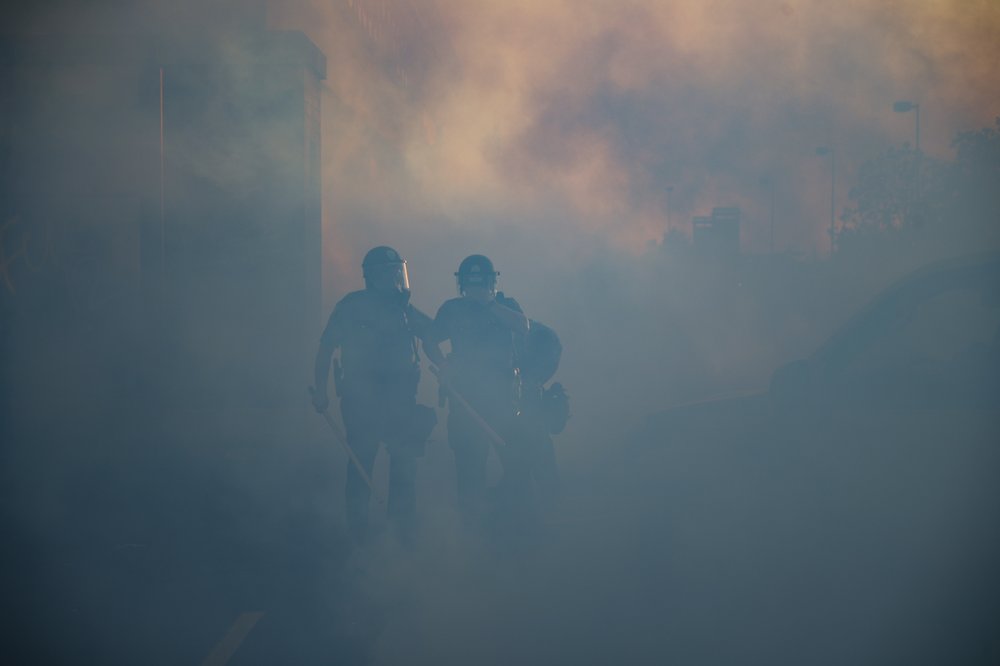
Police officers walk through a cloud of tear gas, Thursday, May 28, 2020, in St. Paul, Minn.
Protestors demonstrate outside of a burning Minneapolis 3rd Police Precinct, Thursday, May 28, 2020, in Minneapolis.
Police move through an area during demonstrations Thursday, May 28, 2020, in St. Paul, Minn. Protests over the death of George Floyd, the black man who died in police custody broke out in Minneapolis for a third straight night.
Protestors demonstrate outside of a burning Minneapolis 3rd Police Precinct, Thursday, May 28, 2020, in Minneapolis.
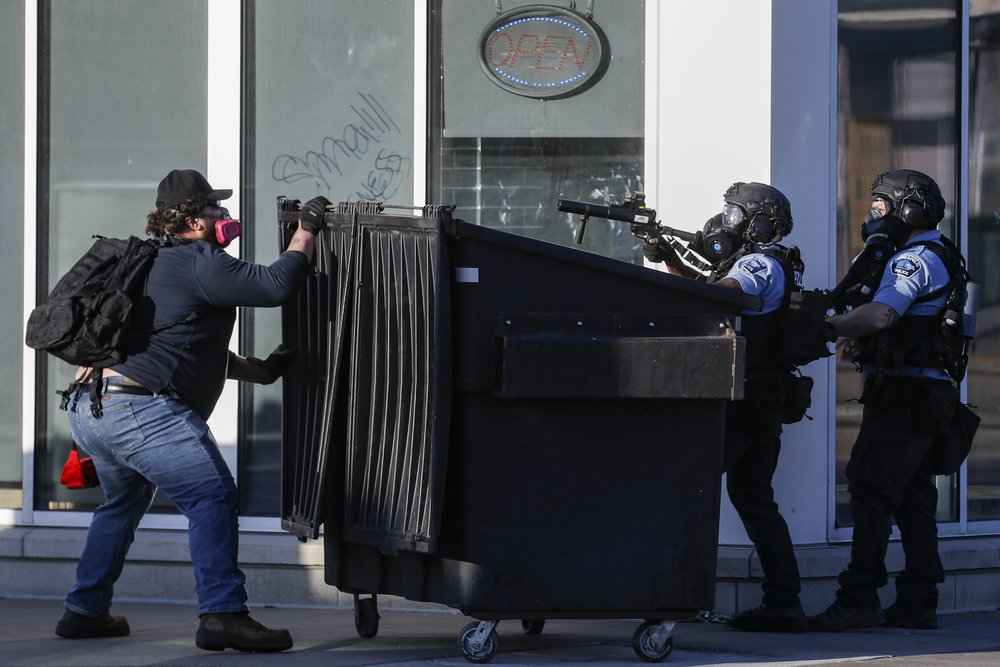
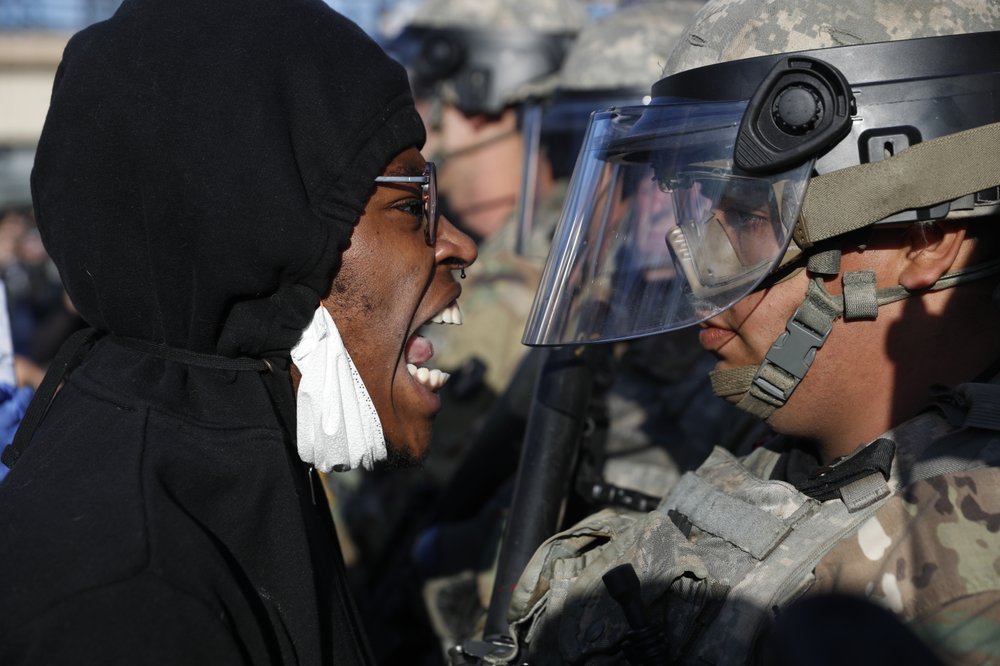
A protestor faces off with two police officers using less-lethal ammunition in their weapons, Thursday, May 28, 2020, in St. Paul, Minn.
A protester gestures in front of the burning 3rd Precinct building of the Minneapolis Police Department on Thursday, May 28, 2020, in Minneapolis.
A woman yells at a sheriff's deputy during a protest following the death of George Floyd at the hand of Minneapolis police officers, Thursday, May 28, 2020, in Minneapolis.
Protestors watch as police in riot gear walk down a residential street, Thursday, May 28, 2020, in St. Paul, Minn.
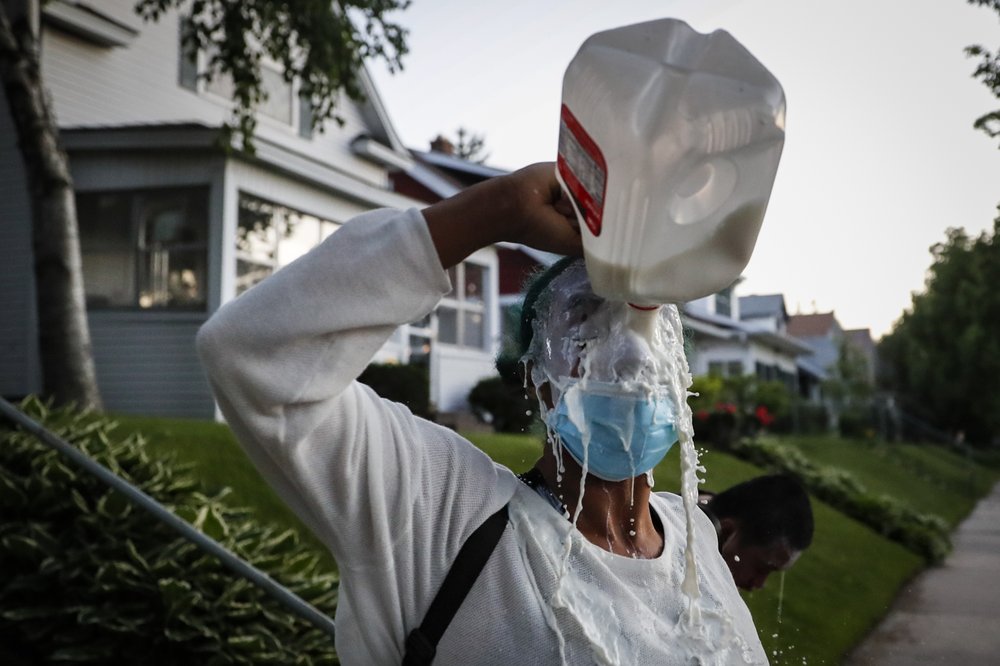
A protestor douses her face with milk after being exposed to tear gas fired by police, Thursday, May 28, 2020, in St. Paul, Minn.
Protestors demonstrate outside of a burning liquor store near the Minneapolis 3rd Police Precinct, Thursday, May 28, 2020, in Minneapolis.
A liquor store is burnt during protests near the Minneapolis 3rd Police Precinct, Thursday, May 28, 2020, in Minneapolis.
Protestors enter a burning Minneapolis 3rd Police Precinct, Thursday, May 28, 2020, in Minneapolis.
The National Guard is in Minneapolis, following a night of unrest that saw protesters torch a police station that the department abandoned. It came after three days of protests over the death of George Floyd who died in police custody.
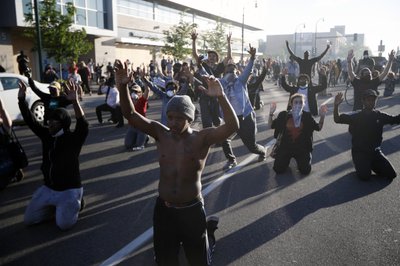
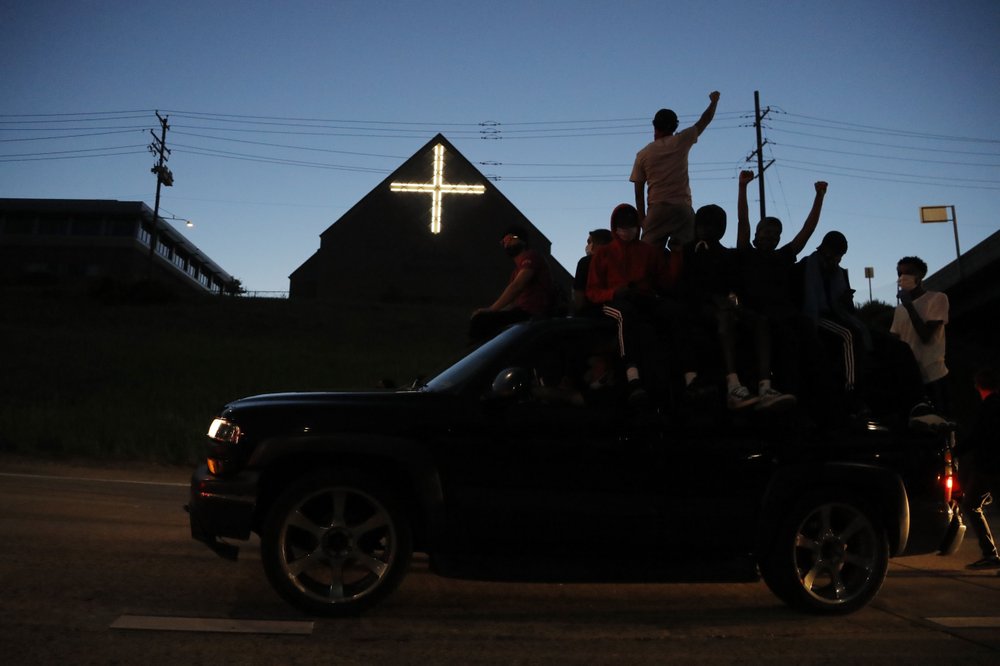
Demonstrators gather in the street with their hands raised Friday, May 29, 2020, in Minneapolis. Protests continued following the death of George Floyd, who died after being restrained by Minneapolis police officers on Memorial Day.
A protester yells at a member of the Minnesota National Guard Friday, May 29, 2020, in Minneapolis.
Minnesota National Guard walk past protesters Friday, May 29, 2020, in Minneapolis.
A protester is doused with milk Friday, May 29, 2020, in Minneapolis.
Protests, some violent, spread in wake of George Floyd death
By SUDHIN THANAWALA, May 29, 2020
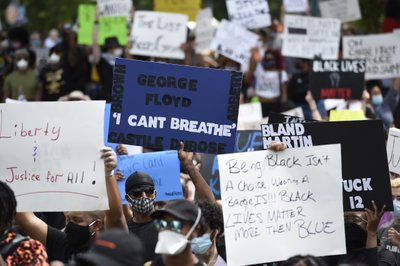
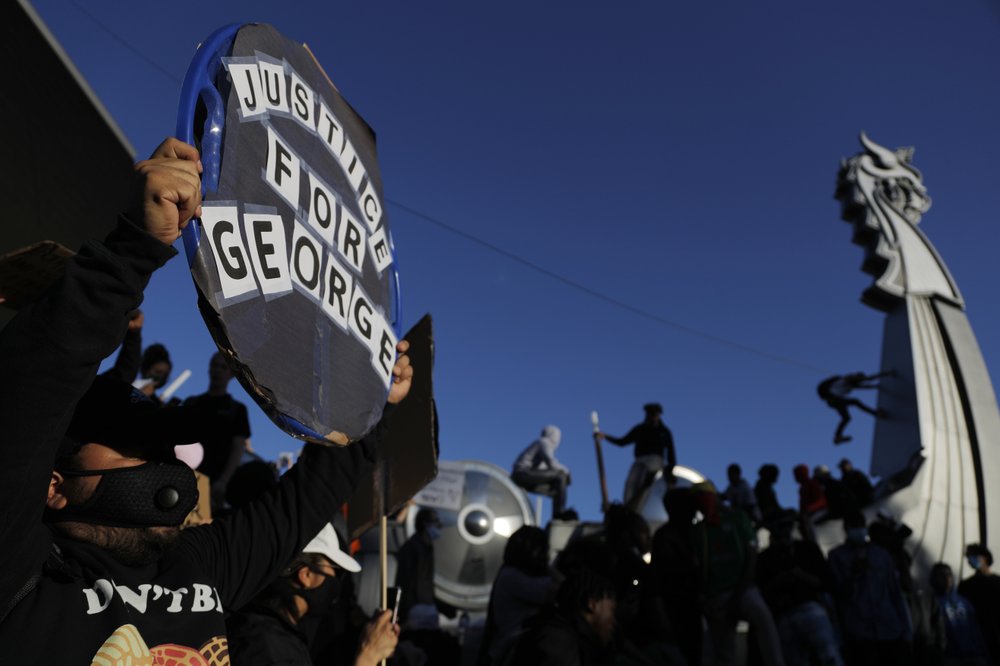
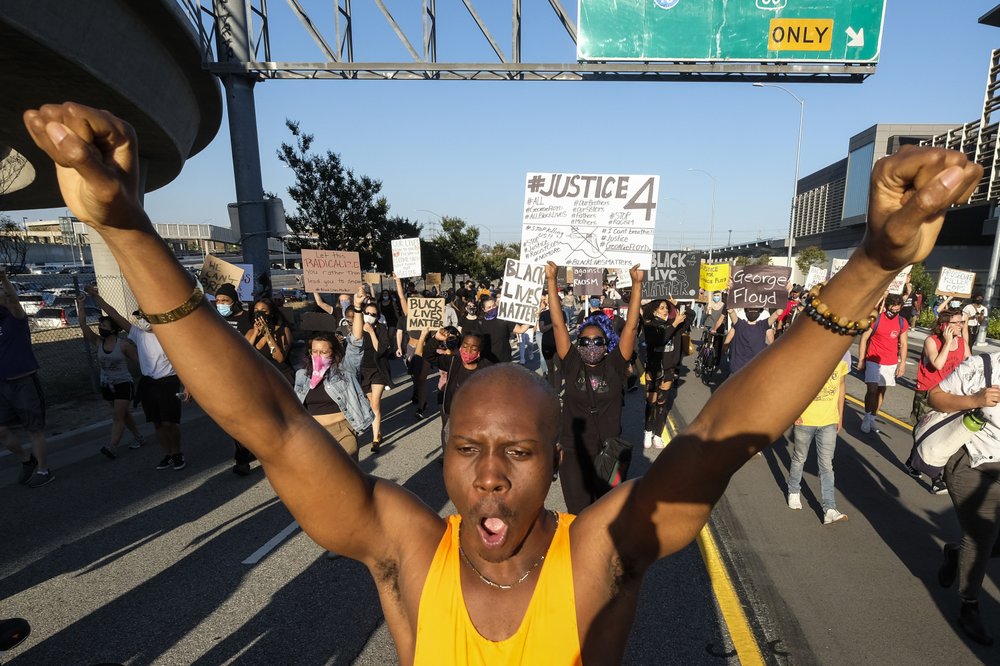
ATLANTA (AP) — Demonstrators marched, stopped traffic and in some cases lashed out violently at police as protests erupted Friday in dozens of U.S. cities following the killing of George Floyd after a white officer pressed a knee into his neck while taking him into custody in Minnesota. In Phoenix, Denver, Las Vegas, Los Angeles and beyond, thousands of protesters carried signs that said: “He said I can’t breathe. Justice for George.” They chanted ”“No justice, no peace” and “Say his name. George Floyd.”
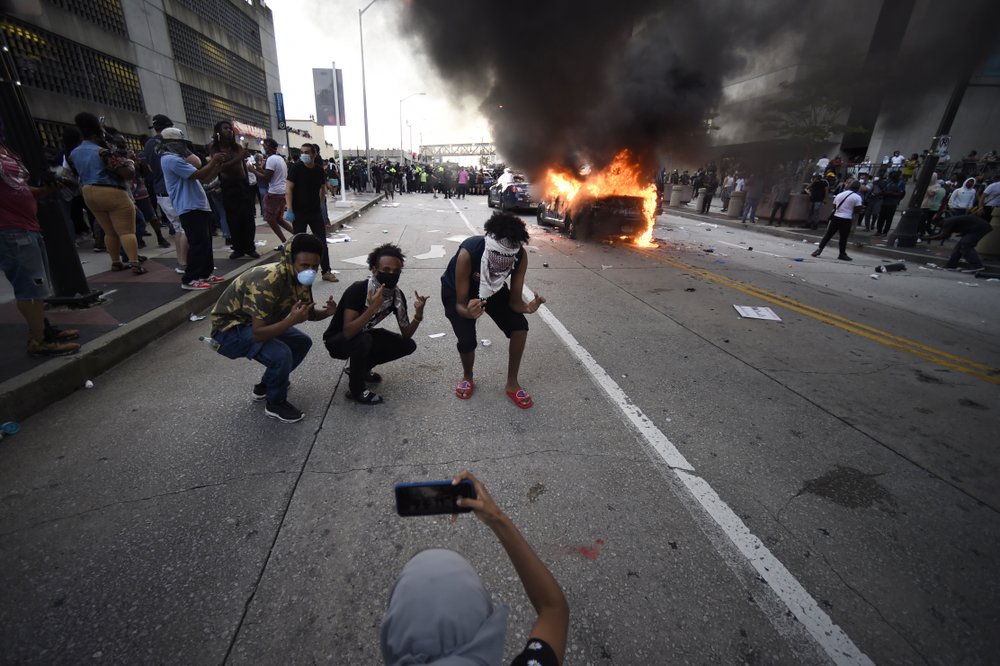
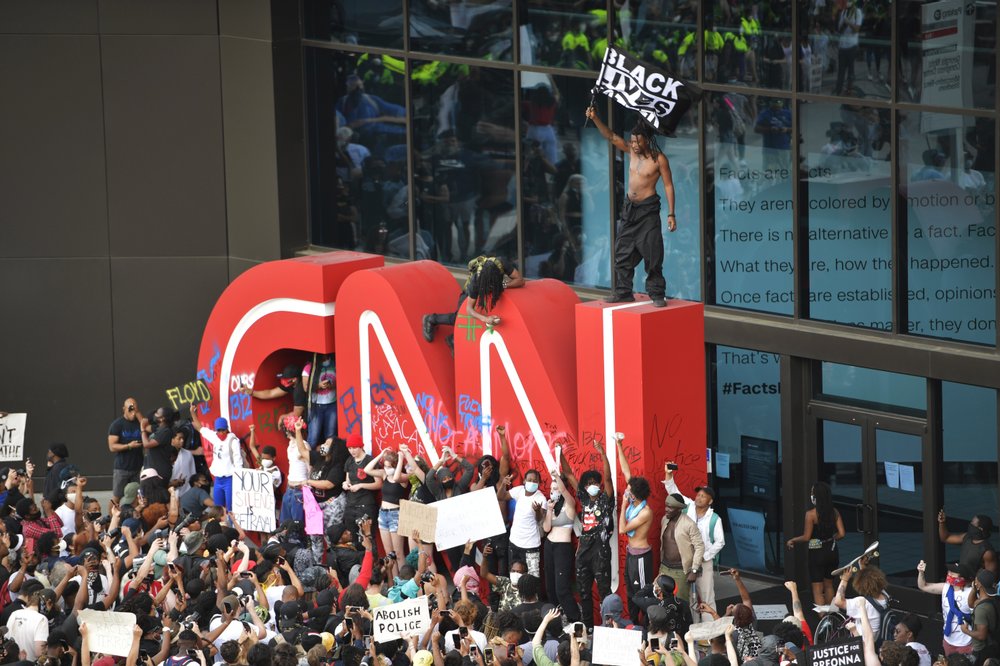
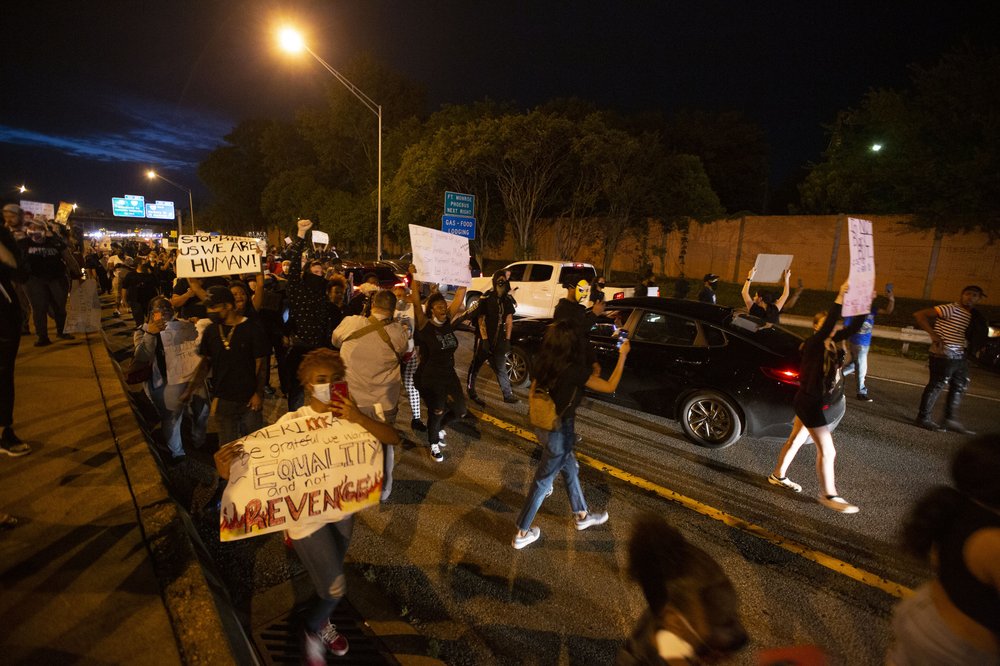
After hours of peaceful protest in downtown Atlanta, some demonstrators suddenly turned violent, smashing police cars, setting one on fire, spray-painting the iconic logo sign at CNN headquarters, and breaking into a restaurant. The crowd pelted officers with bottles, chanting “Quit your jobs.” People watched the scene from rooftops, some laughing as skirmishes broke out. Demonstrators ignored police demands to disperse. Some protesters moved to the city’s major interstate thoroughfare to try to block traffic.
Mayor Keisha Lance Bottoms passionately addressed the protesters at a news conference: “This is not a protest. This is not in the spirit of Martin Luther King Jr.”
“You are disgracing our city,” she told protesters. “You are disgracing the life of George Floyd and every other person who has been killed in this country. We are better than this. We are better than this as a city. We are better than this as a country. Go home, go home.”
Bottoms was flanked by rappers T.I. and Killer Mike, as well as the King’s daughter, Bernice King.
Killer Mike cried as he spoke.
“We have to be better than this moment. We have to be better than burning down our own homes. Because if we lose Atlanta what have we got?” he said.
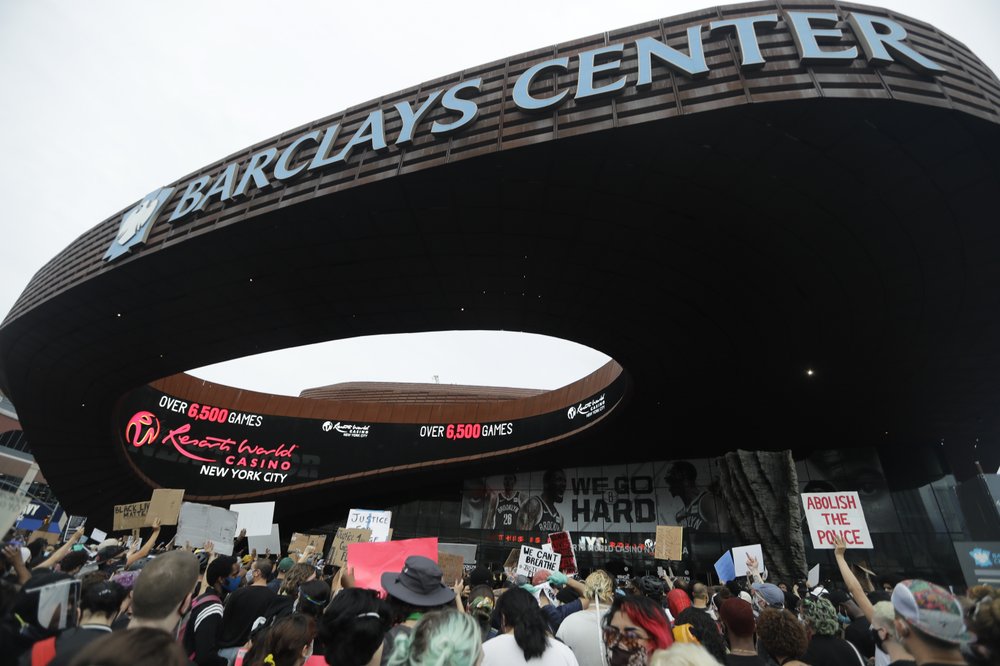
In Brooklyn, crowds of demonstrators chanted at police officers lined up outside the Barclays Center. There were several moments of struggle, as some in the crowd pushed against metal barricades and police pushed back.
Scores of water bottles flew from the crowd toward the officers, and in return police sprayed an eye-irritating chemical at the group twice.
The names of black people killed by police, including Floyd and Eric Garner, who died on Staten Island in 2014, were on signs carried by those in the crowd, and in their chants.
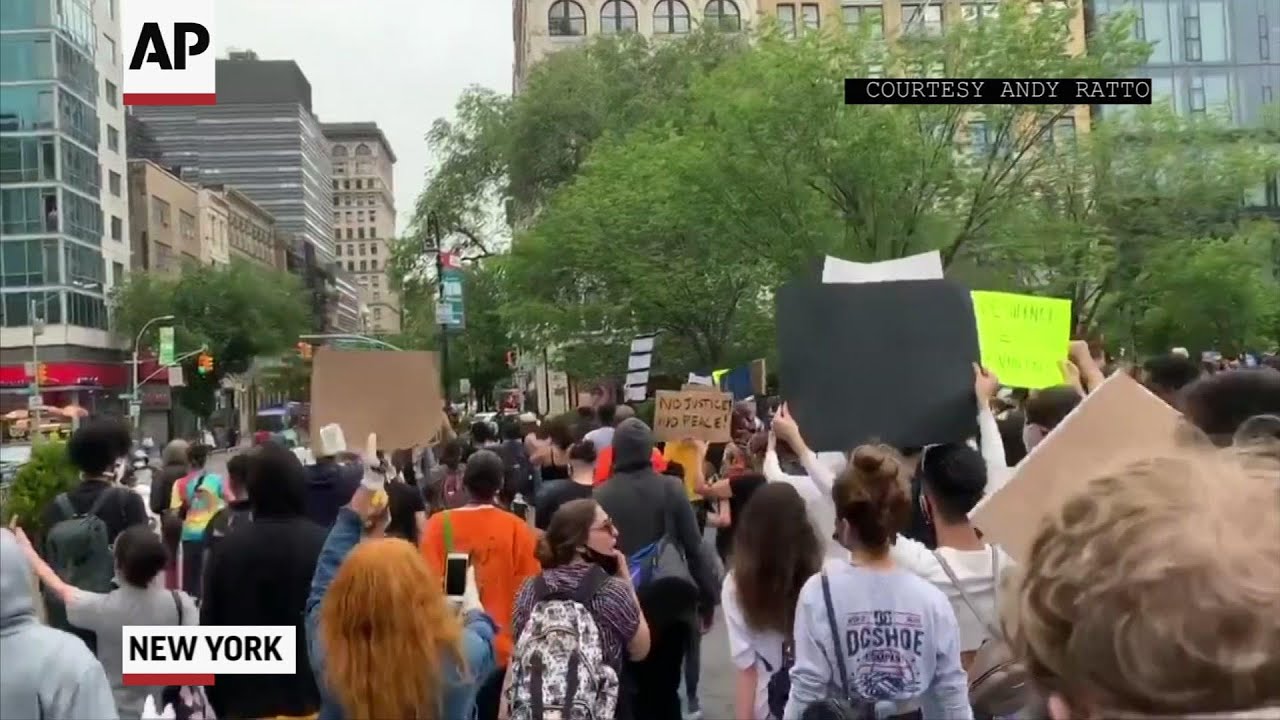
“It’s my duty to be out here,” said Brianna Petrisko, among those at Foley Square in lower Manhattan, where most were wearing masks amid the coronavirus pandemic. “Our country has a sickness. We have to be out here. This is the only way we’re going to be heard.”
In Houston, where George Floyd grew up, several thousand people rallied in front of City Hall. Police had apparently taken into custody a woman who had a rifle and had tried to use it to incite the crowd.
Jimmy Ohaz, 19, came from the nearby city of Richmond, Texas.
“My question is how many more, how many more? I just want to live in a future where we all live in harmony and we’re not oppressed.”
Demonstrators chanting "I can't breathe" and "Black lives matter" took to Manhattan's streets on Thursday in protest of the death of a black Minnesota man who died after a police officer spent minutes kneeling on his neck.
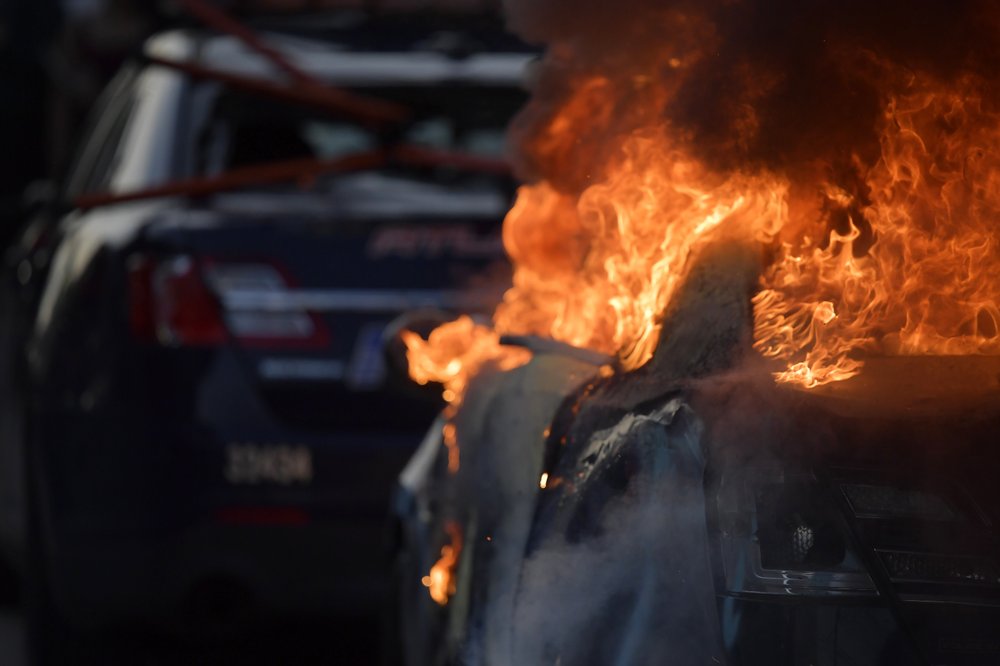
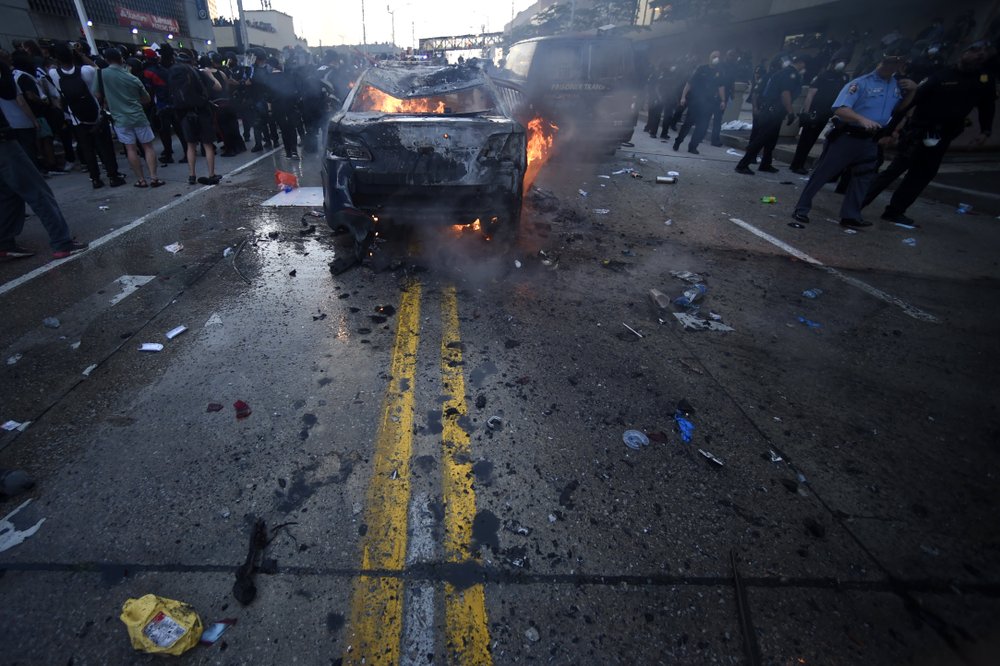
An Atlanta Police Department vehicle burns as people pose for a photo during a demonstration against police violence, Friday, May 29, 2020, in Atlanta. The protest started peacefully earlier in the day before demonstrators clashed with police. The Memorial Day death of George Floyd in police custody in Minneapolis has sparked protests nationwide.
Protesters angered by the death of George Floyd, a handcuffed black man who died while in police custody, took to the streets across the country overnight Thursday.
Protesters angry over the death of George Floyd in Minneapolis police custody turned out for a demonstration in Columbus that began peacefully but turned violent, with police pepper-spraying protesters.
People gathered Friday at the Wisconsin Black Historical Society in Milwaukee to protest George Floyd's killing in Minneapolis.
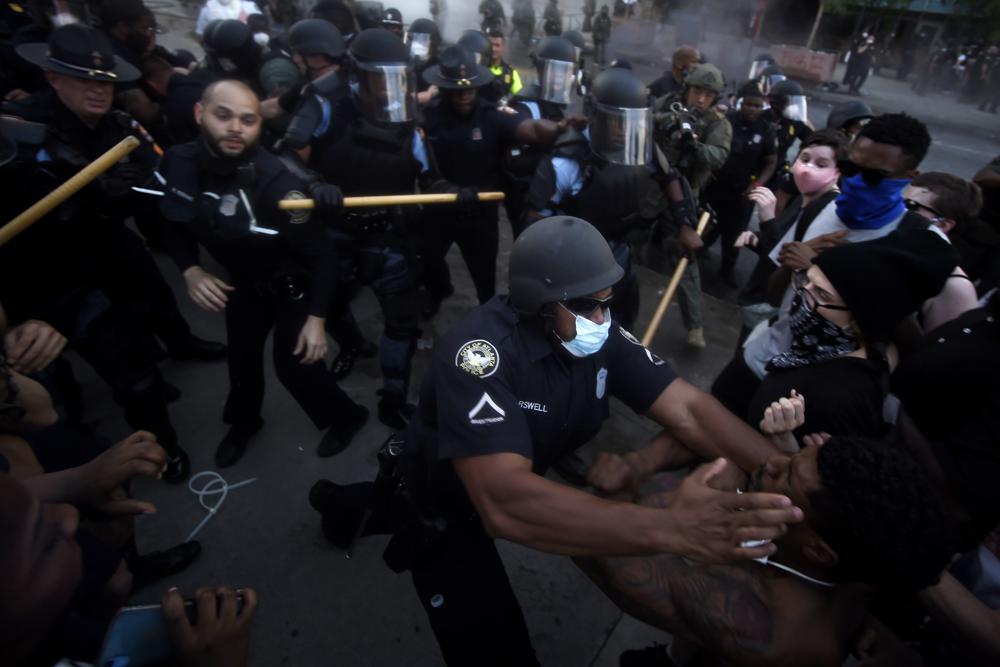
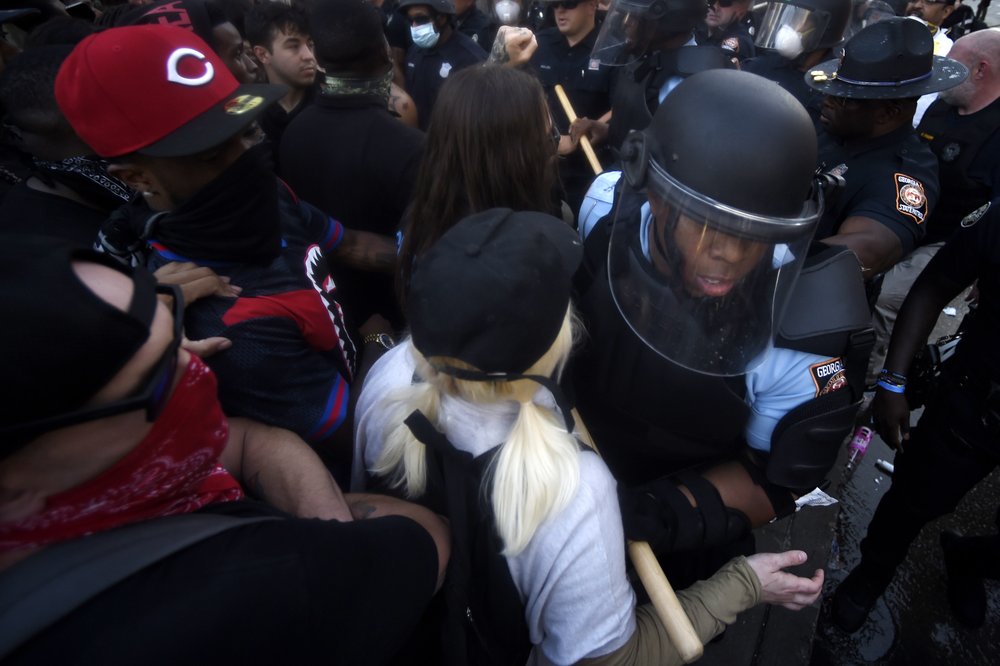
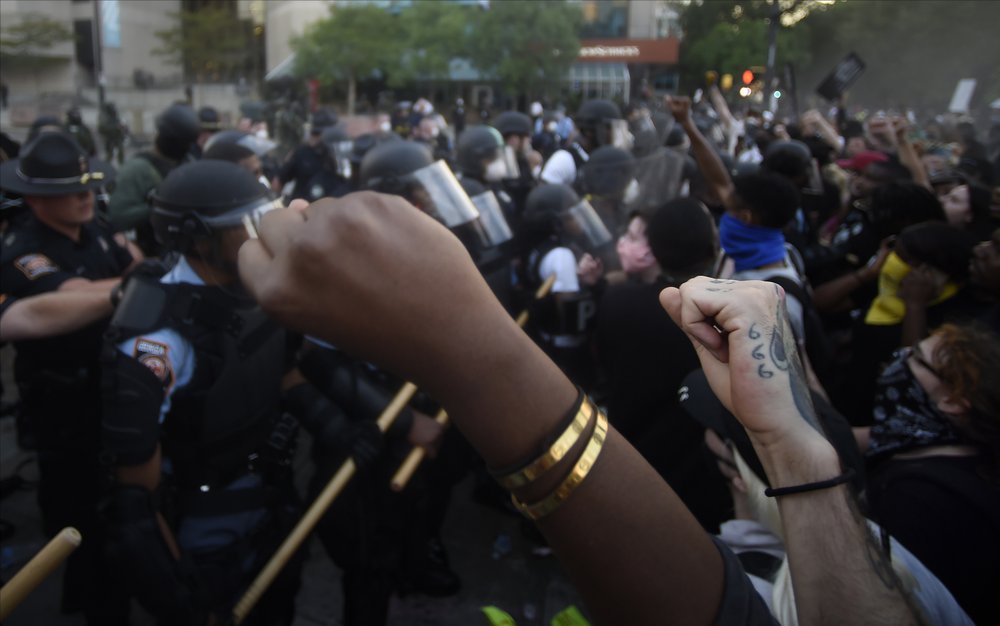
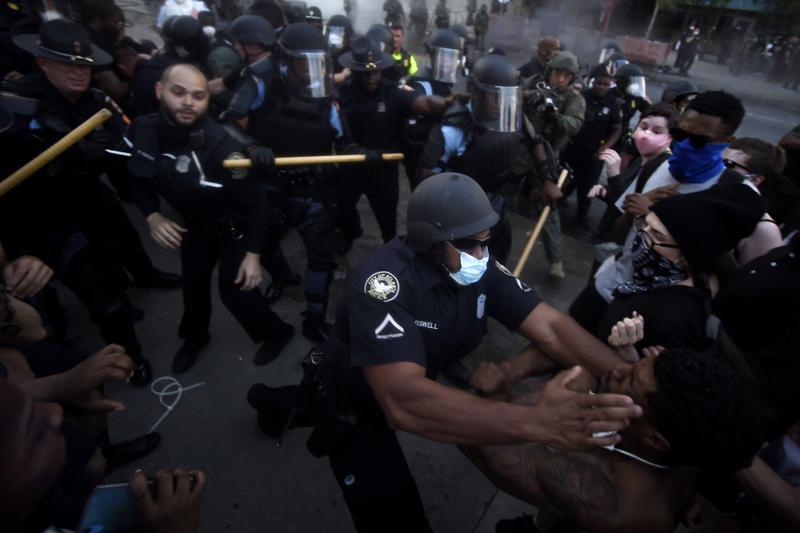
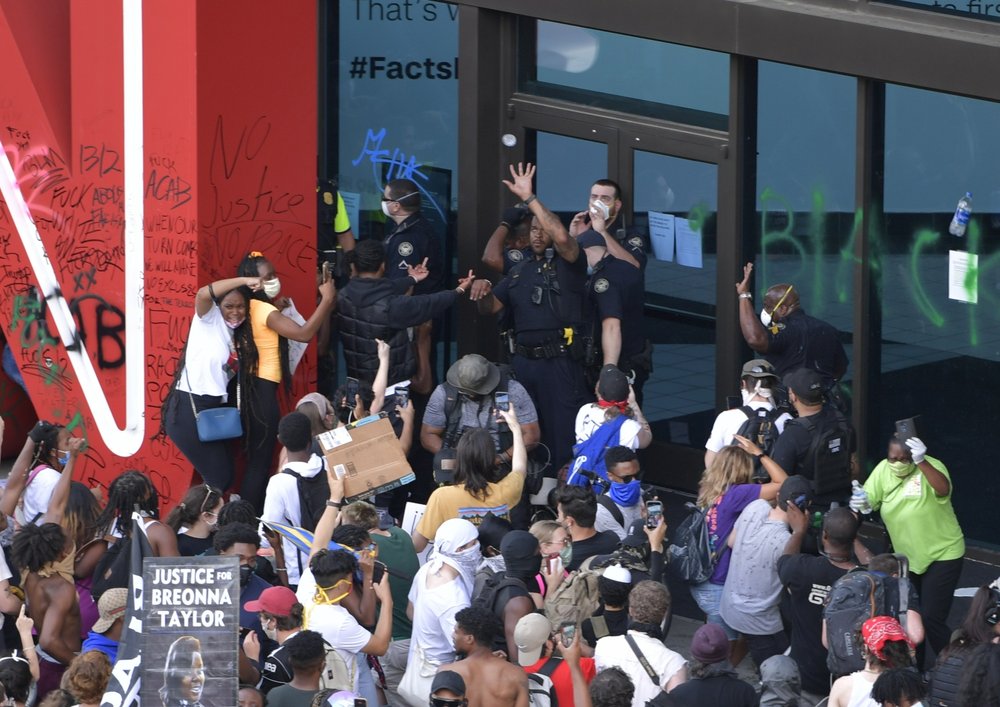
Police officers and protesters clash near CNN Center, Friday, May 29, 2020, in Atlanta, in response to George Floyd's death in police custody in Minneapolis on Memorial Day. The protest started peacefully earlier in the day before demonstrators clashed with police.
An Atlanta Police Department vehicle burns during a demonstration against police violence, Friday, May 29, 2020 in Atlanta.
Police officers and protesters clash near CNN center, Friday, May 29, 2020 in Atlanta. The protest started peacefully earlier in the day before demonstrators clashed with police.
An Atlanta Police Department vehicle burns during a demonstration against police violence, Friday, May 29, 2020 in Atlanta.
Protesters rally at the Barclays Center over the death of George Floyd, a black man who was in police custody in Minneapolis Friday, May 29, 2020, in the Brooklyn borough of New York. Floyd died after being restrained by Minneapolis police officers on Memorial Day.
Police try to contain protesters during a rally at the Barclays Center over the death of George Floyd, a black man who was in police custody in Minneapolis Friday, May 29, 2020, in the Brooklyn borough of New York.
A protester is hit with a baton by San Jose police, Friday, May 29, 2020, in San Jose, Calif., as more demonstrations take place nationally after George Floyd died in police custody on Memorial Day.
A masked woman speaks with a San Jose police officer while protesting on Friday, May 29, 2020, in San Jose, Calif.
Protests, some violent, spread in wake of George Floyd death
By SUDHIN THANAWALA
ATLANTA (AP) — Demonstrators marched, stopped traffic and in some cases lashed out violently at police as protests erupted Friday in dozens of U.S. cities following the killing of George Floyd after a white officer pressed a knee into his neck while taking him into custody in Minnesota.
Georgia’s governor declared a state of emergency in one county to activate up to 500 members of the state National Guard “to protect people & property in Atlanta.”
Gov. Brian Kemp said in a pair of tweets early Saturday that the move came at the request of Atlanta Mayor Keisha Lance Bottoms and in consultation with emergency officials. The Georgia National Guard will deploy “immediately” to assist law enforcement, he said.
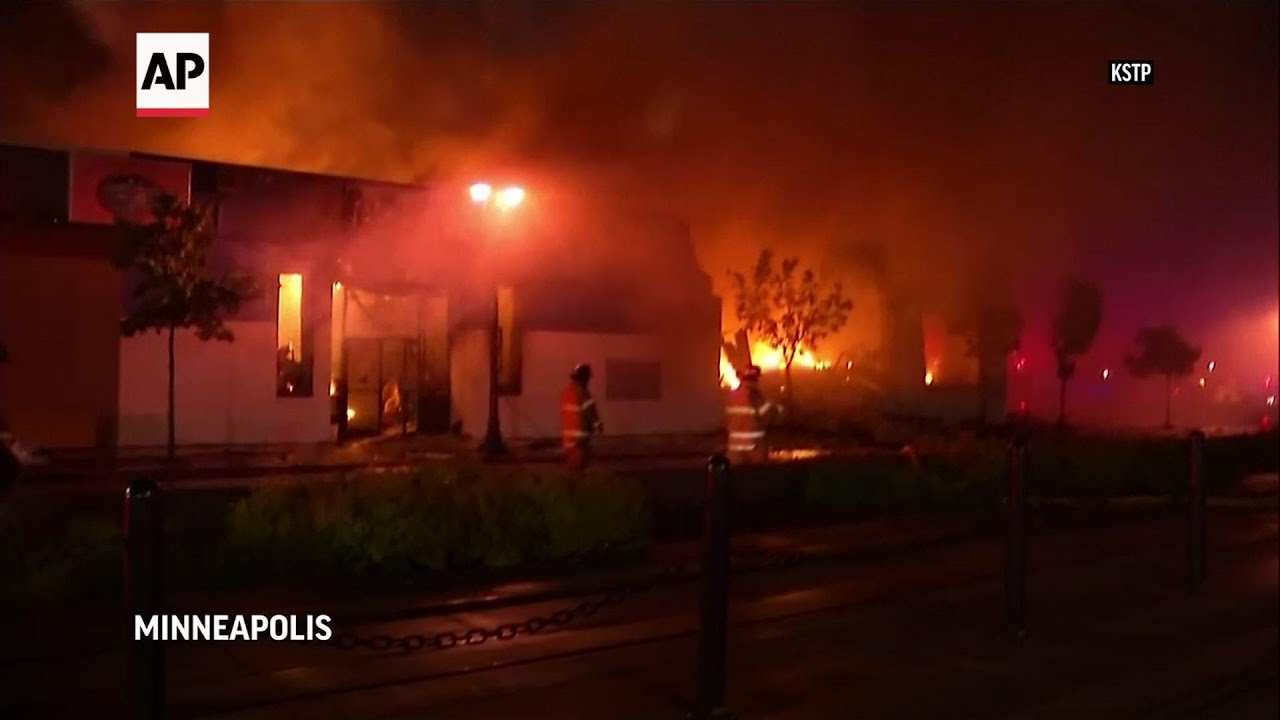
In Minneapolis, where a police precinct was burned the night before, peaceful protests picked up steam as darkness fell, with thousands of people ignoring an 8 p.m. curfew to walk streets in the southern part of the city. Some cars were set on fire in scattered neighborhoods, business break-ins began and eventually there were larger fires. As a pair of restaurants and a Wells Fargo branch were set ablaze, a heavy contingent of National Guard, state troopers and police moved in, some on foot and some in vehicles.
In Phoenix, Denver, Las Vegas, Los Angeles and beyond, thousands of protesters carried signs that said: “He said I can’t breathe. Justice for George.” They chanted ”“No justice, no peace” and “Say his name. George Floyd.”
After hours of peaceful protest in downtown Atlanta, some demonstrators suddenly turned violent, smashing police cars, setting one on fire, spray-painting the iconic logo sign at CNN headquarters, and breaking into a restaurant. The crowd pelted officers with bottles, chanting “Quit your jobs.”
At least three officers were hurt and there were multiple arrests, Atlanta police spokesman Carlos Campos said. Campos said protesters shot BB guns at officers and threw bricks, bottles and knives at them. People watched the scene from rooftops, some laughing as skirmishes broke out.
Bottoms passionately addressed the protesters at a news conference: “This is not a protest. This is not in the spirit of Martin Luther King Jr.”
“You are disgracing our city,” she told protesters. “You are disgracing the life of George Floyd and every other person who has been killed in this country. We are better than this. We are better than this as a city. We are better than this as a country. Go home, go home.”
Bottoms was flanked by rappers T.I. and Killer Mike, as well as King’s daughter, Bernice King.
Killer Mike cried as he spoke.
“We have to be better than this moment. We have to be better than burning down our own homes. Because if we lose Atlanta what have we got?” he said.
After Mayor Bottoms appealed for calm, the violence continued. More cars were set on fire, a Starbucks was smashed up, the windows of the College Football Hall of Fame were broken, and the iconic Omni Hotel was vandalized.
Protesters gathered outside the White House, with President Donald Trump inside, and some tried to push through barriers set up by the U.S. Secret Service along Pennsylvania Avenue.
An initially peaceful demonstration in New York City spiraled into chaos as night fell, as protesters skirmished with officers, destroyed police vehicles and set fires.
In Brooklyn, activists who had marched from Manhattan chanted insults at officers lined up outside the Barclays Center and pelted them with water bottles. Police sprayed an eye-irritating chemical into the largely diverse crowd multiple times, then cleared the plaza.
Video posted to social media showed officers using batons and shoving protesters down as they took people into custody and cleared streets.
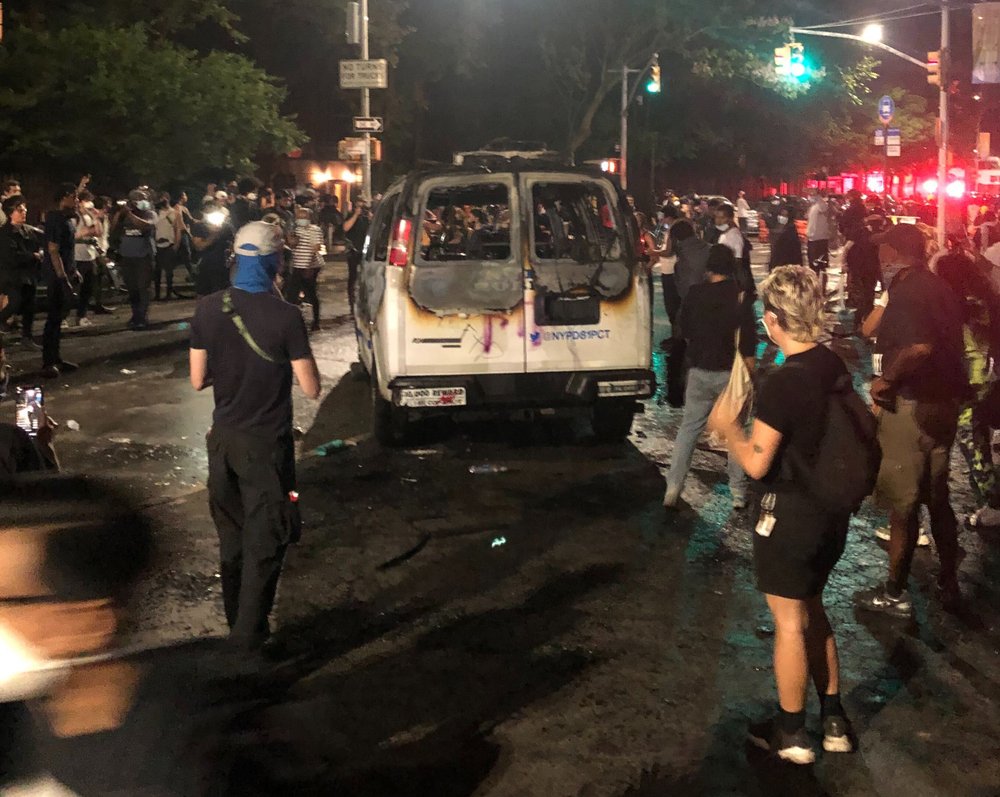
Demonstrators rocked a police van, set it ablaze, then scrawled graffiti across its charred hulk and set it on fire a second time as officers retreated from the area. Blocks away, protesters used a club to batter another police vehicle.
Numerous people were arrested and police brought in buses to carry off those they arrested.
“We have a long night ahead of us in Brooklyn,” Mayor Bill de Blasio tweeted. “Our sole focus is deescalating this situation and getting people home safe. There will be a full review of what happened tonight. We don’t ever want to see another night like this.”
The police department said numerous officers were injured, including one who had a tooth knocked out.
The names of black people killed by police, including Floyd and Eric Garner, who died on Staten Island in 2014, were on signs carried by those in the crowd, and in their chants.
“It’s my duty to be out here,” said Brianna Petrisko, among those at Foley Square in lower Manhattan, where most were wearing masks amid the coronavirus pandemic. “Our country has a sickness. We have to be out here. This is the only way we’re going to be heard.”
In Houston, where George Floyd grew up, several thousand people rallied in front of City Hall. Among them was 19-year-old Jimmy Ohaz, who came from the nearby city of Richmond, Texas.
“My question is how many more, how many more? I just want to live in a future where we all live in harmony and we’re not oppressed.”
Tensions rose in several West Coast cities as night fell and protesters blocked highways in Los Angeles and Oakland.
About 1,000 protesters gathered in Oakland. They smashed windows, sprayed buildings with “Kill Cops” graffiti and were met with chemical spray from police. Oakland Police were notifying a crowd that the demonstrationwas an unlawful assembly. Authorities said officers were injured when projectiles were thrown and that they were asking people to leave the area.
Demonstrators in Los Angeles scuffled at times with police, with a few protesters detained and one officer receiving medical treatment, police said. An LAPD vehicle had its windows smashed, and CNN reported that someone wrote “killer” on a patrol car.
Protesters repeatedly clashed with police in the Silicon Valley city of San Jose, said Mayor Sam Liccardo, and police responded with flash-bang grenades and rubber bullets. One officer was being treated at a hospital for an injury that was not life-threatening, he and police officials said.
Liccardo said his own officers shared the community’s outrage over Floyd’s in-custody death.
“It was a horrible injustice. I’d venture to guess that every police officer out there feels much of the same anger about what happened in Minneapolis,” he told The Associated Press.
Thirty miles to the west, Santa Cruz police chief Andrew G. Mills said in a statement that the actions by Minneapolis officers in Floyd’s death “are the antithesis of what we view as good policing.”
Protesters move along a highway, Friday, May 29, 2020, in Minneapolis. Protests continued following the death of George Floyd, who died after being restrained by Minneapolis police officers on Memorial Day.
Protesters gather outside the Minnesota Vikings football stadium, Friday, May 29, 2020, in Minneapolis. Protests continued following the death of George Floyd, who died after being restrained by Minneapolis police officers on Memorial Day.
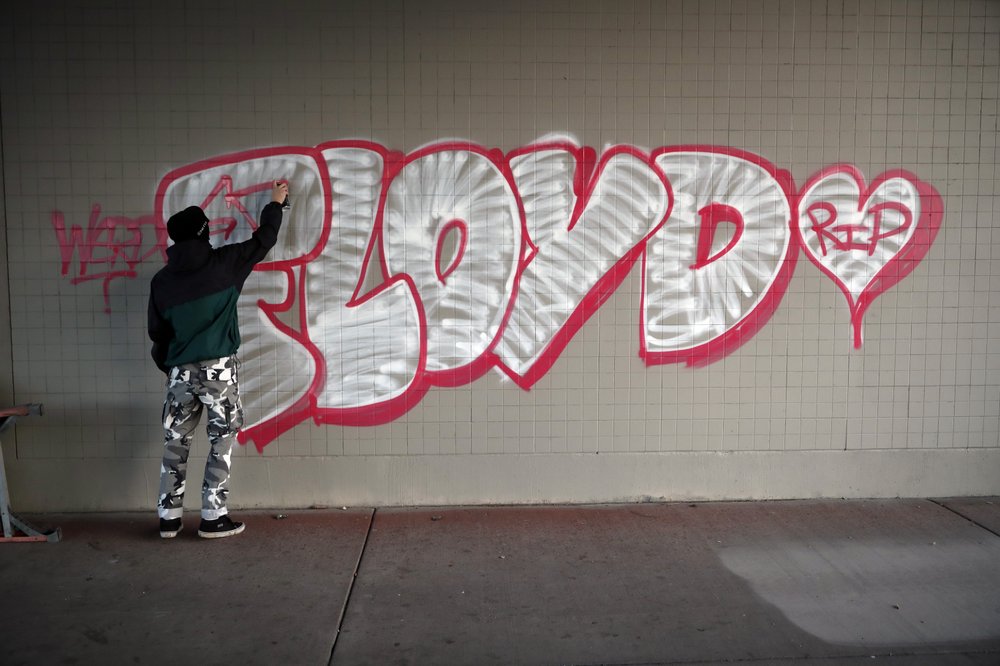
A protester spray paints George Floyd's name Friday, May 29, 2020, in Minneapolis. Protests continued following the death of Floyd who died after being restrained by Minneapolis police officers on Memorial Day.
Demonstrators paint on the CNN logo during a protest, Friday, May 29, 2020, in Atlanta, in response to the death of George Floyd in police custody on Memorial Day in Minneapolis. The protest started peacefully earlier in the day before demonstrators clashed with police.
A protester charges police on Friday, May 29, 2020, in San Jose, Calif., as protests continue nationwide over the death of George Floyd while in police custody on Memorial Day in Minneapolis.
A protester is arrested by San Jose police on Friday, May 29, 2020, in San Jose, Calif., as protests continue nationwide over the death of George Floyd while in police custody on Memorial Day in Minneapolis.
Protesters clash with Houston Police officers as they take to Bagby Street near City Hall in Houston, Friday, May 29, 2020, during a demonstration over the death of George Floyd. Floyd died Memorial Day while in the custody of the Minneapolis police.
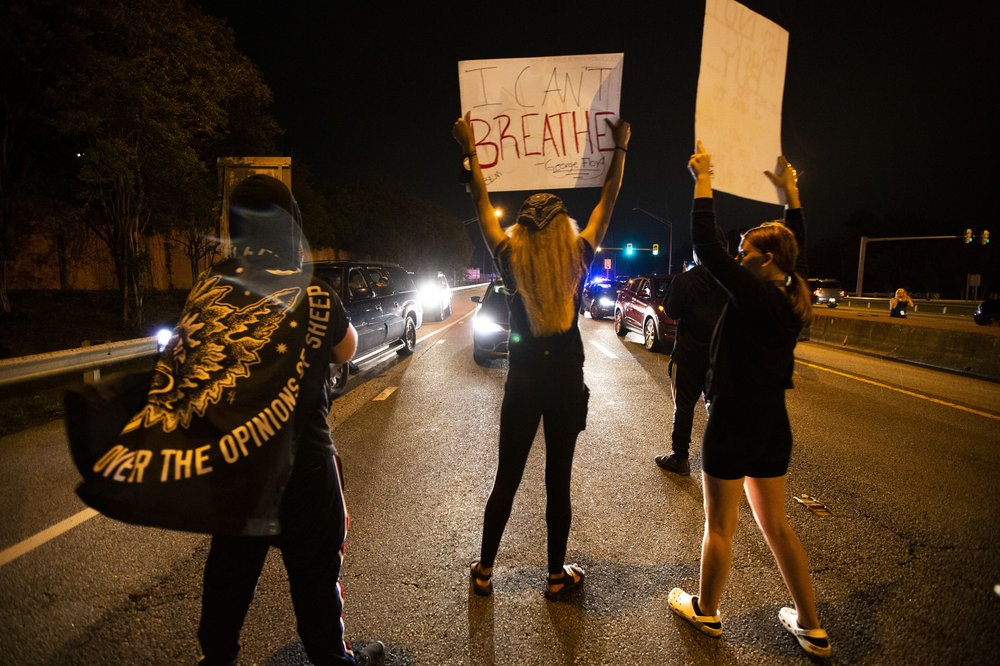
Protesters shout "I can't breathe!" as they block Interstate 64 West bound, late Friday, May 29, 2020, in Hampton, Va., protesting the death of George Floyd, a handcuffed black man who pleaded for air as a white Minnesota police officer knelt on his neck.
Two women lie on the street with signs during a protest over the death of George Floyd, Friday, May 29, 2020, in Los Angeles. Floyd died in police custody Monday in Minneapolis.
Protesters shout "I can't breathe" as they block I-64 westbound Friday, May 29, 2020, in Hampton, Va., while protesting the death of George Floyd. Floyd died Memorial Day while in the custody of the Minneapolis police.
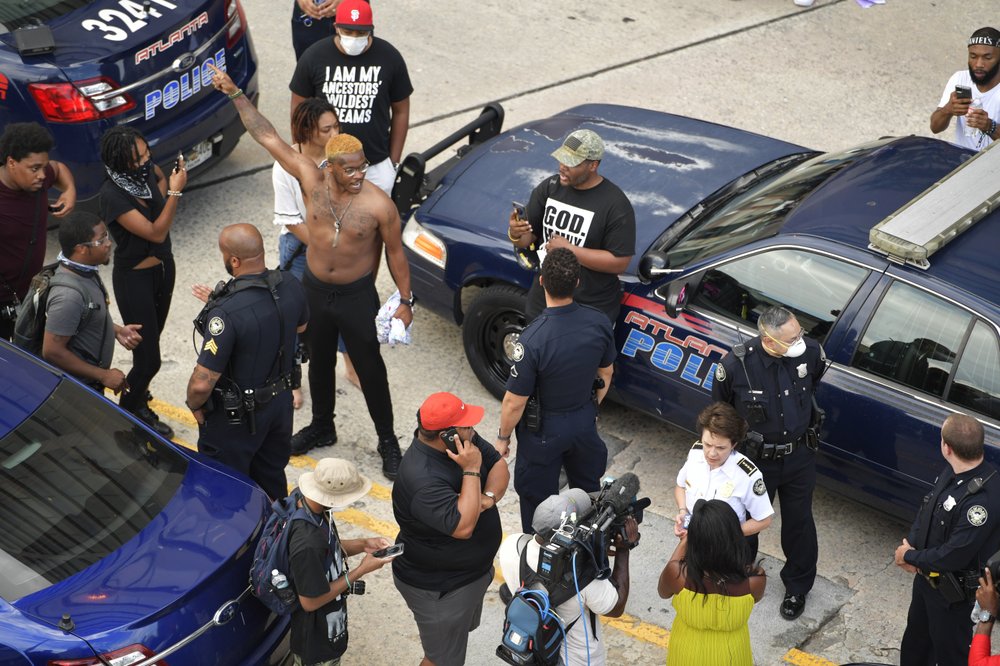
Atlanta Police Chief Erika Shields speaks with media as protesters gather, Friday, May 29, 2020, in Atlanta, in response to the death of George Floyd in police custody on Memorial Day in Minneapolis.
Demonstrators throw water bottles and other items at police during a protest, Friday, May 29, 2020, in Atlanta, in response to the Memorial Day death of George Floyd in police custody in Minneapolis. The protest started peacefully earlier in the day before demonstrators clashed with police.
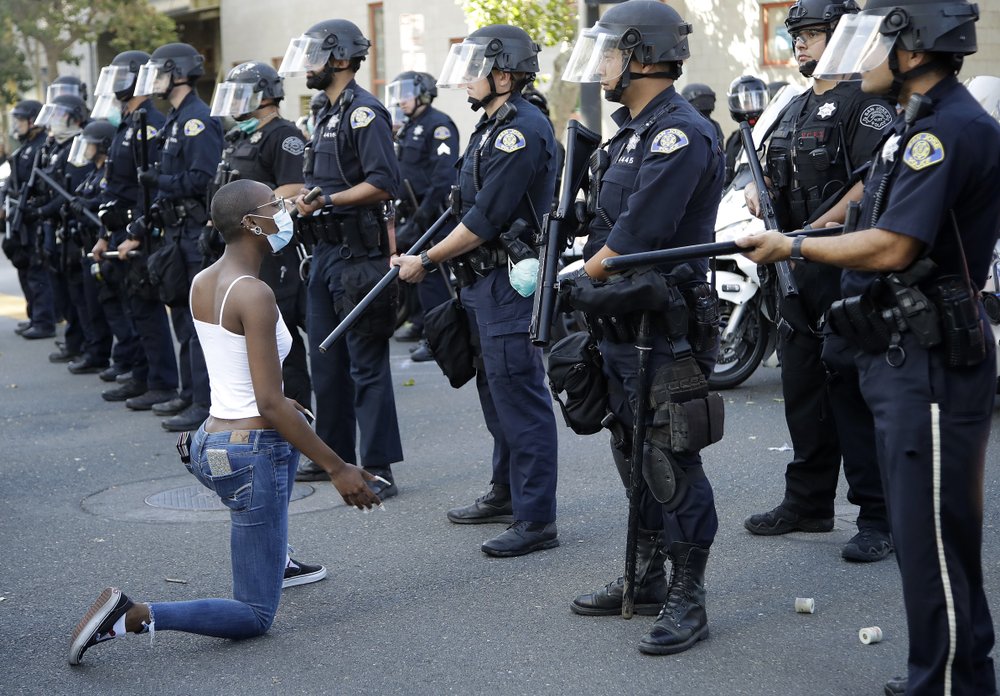
A masked protester kneels before San Jose police on Friday, May 29, 2020, in San Jose, Calif., in response to the death of George Floyd in police custody on Memorial Day in Minneapolis.
Protesters stand near a burned New York City Police Department van in the Brooklyn borough of New York, Friday, May 29, 2020. Demonstrators took to New York City streets on Friday for a second day in protest of the death of George Floyd, the black Minnesota man killed in Minneapolis police custody.
An ampule of remdesivir is pictured during a news conference at the University Hospital Eppendorf (UKE) in Hamburg, Germany, April 8, 2020, as the spread of coronavirus disease (COVID-19) continues.
European, South Korean authorities vie for COVID-19 antiviral remdesivir
Carl O'Donnell, Pushkala Aripaka
(Reuters) - European and South Korean authorities are vying for Gilead Sciences’ (GILD.O) potential COVID-19 treatment, remdesivir, even though the drugmaker has yet to gain regulatory approval in either market and is still ramping up production of the anti-viral drug.
Governments are racing to bolster supplies of remdesivir, which U.S. regulators greenlighted this month as a treatment for the novel coronavirus. Foster City, California-based Gilead said it will donate 1.5 million doses of remdesivir, enough to treat at least 140,000 patients, to combat the global pandemic.
There is currently no approved medication or vaccine for the highly contagious and sometimes fatal illness, but EU countries are already administering remdesivir to COVID-19 patients under compassionate use rules.
The European Medicines Agency (EMA) noted it has not yet received an application from the U.S. drugmaker, but said its human medicines committee's (CHMP) timeline to assess the drug would be "reduced to the absolute minimum,". (bit.ly/2ZPh6HA)
Two weeks ago, the regulator told the European Parliament it may give an initial green light for sale of remdesivir as a COVID-19 treatment, fast-tracking the drug to market amid tight global competition for resources. (reut.rs/3gv8nQN)
On Friday, South Korean health authorities said they would request imports of remdesivir to treat COVID-19, as new outbreaks of the disease flare after social distancing restrictions were eased.
This month, the U.S. Department of Health and Human Services said Gilead had committed to supply U.S. hospitals with about 607,000 vials of remdesivir, about 40% of the total 1.5 million-vial donation.
Japan and the United Kingdom have both cleared the drug for use and moved to begin supplying it to patients.
The United States, the world's biggest pharmaceutical market, this month granted emergency use authorization for remdesivir in COVID-19, but has yet to approve the broader use of the drug. (reut.rs/2zLw6es)
The EMA has been reviewing the drug and suggested a beneficial effect in treating hospitalised patients with mild-to-moderate or severe COVID-19. (bit.ly/2TREq3v)
Final approvals are up to the European Commission, which generally endorses CHMP recommendations.
Remdesivir is the first drug to show benefit in a large placebo-controlled trial. Preliminary results from a National Institute of Allergy and Infectious Diseases (NIAID) trial showing the drug cut hospital stays by 31%, or about four days, compared with a placebo
Last month, Gilead said it will work with international partners to expand production of remdesivir. The company said it expects to have more than a million remdesivir treatment courses manufactured by December, “with plans to be able to produce several million treatment courses in 2021.”
The U.S. government began distributing the drug this month but doctors said they were concerned after being denied their request to obtain the new therapy, IDSA president Dr. Thomas File told Reuters in May.
Testing Is Key to Beating Coronavirus, Right? Japan Has Other Ideas
The country (17,545, 902, 39th) has reported fewer deaths than other major nations and ended a state of emergency even while maintaining a low testing rate.
NYT, Ben Dooley & Makiko Inoue, May 29, 2020
TOKYO — As the world tries to get a handle on the coronavirus and emerge from paralyzing lockdowns, public health officials have repeated a mantra: “test, test, test.”
But Japan went its own way, limiting tests to only the most severe cases as other countries raced to screen as many people as possible. Medical experts worried that the approach would blind the country to the spread of infection, allowing cases to explode and swamping hospitals.
It hasn’t happened. Japan — the grayest country in the world and a popular tourist destination with large, crowded cities — has one of the lowest mortality rates from Covid-19 among major nations. The medical system has not been overwhelmed. And the government never forced businesses to close, although many chose to.
This week, Prime Minister Shinzo Abe declared Japan’s battle against the outbreak a resounding success, taking the country off an emergency footing — a sort of “lockdown lite” that lasted only a month and a half.
“By doing things in a uniquely Japanese way, we were able to almost completely end this wave of infection,” Mr. Abe said, adding that what he called the “Japan model” offered a path out of the global pandemic.
It’s still unclear, though, exactly what accounts for Japan’s achievement and whether other countries can take lessons from its approach. Critics say Japan undercounted coronavirus deaths. And some warn that further waves of infection could undermine the government’s self-congratulatory pronouncements.
Instead of testing widely to understand and limit the virus’s spread through the general population, Japan has focused on quickly containing small outbreaks through contact tracing. Instead of dictating strict constraints on daily life, it has focused on educating people about measures like social distancing and gently prodding them to follow along.
The Kabukicho district in Tokyo on Monday as Prime Minister Shinzo Abe announced that he was lifting a state of emergency.
Theories for the country’s relatively low mortality rate run the gamut from cultural attributes — widespread mask wearing, a practice of regular hand washing, a near absence of physical greetings like hugs and handshakes — to just plain luck.
A combination of many other factors, including government measures and changes in behavior among a public that feels strong pressure to follow the rules, could also be at work.
Individual actions “may seem small or mundane,” said Keiji Fukuda, an epidemiologist who directs the School of Public Health at the University of Hong Kong. But, he added, “the cumulative impact of all of those efforts across the entire country to really implement some kind of distancing” may have been substantial.
Whatever the formula, Japan has so far succeeded in keeping deaths low. The country has recorded fewer than 900 deaths even as the United States and European countries have reported tens of thousands.
Epidemiologists say widespread testing for the virus is important because it allows officials to isolate those who test positive, and to track trends in infection rates to help determine when it is safe to reopen schools, businesses and other places where people congregate.
Restaurants in the Shinjuku district on Tuesday, the day after the state of emergency ended.
Researchers at Harvard have said the goal should be to test nearly everyone who has at least mild flulike symptoms, as well as an average of 10 contacts for each person who tests positive.
Countries like South Korea and China that faced fast-growing outbreaks early in the pandemic quickly ramped up testing. China performed more than three times as many tests in Wuhan in a single day than those Japan has conducted nationwide since Feb. 18 — about 455,000 tests on around 278,000 people.
Japan initially told people who suspected they were infected with the virus not to seek help unless they had experienced a fever for four days, or two days if they were over 65. Even some people with seemingly severe symptoms were refused, provoking theories that the government was trying to hide the true extent of the problem.
Medical experts said the guideline was intended to conserve hospital resources. A national law on infectious diseases mandated that anyone who tested positive, even those who were asymptomatic, had to be placed in one of the country’s few isolation wards, creating a strong disincentive for doctors to test patients with milder symptoms.
The Japanese government also said early on that test kits must be rationed because they were in short supply. That argument has since faded, however, as Japan has never used even half of its testing capacity on any given day, and it has increased its testing capacity to just over 24,000 a day.
Cleaning escalators in Tokyo.
Japan has since eased its rules to allow those who test positive but are asymptomatic to stay in hotels. It is preparing to begin limited testing for antibodies, hoping to get a better grasp of the number of people who have been infected. It also plans to introduce a smartphone app to help with contact tracing.
Despite the constrained testing for the virus, the rate of positive results has dropped below 1 percent, a fact that the government’s expert panel on the virus says demonstrates that current testing levels are sufficient.
But a group of prominent Japanese academics, businesspeople and other figures has called on the government to take a much bolder step: build a capacity of 10 million tests a day and offer testing to anyone who wants it. Consecutive negative results, the group argues, could allow people to fully resume social and economic activities.
As the country has seemingly defied the odds, many public health experts, including some in the government, have warned against drawing any definite conclusions from Japan’s experience.
They caution that Japan is not in the clear yet, and that a second or third wave of infections could strike at any time. As more data on deaths from this year becomes available — there are indications that Tokyo has undercounted dozens of coronavirus deaths — the picture may not look quite as good.
Social distancing at a bank in Tokyo.
Some say Japan may have a large hidden population of asymptomatic cases. Shigeru Omi, the deputy head of the government’s expert panel on the coronavirus, told lawmakers that the real number of infections could be as much as 10 or 20 times as high as currently believed. Japan has reported fewer than 17,000 cases, versus more than 1.7 million in the United States.
Norio Sugaya, an infectious diseases expert at Keiyu Hospital in Yokohama, noted that Japan’s mortality rate, while vastly lower than those in hard-hit countries like Spain or Britain, is one of the worst in Asia.
In February, an outbreak of the virus aboard the cruise ship Diamond Princess left officials scrambling. The response was widely seen as a disaster, but health experts turned it into a learning opportunity.
Epidemiologists and public health experts used the data from the ship to help develop a framework for stopping the virus’s spread in Japan.
The approach emphasized reducing people’s exposure to the conditions that led the pathogen to spread on the ship. A public education campaign urged people to avoid the “Three C’s” — closed spaces with poor ventilation, crowded places and close contact.
Protective sheeting at a 7-Eleven store in Tokyo last month.
On TV talk shows, hosts took a “no question is too stupid” approach to talking about the virus, assuaging viewers’ anxiety and stressing the basic science of prevention: wash your hands, wear a mask, keep your distance from others.
At the same time, community health centers raced to investigate clusters using a monitoring system that had been developed to trace cases of influenza and tuberculosis.
Another key factor may have been Mr. Abe’s decision to close schools in late February, well before almost any other country. The decision was hugely unpopular, but it appears to have provoked an almost instantaneous change in behavior, according to polling conducted by researchers at Hiroshima University.
The day after the announcement, the percentage of people who were avoiding crowded places nearly doubled, rising to almost 60 percent. By mid-March, it was over 75, the study found.
In April, as cases began to spike, Mr. Abe declared a state of emergency. Businesses were requested to close or reduce their hours. People were asked to make only necessary trips. There were no penalties, but many complied anyway.
Makoto Sasho, 50, decided to close his grilled eel restaurant in the Meguro neighborhood of Tokyo and focus on delivery and carryout, despite assurances from the government that businesses like his could continue table service.
“We conformed to society’s expectations of us,” he said, adding that “when I thought about the future, I knew we absolutely could not be responsible for a cluster.”
As Japan now begins to reopen, some experts fear that people will begin to let down their guard.
In a speech on Monday night, Mr. Abe emphasized that the end of the state of emergency did not mean a return to normal life.
“What we need to aim for,” he said, “is establishing a new normal.”
Mr. Sasho said that his customers were clamoring for him to reopen, but that he was not sure he was ready.
“It’s a new way of life,” he said. “Maybe I’ll just stick with delivery and takeout.”
Enjoying the outdoors in Yokohama on Tuesday
German Chancellor Angela Merkel briefs the media after a meeting of former East German state governors, at the chancellery in Berlin, Germany, May 27, 2020.
Germany's Merkel rejects Trump invite to attend G7 summit in Washington: Politico
(Reuters) - German Chancellor Angela Merkel has refused to accept U.S. President Donald Trump’s invitation to attend an envisaged summit of the Group of Seven (G7) in the United States, Politico reported on Friday.
“The federal chancellor thanks President Trump for his invitation to the G7 summit at the end of June in Washington. As of today, considering the overall pandemic situation, she cannot agree to her personal participation, to a journey to Washington,” the report quoted German government spokesman Steffen Seibert as saying.
“She will of course continue to monitor the development of the pandemic.”
Trump believes there would be “no greater example of reopening” than holding a G7 summit in the United States near the end of June, the White House said on Tuesday.
Tennis - "The Match In Africa" Exhibition Match - Cape Town Stadium, Cape Town, South Africa - February 7, 2020 Switzerland's Roger Federer celebrates after winning the exhibition match against Spain's Rafael Nadal
Federer is the world's highest-paid athlete, says Forbes
Frank Pingue
(Reuters) - Roger Federer is the world’s highest-paid athlete for 2020 as the COVID-19 pandemic knocked soccer’s Lionel Messi off top spot, according to the annual Forbes list released on Friday.
The Swiss tennis great, owner of a men’s record 20 Grand Slam singles titles, earned $106.3 million in the last 12 months, including $100 million via endorsements, to move up four places and become the first player from his sport to top the list.
Soccer players Cristiano Ronaldo ($105 million), Messi ($104 million) and Neymar ($95.5 million) and American basketball player LeBron James ($88.2 million) rounded out the top five.
“The coronavirus pandemic triggered salary cuts for soccer stars Messi and Ronaldo, clearing the way for a tennis player to rank as the world’s highest-paid athlete for the first time,” said Kurt Badenhausen, senior editor at Forbes.
“Roger Federer is the perfect pitchman for companies, resulting in an unparalleled endorsement portfolio of blue-chip brands worth $100 million a year for the tennis great.”
Japan’s Naomi Osaka ($37.4 million), who was ranked 29th on the list, surpassed fellow tennis player Serena Williams ($36 million) as the world’s highest-earning female athlete.
Osaka and Williams were the only women on the list.
Basketball players led all sports with 35 players among the top 100. American football occupied 31 spots, none higher than six-times Super Bowl champion Tom Brady ($45 million) who was ranked 25th.
Soccer was the next most represented sport with 14 players, followed by tennis (six), boxing and mixed marital arts (five), golf (four), motor racing (three), and baseball and cricket with one each.
PGA Tour Canada cancels 2020 season due to COVID-19
TORONTO (Reuters) - The Mackenzie Tour-PGA Tour Canada said on Friday it had decided to cancel its 2020 season due to border restrictions related to the COVID-19 pandemic that also requires mandatory quarantines for those entering the country.
The tour for up-and-coming players, which is owned and operated by the PGA Tour, had planned to hold a record 13 events this year across Canada.
“With growing uncertainty surrounding the border and the 14-day quarantine regulations, among other factors, we’ve weighed all of our options and concluded that it is not feasible to play this summer,” Scott Pritchard, the Mackenzie Tour’s executive director, said in a news release.
“With the safety of the communities we play in mind, as well as the well-being of our players, sponsors, tournament-organizing committees, volunteers and golf course staff, we came to the realization that this is the best decision for everyone involved.”
The tour said players who earned their status at the three completed qualifying tournaments this year will retain it for the 2021 season while qualifying tournament entrants yet to compete will be guaranteed spots at a 2021 qualifying site.
Following a three-month hiatus because of the novel coronavirus, the U.S.-based PGA Tour is scheduled to resume with the June 11-14 Charles Schwab Challenge in Fort Worth, Texas without spectators.
Tiger Woods tees off the 9th hole during the final round of the Zozo Championship, a PGA Tour event, at Narashino CC in Inzai, Chiba Prefecture, east of Tokyo, Japan October 27, 2019, in this photo released by Kyodo.
Tiger Woods docuseries coming to HBO in fall
Tiger Woods is the latest sports superstar to be the subject of an upcoming television documentary.
HBO will air the documentary later this year, journalist Armen Keteyian told the Burst Your Bubble podcast. Keteyian was the co-author of the best-selling 2018 biography of Woods.
Per Golf.com, Keteyian said the Woods docuseries will be four hours, spread over two episodes. Matthew Hamachek and Matthew Heineman are the project’s principal directors, and Keteyian and Jeff Benedict, his co-author, are executive producers.
“I can tell you that it’s scheduled to come out in the fall,” he said on the podcast. “Don’t be surprised if it airs right around the Masters in November. If you are HBO, that’s the smartest and best place to do it. I can tell you this, I have seen it now several times, including this morning when I watched the final two hours. It’s a fabulous job.”
The Woods profile follows “The Last Dance,” a 10-part series documenting the final season of Michael Jordan’s tenure with the Chicago Bulls that concluded this month on ESPN.
Tampa Bay Buccaneers quarterback Tom Brady and ESPN announced last week that the network will air a nine-part documentary series in 2021 focusing on Brady’s nine Super Bowl appearances.
A camera crew followed Kobe Bryant in his final season with the Los Angeles Lakers in 2015-16, filming him and teammates in locker rooms on the road and at home, in the training room, at practice and on the team plane.
The videos have started to be edited for a future documentary, and Bryant reviewed the work in progress and gave his input before his death in a helicopter crash on Jan. 26.
The Latest: India has another record jump of cases
The Latest on the coronavirus pandemic. The new coronavirus causes mild or moderate symptoms for most people. For some, especially older adults and people with existing health problems, it can cause more severe illness or death.
TOP OF THE HOUR:
— India has another record single day jump of nearly 8,000 coronavirus cases
— 400 German managers, workers and family members have begun returning to China
___
NEW DELHI, India —India has registered another record single day jump of 7,964 coronavirus cases and 265 deaths, a day before the two-month-old lockdown across the country of 1.3 billion people is set to end.
The Health Ministry on Saturday put the total number of cases in India at 173,763 with 4,971 (4,980) deaths. The total infections included 86,422 active cases and 82,369 recoveries.
More than 70% of coronavirus cases in India are concentrated in Maharashtra, Gujarat, Tamil Nadu, New Delhi, Madhya Pradesh and Rajasthan states.
Meanwhile, Prime Minister Narendra Modi, in an open letter on one year of the government’s second term, asserted that India was traversing on the path to “victory” in its battle against the virus. He said India will set “an example in economic revival” and asked the countrymen to show a “firm resolve.”
Modi also acknowledged the “tremendous suffering” of migrant workers and laborers who were the worse hit after India imposed a nationwide coronavirus lockdown in late March, forcing millions of them to flee cities after losing their jobs and make grueling and dangerous trips back to their hometowns.
The federal government is expected to issue a new set of guidelines this weekend, possibly extending the lockdown in worst-hit areas.
India started easing lockdown restrictions earlier this month, allowing reopening of shops and manufacturing and resumption of some trains and domestic flights and vehicles’ movement.
Metro services, schools and colleges, hotels and restaurants are shuttered nationwide.
India has surpassed China both in terms of confirmed cases and deaths from the disease.
___
BEIJING — Around 400 German managers, workers and family members have begun returning to China aboard charter flights as multinational companies in the world’s second-largest economy seek to get their operations running again at full speed.
A pair of flights from Frankfurt to the Chinese business hubs of Tianjin and Shanghai were organized by the German Chamber of Commerce in China in cooperation with Germany’s diplomatic missions and airline Lufthansa and are the first repatriation flights from Europe to China for foreign nationals. China has largely banned all foreigners from entering China because of the coronavirus outbreak.
“This is an important step to reconnect China’s and Germany’s economies,” Jens Hildebrandt, executive director of the German Chamber of Commerce in North China, was quoted as saying in a news release. “It is our common interest to contribute in helping the economy return to normalcy and pre-virus levels.” More than 5,200 German companies operate in China, employing more than 1 million people. “We know there is a huge demand in the German business community to get more foreign employees back to China,” Hildebrandt was quoted as saying.
The first flight with 200 passengers was due to arrive shortly before noon on Saturday in Tianjin, a port city just east of the capital Beijing. Another flight to Shanghai. The second flight was expected to arrive in Shanghai around midday on Thursday, June 4.
___
SEOUL, South Korea -- South Korea reported 39 new cases of the coronavirus, most of them in the densely populated Seoul metropolitan area, where officials have found more than a hundred infections linked to warehouse workers.
Figures from South Korea’s Centers for Disease Control and Prevention on Saturday brought national totals to 11,441 cases and 269 deaths. At least 12 of the new cases were linked to international arrivals.
KCDC director Jeong Eun-kyeong said during a virus briefing Friday afternoon that at least 102 infections have been linked to workers at a massive warehouse operated by Coupang, a local e-commerce giant that has seen orders spike during the epidemic.
The company has been criticized for failing to implement proper preventive measures and enforce distance between employees, with virus discovered on the safety helmets, laptops, keyboards and other equipment they share.
Health workers have also found at least 266 infections linked to nightclubs and other entertainment venues in the Seoul metropolitan area, which saw huge crowds in early May as officials eased social distancing guidelines.
The resurgence in infections have alarmed officials as millions of children have been returning to schools nationwide.
While shutting nightspots and public spaces to slow the spread of the virus, government officials have so far maintained the phased reopening of schools, expressing hope that the recent transmissions could be contained quickly.
Indians wearing masks travel in a ferry during the coronavirus pandemic in Kochi, Kerala state, India, Friday, May 29, 2020. Prime Minister Narendra Modi’s government is preparing a new set of guidelines to be issued this weekend, possibly extending the lockdown in worst-hit areas while promoting economic activity elsewhere, with unemployment surging to 25%.
Trump cuts WHO funding as US economy clouds speedy recovery
By MARTIN CRUTSINGER and DAN SEWELL, May 29, 2020
WASHINGTON (AP) — Grim employment and spending numbers darkened the prospects for a speedy recovery in the U.S. as the economic devastation from the coronavirus pandemic continues to spread, even as states moved to reopen more sectors.
President Donald Trump meanwhile announced that the United States will end its support for the World Health Organization, charging it didn’t respond adequately to the pandemic because of China’s “total control” over the U.N. agency.
Trump said Chinese officials “ignored” their reporting obligations to the WHO and pressured the agency to mislead the world when the virus was first discovered.
The U.S. is the largest source of financial support for the WHO, and its exit is expected to significantly weaken the organization. Trump said the U.S. would be “redirecting” the money to “other worldwide and deserving urgent global public health needs,” without providing specifics.
The WHO declined to comment on the announcement.
Asian countries have also been tentatively moving toward a return to a kind of normalcy. Around 400 German managers, workers and their families began returning to China aboard charter flights as multinational companies in the world’s second-largest economy seek to get their operations running again.
More than 5,200 German companies operate in China, employing more than 1 million people.
“We know there is a huge demand in the German business community to get more foreign employees back to China,” said Jens Hildebrandt, executive director of the German Chamber of Commerce in North China.
China reported reported four new confirmed cases on Saturday, all brought from outside the country, and no new deaths. Just 63 people remained in treatment.
South Korea reported 39 new cases on Saturday, most of them in the densely populated Seoul metropolitan area where officials have linked the infections to warehouse workers. Authorities have so far maintained the phased reopening of schools in the hope that the recent transmissions could be contained quickly.
India registered another record single day jump of 7,964 cases and 265 deaths, a day before the 2-month-old lockdown is set to end.
U.S. Commerce Department statistics released Friday showed a record-shattering 13.6% drop in spending in April, a day after a federal jobs report showed another 2 million-plus Americans went out of work last week. Consumer spending is the primary driver of the U.S. economy.
The figures showed that consumers are unable or reluctant to spend, as wages and salaries — normally the key component of overall income — sank by an annualized $740 billion in April.
The latest job-loss figures from the U.S. Labor Department brought to 41 million the running total of Americans who have filed for unemployment since shutdowns took hold in mid-March.
The bad economic news in the U.S. was echoed in Europe, where an extensive social welfare net was showing signs of fraying, as protests erupted for a second day in Spain against layoffs by French carmaker Renault and Italy’s chief central banker warned that “uncertainty is rife.”
However, Italy’s Health Ministry reported no critical coronavirus infection spikes in any region, giving a positive go-ahead for the planned June 3 reopening of Italy to inter-regional travel by Italians and Europeans alike.
Russia’s government, meanwhile, presented updated coronavirus statistics to include deaths of those who tested positive for the virus but died of other causes.
Friday’s announcement by Deputy Prime Minister Tatyana Golikova followed criticism from some Russian and Western experts who alleged that Russian authorities were under-reporting COVID-19 deaths for political reasons.
U.S. cities and states are under increasing pressure reopen, especially for service industries that had seen customer numbers evaporate. New Orleans, however, will likely ease restrictions on gatherings and businesses more slowly than the rest of Louisiana, a city health official said Friday.
Democratic Gov. John Bel Edwards is expected to announce Monday whether Louisiana will further ease restrictions when current emergency orders expire June 5.
Florida hopes to revive its tourism industry, with Universal Orlando planning to reopen its hotels on June 2. SeaWorld plans to start receiving visitors again beginning June 11 and Walt Disney World announced it will begin reopening in phases on July 11.
With most of Las Vegas’s businesses and all casinos shuttered through April, state regulators reported Friday that monthly gambling tax revenues were down nearly 100% compared with a year ago. Tourism officials tallied fewer than 107,000 visitors to Las Vegas during the month, down 97% from a year ago.
In Missouri, officials said they were trying to notify “mass numbers of unknown people” after someone who attended crowded pool parties Memorial Day weekend at the Lake of the Ozarks tested positive for COVID-19. Video of the parties circulated widely online, with many people criticizing revelers for flouting social distancing guidelines.
New York City, the nation’s worst pandemic hot spot, was on track to begin reopening June 8 as the state gradually loosens restrictions, Gov. Andrew Cuomo said Friday.
A federal public health study released Friday concluded that the spark that started the U.S. coronavirus epidemic arrived during a three-week window from mid-January to early February, before the nation halted travel from China.
Worldwide, the virus has infected about 5.9 million people and killed about 360,000, according to a tally by Johns Hopkins University. The true dimensions of the disaster are widely believed to be significantly greater, with experts saying many victims died without ever being tested.
Workers wearing protective gear disinfect as a precaution against the new coronavirus in a class at a high school in Busan, South Korea, Saturday, May 30, 2020.
Muslims pray spaced apart to help curb the spread of the coronavirus during a Friday prayer at the Al Barkah Grand Mosque in Bekasi on the outskirts of Jakarta, Indonesia, Friday, May 29, 2020. Muslims in some parts of Indonesia attended Friday prayers as mosques closed by the coronavirus for weeks were allowed to start reopening in the world's most populous Muslim nation.
In this Wednesday, May 27, 2020 photo, medical worker Kenza, left, boxes during a training session with French boxer Hassan N’Dam at the Villeneuve-Saint-Georges hospital, outside Paris. A world champion French boxer is taking his skills to hospitals, coaching staff to thank the medical profession for saving his father-in-law from the virus, and giving them new confidence and relief from their stressful jobs.
Actos including Anna Kendrick, Jessica Alba and Tracee Ellis Ross share their concerns about going back to work after lockdown.
In this May 16, 2020, file photo, Tina Nguyen, left, a nurse at the International Community Health Services clinic in Seattle's International District, takes a nose swab sample from David Carroll, an ICHS employee, during testing for the coronavirus in Seattle. At a cost of $120-130 per test and NHL Commissioner Gary Bettman’s estimate the league will need 25,000-35,000 in total to get through the playoffs, the price tag he concedes is “millions of dollars.” But regular testing is something players insisted on in the name of feeling safe to compete.
A sign welcomes customers in the dining room of San Pedro Brewing Company on Friday, May 29, 2020, in the San Pedro area of Los Angeles. Restaurants were allowed to open their dining rooms with restrictions today.
Customers eat dinner in the dining room of San Pedro Brewing Company on Friday, May 29, 2020, in the San Pedro area of Los Angeles.
Tim Stevenson serves an appetizer to customers at San Pedro Brewing Company on Friday, May 29, 2020, in the San Pedro area of Los Angeles.
Christy Schlesinger, right, picks up a carryout dinner order in the Georgetown neighborhood of Washington, Friday, May 29, 2020, as the District of Columbia loosens restrictions on restaurants that have been in place since March 25 because of the pandemic.
People gather outside for dinner at a restaurant in the Georgetown neighborhood of Washington, Friday, May 29, 2020, as the District of Columbia loosens restrictions on restaurants that have been in place since March 25 because of the pandemic.
Kreation Organic manager Frank D'Andrea, left, measures a required six-feet distance between tables as his staff gets ready for customers to sit outdoors in Los Angeles, Friday, May 29, 2020. Populous Los Angeles County won approval Friday to reopen restaurants and hair-cutting businesses to customers. At the same time, remote Lassen County, the first California jurisdiction to backpedal on a reopening plan, reversed itself again and decided to allow in-person dining and shopping in stores after determining it mitigated its first small outbreak of coronavirus cases.
JCPenney was among the stores that stayed closed when the Arden Fair Mall reopened in Sacramento, Calif., Friday, May 29, 2020. Arden Fair reopened Friday since closing in March due to the coronavirus pandemic.
Shoppers practice social distancing as they wait in line to enter the Champs store in the Arden Fair Mall in Sacramento, Calif., Friday, May 29, 2020.
This May 27, 2020, file photo, shows demonstrators marching during a protest of the death of George Floyd, a black man who was in police custody in Minneapolis, in downtown Los Angeles. The police killing of a black man in Minneapolis is prompting large groups of protesters to gather in many U.S. cities at a time when health officials are urging people to stay apart to curb spread of the coronavirus. Public health experts worry it could further transmit the highly infectious virus.
This May 24, 2020, file photo, shows visitors gathering on the beach in Newport Beach, Calif., during the coronavirus outbreak. The police killing of a black man in Minneapolis is prompting large groups of protesters to gather in many U.S. cities at a time when health officials are urging people to stay apart to curb spread of the coronavirus. Public health experts worry it could further transmit the highly infectious virus.
Chase Elliott celebrates after winning a NASCAR Cup Series auto race at Charlotte Motor Speedway Thursday, May 28, 2020, in Concord, N.C.
Wearing masks to prevent the spread of the new coronavirus, Thiago do Nascimento, right, and Keilla de Almeida kiss during their drive-thru wedding at the registry office in the neighborhood of Santa Cruz, Rio de Janeiro, Brazil, Thursday, May 28, 2020. Couples have begun turning to this unconventional union at a notary in Santa Cruz since the COVID-19 started battering Brazil.
The World Health Organization (WHO) logo is pictured at the entrance of its headquarters in Geneva, January 25, 2015.
WHO, 37 countries launch alliance to share tools to battle COVID-19
ZURICH (Reuters) - Thirty-seven countries and the World Health Organization (WHO) appealed on Friday for common ownership of vaccines, medicines and diagnostic tools to tackle the global coronavirus pandemic, taking aim at patent laws they fear could become a barrier to sharing crucial supplies.
While the push by mostly developing nations, called the COVID-19 Technology Access Pool, won praise from groups including Doctors Without Borders, a drug industry alliance questioned if the effort to pool intellectual property would really broaden access to medicines.
Developing and some small nations fear rich countries pumping resources into finding vaccines - more than 100 are in development - will muscle their way to the front of the queue, once a candidate succeeds.
“Vaccines, tests, diagnostics, treatments and other key tools in the coronavirus response must be made universally available as global public goods,” said Costa Rica President Carlos Alvarado.
The effort, originally proposed in March, aims to provide a one-stop shop for scientific knowledge, data and intellectual property amid a pandemic that has infected more than 5.8 million people and killed more than 360,000.
The WHO issued a “Solidarity Call to Action”, asking other stakeholders to join the voluntary push.
“WHO recognises the important role that patents play in fuelling innovation but this is a time when people must take priority,” WHO Director General Tedros Adhanom Ghebreyesus told an online news briefing.
The International Federation of Pharmaceutical Manufacturers & Associations raised concerns about undermining intellectual property protections, which the group said already enable collaboration and will also be needed after the pandemic is over.
“The ‘Solidarity Call to Action’ promotes a one-size-fits all model that disregards the specific circumstances of each situation, each product and each country,” the federation said.
Anna Marriott, health policy manager for anti-poverty group Oxfam, said the divide over how to handle patents illustrated how some regions could wind up losers.
“The pharmaceutical industry’s attempt to rubbish the World Health Organisation’s initiative suggests they care more for profits than people’s health,” she said.
Sweden excluded as neighbours Denmark and Norway ease travel restrictions
Terje Solsvik, Jacob Gronholt-Pedersen
OSLO/COPENHAGEN (Reuters) - Norway and Denmark will allow tourists to travel between the two countries from mid-June, their governments announced on Friday, although border crossings with Sweden, where the number of COVID-19 infections is higher, will remain restricted.
Danish Prime Minister Mette Frederiksen and Norwegian Prime Minister Erna Solberg said in separate news conferences that most restrictions related to travel between the two countries would end on June 15.
“We can’t open too suddenly, that would jeopardise everything we’ve accomplished,” Norway’s Solberg said.
Denmark will also welcome tourists from Germany and Iceland. All foreign visitors will need to book at least six nights accommodation before arriving and they will not be allowed to stay in the capital Copenhagen, where most of the country’s coronavirus infections are.
Tourists from Sweden will still not be able to visit. Sweden’s death rate per capita from the disease is many times higher than the combined total of the other Nordic countries.
“We are looking at the possibility of regional solutions, for example opening up the Oresund region,” Swedish Foreign Minister Ann Linde said at a news conference on Friday, adding she had been in contact with the Danish foreign minister on Friday.
Meanwhile, Sweden has advised all its citizens against travelling abroad until July 15.
On Tuesday, Linde said excluding Sweden from moves to open borders across the Nordic region would be a political decision and not justifiable on health grounds.
She also added that the COVID-19 spread and death rate was higher in the Copenhagen area than in the Swedish region Skane that borders Denmark.
Thousands of people are also exempt from the travel restrictions and commute daily between Denmark and southern Sweden.
Norway announced on Thursday it would allow business travel to resume across the Nordic region from June 1.
The idea of travel bubbles, or travel corridors, is gaining traction with governments around the world as a way to restart international travel as the pandemic eases.
(GRAPHIC: Nordic novel coronavirus cases and deaths - here)
Priti Patel arrives at Downing Street in London, Britain February 13, 2020.
Britain may offer 'path to citizenship' for nearly 3 million in Hong Kong
LONDON (Reuters) - Britain is prepared to offer extended visa rights and a pathway to citizenship for almost 3 million Hong Kong residents in response to China’s push to impose national security legislation in the former British colony.
China’s parliament has approved a decision to go forward with national security legislation for Hong Kong that democracy activists, diplomats and some in the business world fear will jeopardise its semi-autonomous status and its role as a global financial hub.
Britain, the United States, Australia, Canada and the EU have all sharply criticised the move.
Foreign minister Dominic Raab said on Thursday that if Beijing went ahead, Britain would extend the rights of 350,000 ‘British National Overseas’ passport holders.
On Friday the interior ministry said that this policy would apply to all BNOs currently in Hong Kong - a much larger group of around 2.9 million people according to British government figures.
“If China imposes this law, we will explore options to allow British Nationals Overseas to apply for leave to stay in the UK, including a path to citizenship,” Home Secretary Priti Patel said in a statement.
“We will continue to defend the rights and freedoms of the people of Hong Kong.”
Beijing says the new legislation, likely to come into force before September, will tackle secession, subversion, terrorism and foreign interference in the city.
Chinese authorities and Hong Kong’s government say the legislation poses no threat to the city’s autonomy and the interests of foreign investors will be preserved.
In broadside against China, Trump moves toward ending Hong Kong privileges
Steve Holland, David Brunnstrom, Sarah Wu
WASHINGTON/HONG KONG (Reuters) - President Donald Trump on Friday ordered his administration to begin the process of eliminating special U.S. treatment for Hong Kong to punish China, but stopped short of an immediate end to the territory’s cherished privileges that have helped it remain a global financial center.
In making the announcement, Trump used some of his toughest rhetoric yet against China, saying Beijing had broken its word over Hong Kong’s autonomy by moving to impose new national security legislation and the territory no longer warranted U.S. economic privileges.
At a White House news conference, Trump called this a tragedy for the people of Hong Kong, China and the world, having already attacked Beijing’s handling of the coronavirus pandemic, which began in the Chinese city of Wuhan. Trump said China’s “malfeasance” was responsible for massive suffering and economic damage worldwide.
Trump's move towards erasing HK privileges is 'recklessly arbitrary': Global Times
U.S., Britain raise Hong Kong at U.N. Security Council, angering China
See more stories
“We will take action to revoke Hong Kong’s preferential treatment as a separate customs and travel territory from the rest of China,” Trump said, adding that the United States would also impose sanctions on individuals seen as responsible for “smothering - absolutely smothering - Hong Kong’s freedom.”
He did not name any of the potential sanctions targets. Trump said his announcement would “affect the full range of agreements we have with Hong Kong,” from the U.S. extradition treaty to export controls on dual-use technologies and more “with few exceptions.”
“Our actions will be strong, our actions will be meaningful,” Trump added.
China’s state-run Global Times newspaper called Trump’s move towards erasing Hong Kong’s privileges “recklessly arbitrary.”
Trump gave no time frame for the moves, suggesting he may be trying to buy time before deciding whether to implement the most drastic measures that have drawn strong resistance from U.S. companies operating in the territory.
He also said he was issuing a proclamation on Friday to better safeguard vital university research by suspending the entry of foreign nationals from China identified as potential security risks.
Sources, including a current U.S. official, told Reuters on Thursday that the latter move, which had been expected, could affect 3,000 to 5,000 Chinese graduate students.
U.S. stocks finished mostly higher on Friday after the market viewed Trump’s announcement as less threatening to the U.S. economy than investors had feared.
REVVED-UP RHETORIC
Trump’s revved-up rhetoric against China comes in the midst of a 2020 re-election campaign in which opinion polls show U.S. voters increasingly embittered toward Beijing, especially over the novel coronavirus.
However, Trump may be mindful that a more serious rupture with Beijing could upend his hard-fought Phase One trade deal with the world’s second-largest economy, which he has counted on for economic benefit in major U.S. farm states.
Trump also will have to take into account the effect on the more than 1,300 U.S. firms that have offices in Hong Kong and provide about 100,000 jobs.
Daniel Russel, the top U.S. diplomat for East Asia until early in Trump’s administration, said Trump’s Hong Kong provisions remained “fairly vague” and added that “it remains to be seen how quickly and extensively they are implemented.”
But Russel said there is a risk that removing Hong Kong’s special status might inadvertently accelerate its loss of autonomy.
“Beijing clearly calculated that the collateral damage to their overall interests from U.S. retaliation for would be manageable,” Russel added.
While Trump gave no time frame for moves, two people familiar with the matter said that among the options under consideration were to set a deadline of a year from now for China to ease the political situation in Hong Kong or else face full revocation of its special status.
Such a deadline would buy time to avoid a major rupture in relations ahead of the Nov. 3 U.S. election. By the end of that period, however, Trump might no longer be in office to make the final decision.
Trump’s announcement came two days after Secretary of State Mike Pompeo declared that China’s erosion of Hong Kong’s autonomy meant the territory no longer warranted special treatment under U.S. law.
Earlier, Hong Kong’s Beijing-backed government told Washington to keep out of the debate over the national security legislation being imposed by China, and warned that withdrawal of the financial hub’s special status could backfire on the American economy.
“Any sanctions are a double-edged sword that will not only harm the interests of Hong Kong but also significantly those of the U.S.,” it said in a statement late on Thursday.
It said that from 2009 to 2018, the cumulative U.S. trade surplus of $297 billion with Hong Kong was the biggest among all U.S. trading partners.
In the latest assertion of Beijing’s authority over Hong Kong, China’s Ministry of Public Security (MPS) said it would “direct and support Hong Kong police to stop violence and restore order.”
Chinese authorities and Hong Kong’s government say the legislation poses no threat to the city’s autonomy and the interests of foreign investors will be preserved.
UK PM Johnson and U.S. President Trump criticise China's Hong Kong plan
LONDON (Reuters) - British Prime Minister Boris Johnson and U.S. President Donald Trump said on Friday that China’s plan to impose national security legislation on Hong Kong would undermine the territory’s autonomy.
China’s parliament has approved a decision to go forward with national security legislation for Hong Kong that democracy activists, diplomats and some in the business world fear will jeopardise its semi-autonomous status and its role as a global financial hub.
“The leaders said that China’s plan to impose national security legislation on Hong Kong goes against their obligations under the Sino-British Joint Declaration and would undermine Hong Kong’s autonomy and the One Country Two Systems framework,” said a statement issued by Johnson’s office following a call between the leaders.
Britain, the United States, Australia, Canada and the EU have all already criticised the move.
Johnson and Trump also discussed the importance of G7 leaders meeting in person if possible, with the next summit of the group of major developed economies due to take place in the United States.
The two leaders also discussed telecommunications security, the statement said, but it did not provide any further details on what was said on the topic.
Britain and the United States are at odds over London’s decision to allow Chinese telecoms firm Huawei HWT.UL to play a role in building Britain’s 5G network.
U.S. Ambassador to the United Nations Kelly Craft speaks during a Security Council meeting at United Nations Headquarters in the Manhattan borough of New York City, New York, U.S., February 28, 2020.
U.S., Britain raise Hong Kong at U.N. Security Council, angering China
Michelle Nichols
NEW YORK (Reuters) - The United States and Britain raised China’s plan to impose new security legislation on Hong Kong at the U.N. Security Council on Friday, prompting China and Russia to criticize the United States for excessive use of force against black people.
The 15-member council informally discussed Hong Kong in a closed virtual meeting after China opposed a U.S. call on Wednesday for a formal open council meeting, arguing that it was not an issue of international peace and security.
U.S. Ambassador Kelly Craft asked: “Are we going to take the honorable stand to defend the human rights and the dignified way of life that millions of Hong Kong citizens have enjoyed and deserve ... or are we going to allow the Chinese Communist Party to violate international law and force its will on the people of Hong Kong?”
China’s parliament on Thursday approved a decision to move forward with legislation that democracy activists, diplomats and some in the business world fear will jeopardize Hong Kong’s semi-autonomous status and role as a global financial hub.
“This legislation risks curtailing the freedoms that China has undertaken to uphold as a matter of international law,” acting British U.N. Ambassador Jonathan Allen said after the council discussion. “We are also extremely concerned that ... it will exacerbate the existing deep divisions in Hong Kong.”
Diplomats said Russia and China responded during the council discussion by criticizing the United States over the Minneapolis killing of an unarmed black man - seen on video gasping for breath while a white police officer knelt on his neck - and its handling of growing unrest.
“Why U.S. denies China’s right to restore peace & order in Hong Kong while brutally dispersing crowds at home?” Russia’s Deputy U.N. Ambassador Dmitry Polyanskiy posted on Twitter after the council discussion.
China’s U.N. Ambassador Zhang Jun said in a statement after the meeting that the United States Britain should “mind their own business,” adding that: “Any attempt to use Hong Kong to interfere in China’s internal matters is doomed to fail.
A North Korean flag flies on a mast at the Permanent Mission of North Korea in Geneva October 2, 2014.
North Korea says it supports China's measures on Hong Kong
SEOUL (Reuters) - North Korea on Saturday expressed its support for China’s decision to impose new national security laws in Hong Kong, calling it a “legitimate step” to safeguard the state security.
“Since Hong Kong issue is an issue pertaining thoroughly to the internal affairs of China, any country or force has no rights to say this or that about the issue,” North Korea’s KCNA state news agency cited a representative of North Korea’s foreign ministry as saying.
“We categorically oppose and reject the outside interference detrimental to the security and the social and economic development of Hong Kong.”
North Korea’s comments come after Beijing this week imposed a new national security law on Hong Kong that some say could restrict freedoms in the former British colony, and as U.S. President Donald Trump intensified his confrontation with China by vowing to end the territory’s special trade status with the U.S.
North Korea has previously supported Beijing over the protests in Hong Kong and over China’s “one country and two systems” policy.
Taiwan decriminalises adultery in landmark ruling
TAIPEI (Reuters) - Taiwan’s constitutional court on Friday decriminalised adultery in a landmark judgment aimed at upholding personal rights and privacy, scrapping a law that activists said discriminated against women.
The democratic island became the latest place in Asia to strike down a ban on marital infidelity following South Korea in 2015 and India in 2018.
The constitutional court struck down the adultery law that meant those who had sex with a married person, or with a person outside marriage, could face up to a year in jail.
“The adultery law offers limited help to maintaining marriage relationships ... State power interfering in people’s marriages actually has a negative impact on marriage,” Lin Hui-Huang, secretary-general of the Justice Ministry, said as he read out the judgment.
The adultery law was a violation of a person’s sexual autonomy as well as a “serious invasion of privacy”, he said.
Despite its reputation as a beacon of freedom and human rights in Asia, conservative groups have long argued that the law was essential to uphold the sanctity of marriage.
But questions have been growing for some time about a law that rights activists have criticised as an outdated infringement, with more than 20 petitions brought to courts by people and judges demanding interpretation of it.
While jailings are rare for adultery in Taiwan, activists say women have been disproportionately targeted under the law as the threat of charges has often been used in matrimonial disputes to put pressure on women.
Right activists welcomed the ruling a “new milestone” for Taiwan’s reforms following the landmark legalisation of same-sex marriage last year.
The legalisation was the first in Asia and came after President Tsai Ing-wen had campaigned on a promise of marriage equality in a 2016 presidential election.
Adultery is still considered a crime in various places including some U.S. states.
People wearing protective face masks are seen on a street following an outbreak of the novel coronavirus disease (COVID-19), in Shanghai, China May 28, 2020.
China reports four new coronavirus cases for May 29
(Reuters) - China recorded four new confirmed cases of coronavirus as of the end of May 29, up from none the day before, data from the country’s health authority showed on Saturday.
All of the cases were imported, the National Health Commission (NHC) reported on its website.
The NHC also confirmed four new asymptomatic cases, compared to five the day before.
With no new deaths reported, the death toll remained at 4,634.
A view shows human remains found in an archeological dig, during the search for Irish nobleman Hugh O'Donnell in Valladolid, Spain May 29, 2020.
Spanish dig unearths human remains in hunt for Irish rebel lord
Juan Medina
VALLADOLID, Spain (Reuters) - Spanish archaeologists may have uncovered the final resting place of an Irish nobleman whose bloody 16th-century rebellion almost toppled Ireland’s English rulers.
With some Spanish support, Red Hugh O’Donnell waged war against the English for nine years before his rebels suffered a defeat at the 1602 Battle of Kinsale.
He escaped to Spain, hoping to secure King Philip III’s backing for a renewed assault. But Philip was uninterested and O’Donnell died shortly before his 30th birthday near Valladolid, the site of the Spanish court at the time.
“We’ve known that Hugh O’Donnell was buried in the San Francisco monastery for a long time,” archaeologist Olatz Villanueva told Reuters.
But the location of the chapel that holds his remains, and where explorer Christopher Columbus was originally buried, was a mystery until now.
Last year, a retired Irish army officer passed through Valladolid while walking the Camino de Santiago pilgrimage route and started enquiring, according to Carlos Burgos, president of the Hispano-Irish association.
“He spoke to city officials. They realized he (O’Donnell) was buried here where we are, but they didn’t know the exact site, and that was the start of the story,” he said.
So far the dig has unearthed several skeletons, though none has been confirmed as O’Donnell.
His body should be identifiable due to a lack of big toes, which he lost to frostbite during a daring winter escape from Dublin Castle, where he was imprisoned by the English.
“He’s a very dashing figure. He had a dramatic life and died young,” said Hiram Morgan, a historian at University College Cork, who believes O’Donnell’s native Donegal would likely want his remains repatriated.
“We’re in touch with the Ministry of Culture in Ireland and that’s a decision we will take together,” Valladolid’s Mayor Oscar Puente said.
U.S. President Donald Trump meets with North Korean leader Kim Jong Un at the demilitarized zone separating the two Koreas, in Panmunjom, South Korea, June 30, 2019.
North Korea accuses U.S. of hurting its image with cyber threat warning
SEOUL (Reuters) - North Korea accused the United States of smear tactics on Friday after Washington renewed accusations last month that Pyongyang was responsible for malicious cyber attacks.
It was the latest in a series of exchanges underscoring the friction between the two countries after denuclearization talks launched by U.S. President Donald Trump and North Korean leader Kim Jong Un stalled late last year.
“We want to make it clear that our country has nothing to do with the so-called ‘cyber threat’ that the U.S. is talking about,” North Korea’s Foreign Ministry said in the statement.
It said Washington was trying to use the allegations as leverage, along with the issues of nuclear missiles and human rights as well as accusations of terrorism funding and money laundering. The aim was to “smear our country’s image and create a way to shake us up”, it said.
The U.S. State Department, Treasury, and Department of Homeland Security Issues, along with the FBI, issued a new warning last month about the threat of North Korean hackers, calling particular attention to financial services.
North Korea is alleged to be behind an ambitious, years-long campaign of digital theft, including siphoning cash from ATMs, stealing from major banks, extorting computer users worldwide, and hijacking digital currency exchanges.
Since 2006, the country has been subject to U.N. sanctions that have been strengthened by the Security Council over the years in a bid to cut off funding for Pyongyang’s nuclear and ballistic missile programs.
This week, the U.S. Justice Department accused the country’s state-owned bank of evading U.S. sanctions laws and said it had charged 28 North Korean and five Chinese citizens in its latest crackdown on alleged sanctions violations.
Comments
Post a Comment